Friday did not look dramatic at the index level.
That was the problem.
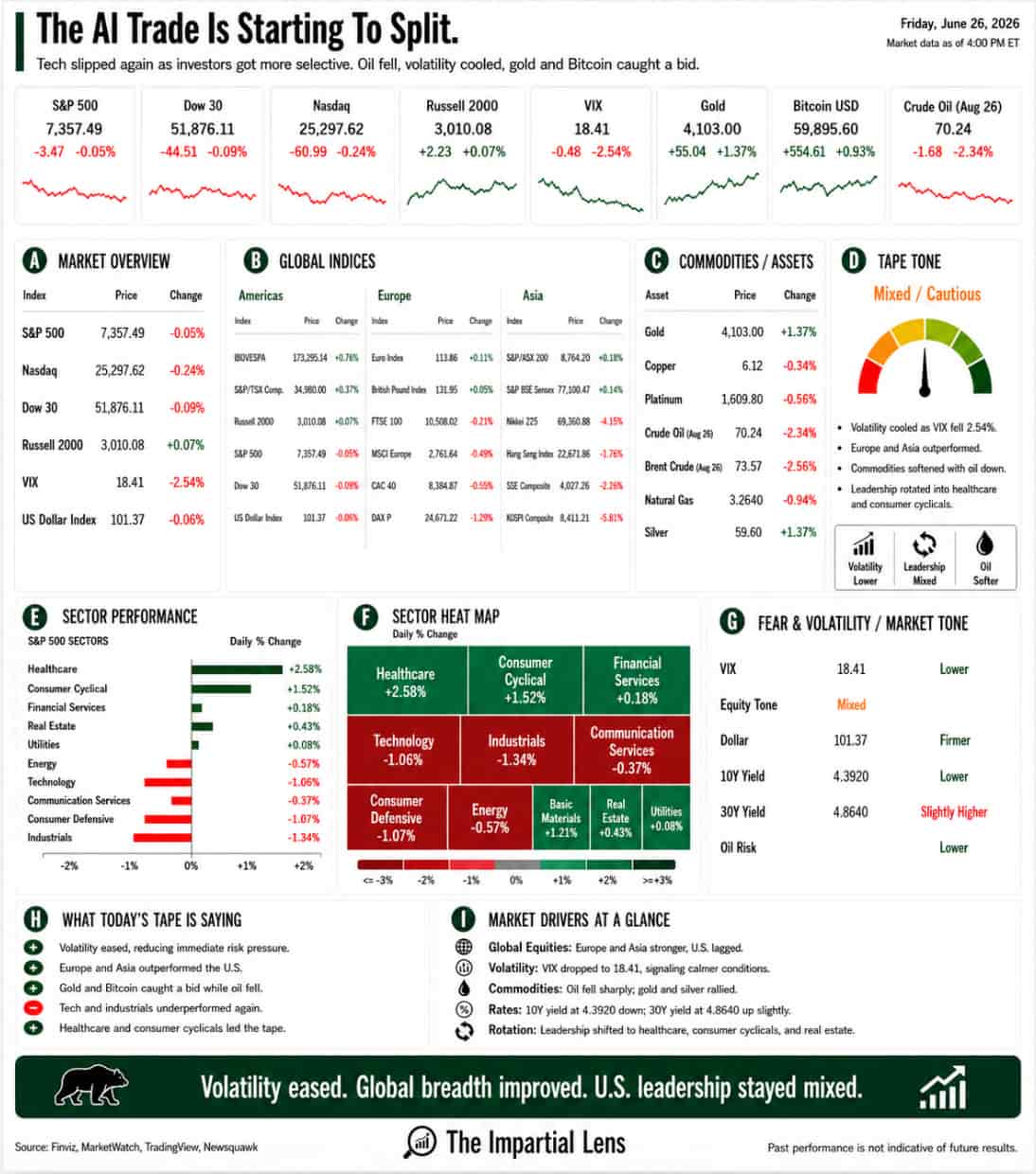
The S&P 500 slipped 0.05%. The Dow fell 0.09%. The Nasdaq lost 0.24%. The Russell 2000 rose 0.07%. On the surface, that looks like a quiet day.
But underneath, the tape was telling a bigger story.
The VIX fell 2.54% to 18.41, so panic cooled. Gold rose 1.37% to $4,103.00. Bitcoin gained 0.93% to $59,895. Crude oil dropped 2.34% to $70.24.
So fear did not explode.
Oil pressure eased.
But tech still could not lead.
That is the part that matters.
The AI Trade Is No Longer One Trade
The market has spent months treating AI like a single story.
Buy chips. Buy data centers. Buy power. Buy memory. Buy hyperscalers. Buy anything connected to compute.
Friday pushed back on that idea.
The headline flow was full of AI stress points: OpenAI reportedly delaying its IPO until 2027, chips under pressure, leverage concerns, SpaceX-linked bond weakness, data-center bottlenecks, memory costs, power constraints, and the growing sense that the world’s biggest trade is becoming more complicated.
That does not mean AI is over.
It means investors are being forced to separate the winners from the crowd.
That is a major shift.
In the first phase of a boom, everything connected to the theme goes up. In the second phase, the market starts asking harder questions.
Who has real revenue?
Who has pricing power?
Who is just spending?
Who owns the bottleneck?
Who is dependent on cheap capital?
Who is hiding behind the word “AI”?
That is where we are now.
Tech Slipped Again
The Nasdaq was lower again, and technology fell 1.06%. Industrials were weak too, down 1.34%. Energy slipped 0.57%. Communication services fell 0.37%.
That tells us the market is not simply rotating into a broad risk-on move.
Healthcare was the standout, up 2.58%. Consumer cyclical rose 1.52%. Financials gained 0.18%. Small caps held the line.
That is not panic.
It is dispersion.
And dispersion is important because it means investors are no longer treating the market as one big trade. They are picking through it.
The mega-cap AI trade is being questioned. Healthcare caught a bid. Some consumer names held up. Gold rallied. Bitcoin stabilized. Oil fell.
The tape did not break.
But leadership got messier.
Oil Fell, But Hormuz Is Not Gone
Crude dropped more than 2%, which should help the macro backdrop.
Lower oil takes pressure off inflation expectations. It helps consumers. It helps transportation. It reduces one of the biggest geopolitical risk premiums from the last few weeks.
But the Middle East story is not finished.
Headlines still point to fragility around Hormuz. Iran is still signaling that safe passage through the Strait depends on sovereignty concerns. The U.S. and Iran are reportedly trying to create a direct channel to reduce conflict risk. Inspectors are expected to return to Iran, but with no clear timeline. Israel and Lebanon headlines remain fragile. There are still reports of strikes, ship risk, and ceasefire violations.
So yes, oil fell.
But the market should not confuse lower oil with a solved geopolitical problem.
This is still a pressure point.
It is just no longer the only one.
Gold And Bitcoin Sent A Different Message
Gold rose sharply. Bitcoin also gained.
That is an interesting combination.
Gold’s move suggests investors still want protection. Bitcoin’s bounce suggests some risk appetite remains alive. The VIX fell, which tells us volatility cooled. But tech weakness tells us investors are not fully comfortable.
This is the kind of market where different assets are telling different stories.
Oil says inflation pressure is easing.
Gold says uncertainty remains.
Bitcoin says risk appetite is not dead.
Tech says leadership is tired.
Healthcare says rotation is alive.
VIX says panic cooled.
That is not a clean message.
It is a conflicted one.
The Real Read
Friday was not about a crash.
It was about a change in character.
The market is becoming more selective. The AI trade is no longer lifting everything attached to it. Mega-cap tech is having its worst stretch in a while. The Magnificent Seven no longer look like one trade. Some names are holding. Some are breaking. Some have gone nowhere.
That matters because the market has leaned heavily on AI to explain almost everything.
High valuations? AI.
Heavy capex? AI.
Power demand? AI.
Memory costs? AI.
Data-center spending? AI.
Productivity hopes? AI.
Earnings resilience? AI.
But now the market is asking whether AI is still a clean tailwind, or whether it has become a crowded, leveraged, expensive, power-hungry trade that needs more things to go right.
That is the real question for the weekend.
The market did not fall apart.
But the easy AI trade is starting to look less easy.
Oil fell.
Volatility cooled.
Gold and Bitcoin caught a bid.
But tech still slipped.
The market’s biggest trade is no longer breaking upward in one piece.
It is starting to split.