
Thursday gave investors the excuse they’d been waiting for.
Oil kept sliding. The Strait of Hormuz reopening story gathered momentum. Gulf energy flows started rebooting. CENTCOM confirmed the naval blockade had ended. Markets could finally price in what they desperately wanted all week: less oil risk.
That relief was enough to reverse Wednesday’s Fed-induced selloff.
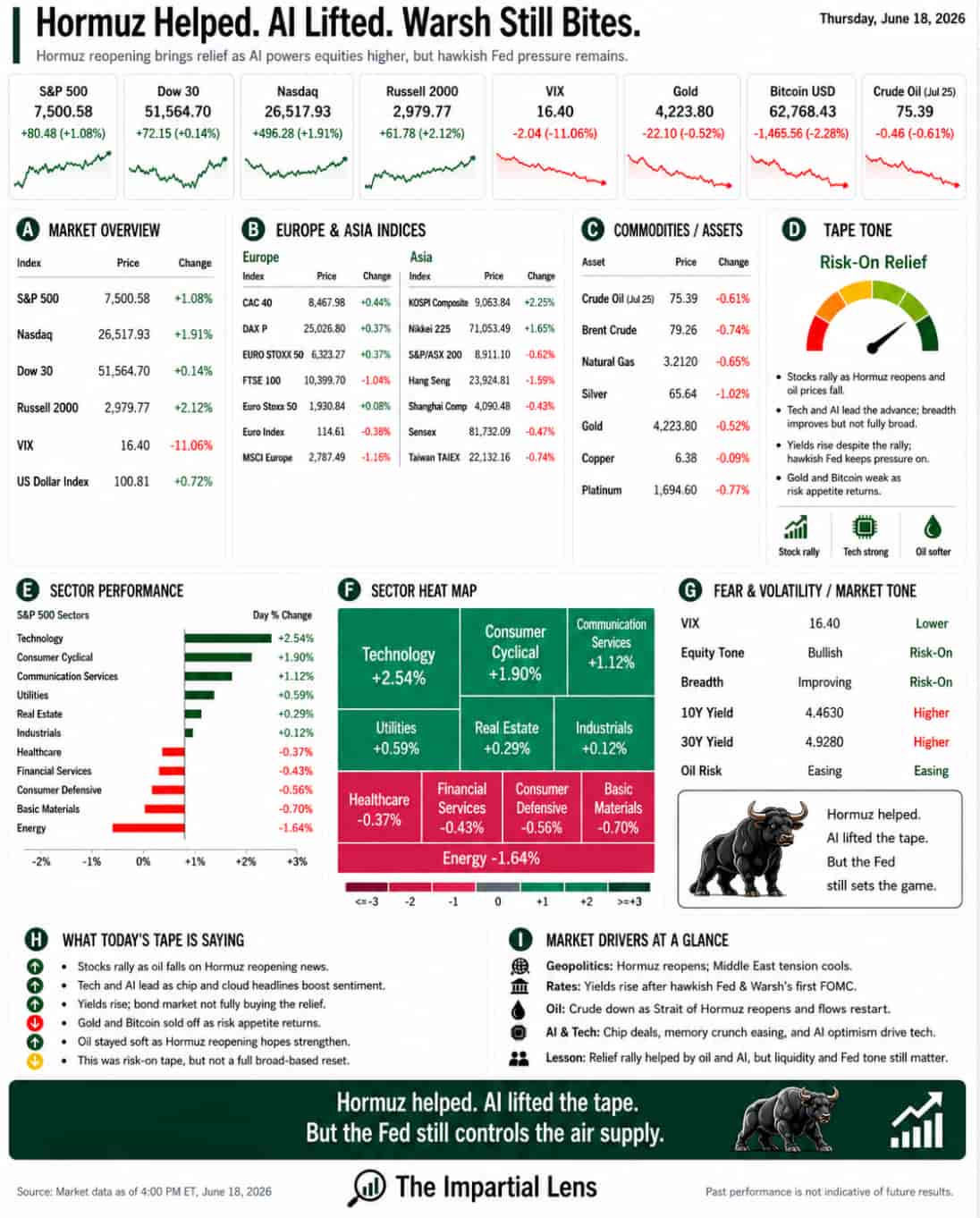
The S&P 500 climbed 1.08%. The Nasdaq surged 1.91%. The Russell 2000 jumped 2.12%. The Dow added 0.14%. Volatility eased, with the VIX dropping 11.06% to 16.40.
Oil remained soft — crude fell 0.61% to $75.39, Brent followed suit. Gold slipped 0.52% to $4,223.80, and Bitcoin dropped more than 2% again.
The message from the tape was clear: Stocks loved the oil relief. But not everything joined the party. Bullion bruised, Bitcoin weak, energy lagged, financials slipped — and the rally leaned heavily on technology.
In short, the market bounced. But it didn’t suddenly get clean.
Hormuz Gave the Market Breathing Room
The biggest macro shift is still energy.
Just days ago, Hormuz was the big pressure point. Oil risk meant inflation risk. Inflation risk meant Fed risk. Fed risk meant valuation risk. That chain had everyone on edge.
Thursday loosened the knot.
If maritime traffic normalizes, delayed Gulf barrels move, Asian refiners gain visibility, and tanker flows improve, the inflation panic loses steam. That’s the relief trade the market is buying.
But here’s the catch: Energy availability isn’t the same as cheap, secure energy.
Asian refiners are already pushing back on soaring tanker rates. Shipping costs, insurance, route confidence, and political risk don’t reset with a signature on a memorandum. The UAE is still pursuing “zero Hormuz dependency.” The adults in the room see this as a warning — not a solved problem.
Markets love to flip a switch. Reality is more complicated.
Warsh Didn’t Disappear
The market tried hard to forget Wednesday.
Kevin Warsh’s first FOMC delivered a hawkish tone: forward guidance removed, focus locked on the inflation target. Thursday’s rally didn’t erase that message — it simply outran it for a day.
This bounce rests on a delicate bargain: oil relief gives the Fed breathing room, and AI earnings give stocks enough momentum to look past higher-for-longer policy.
It can work.
But only as long as oil stays soft, yields behave, and tech keeps carrying the load.
If any link breaks, the rally gets much tougher. Warsh’s Fed isn’t promising rescue — it’s telling markets to earn it.
AI Took the Wheel (Again)
The real engine was AI and big tech.
Apple-related news helped lift the tape: Trump noted Apple’s agreement to work with Intel on U.S. chips, Tim Cook signaled price hikes due to the memory chip crunch, and Amazon is reportedly preparing to sell its Trainium AI chips to others — challenging Nvidia.
The Nasdaq led for a reason.
Yet the AI story is evolving fast — from pure optimism into a complex mix of costs, power demands, chips, memory, and politics. Accenture’s sharp drop on AI-demand fears highlights the flip side: as AI boosts productivity, some business models get squeezed. Winners and victims are starting to separate.
The market still wants AI as a universal winner. Reality is becoming more selective.
Breadth Improved — But Not Perfect
The sector picture looked better than Wednesday, yet remained uneven.
- Technology: +2.54%
- Consumer cyclicals: +1.90%
- Communication services: +1.12%
- Industrials: mildly positive
Financials slipped, energy took another hit, healthcare weakened, consumer defensives lagged, and materials barely moved (utilities were a quiet positive).
This was a tech-led relief rally aided by lower oil and cooling volatility — not a full-market embrace. True broadening still feels premature.
The Real Read
Thursday was a relief day, not a reset.
Hormuz helped. Oil fell. Volatility cooled. Stocks bounced. AI did the heavy lifting.
But the big questions remain:
- Can the Iran MOU hold and Gulf flows normalize without persistently high costs?
- Can the Fed stay hawkish without breaking valuations?
- Can AI keep driving the market amid rising memory and capex pressures?
- Will the rally finally broaden beyond a narrow group of winners?
The market got oil relief. Then AI carried the load.
But this rally is built on trust — trust in the MOU, trust in oil flows, trust in Warsh’s discipline, trust in AI earnings, and trust that liquidity isn’t quietly tightening.
Thursday looked better. It was better.
But better is not the same as safe.
Hormuz helped the market breathe.
AI made it run.
Warsh still controls the air supply.