Markets gave investors a mixed message this week.
On the surface, the damage was concentrated in technology. The Nasdaq fell sharply, while the Dow and small caps managed to finish higher. That tells us this was not a full market breakdown. It looked more like rotation — investors stepping away from the most crowded part of the market while looking for value elsewhere.
But beneath the surface, the bigger story remains the same:
The bond market is still the pressure gauge for the entire system.
The S&P 500 fell nearly 2% for the week. The Nasdaq dropped more than 4.5%. The Dow rose modestly, and the Russell 2000 gained about 1%. That split matters. If investors were truly panicking, almost everything would likely be down together. Instead, the market appears to be questioning stretched growth and AI-related valuations rather than abandoning risk entirely.
That is an important distinction.
The AI trade may not be dead, but the easy momentum has been challenged.
At the same time, bonds caught a bid. Core bonds and investment-grade credit improved slightly, while riskier areas like high-yield bonds, senior loans, and emerging-market debt weakened. That is another important signal. Investors were not blindly buying everything. They were becoming more selective.
In simple terms, higher-quality bonds looked better, while lower-quality credit looked more vulnerable.
That usually happens when markets begin paying closer attention to refinancing risk, economic slowing, and balance-sheet pressure.
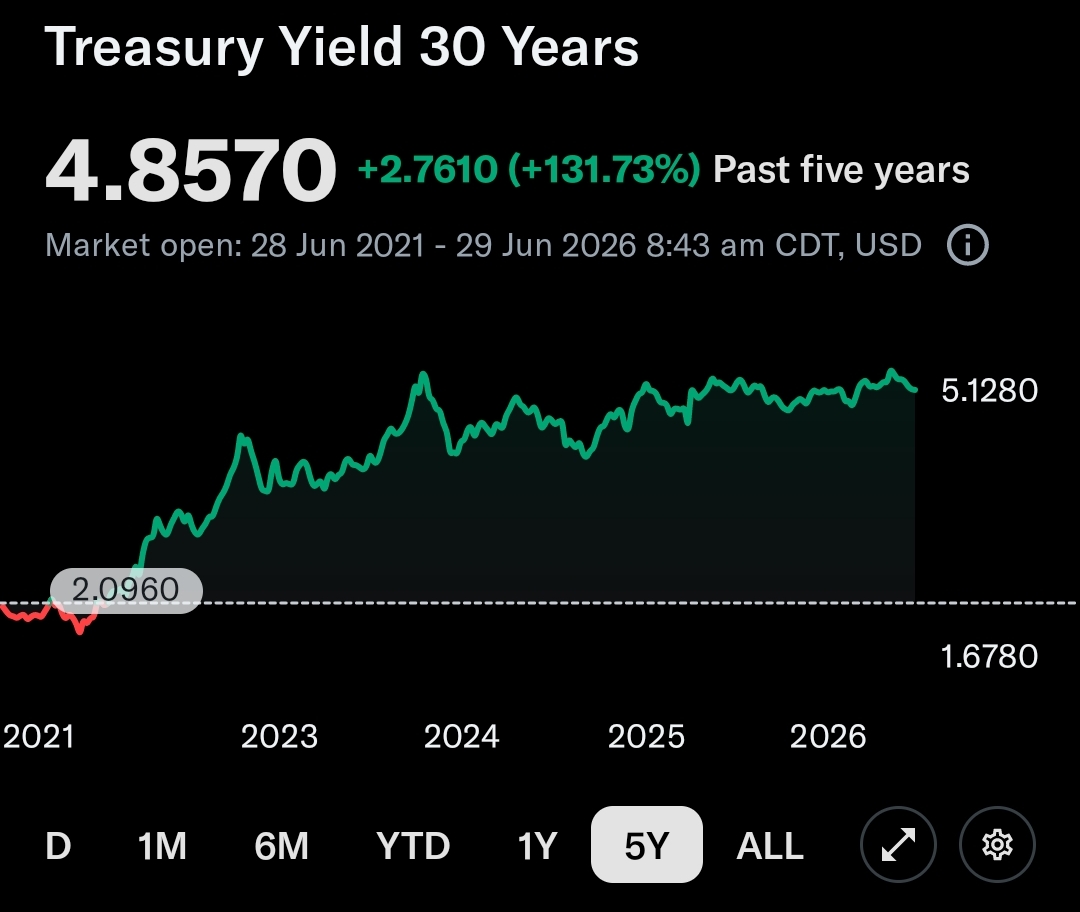
The Treasury curve also eased. The 10-year Treasury yield moved lower, and the 30-year yield came down from recent highs. That helped bond prices. But the bigger point is this: long-term rates are still high compared with the world investors became used to after the financial crisis.
Source: Yahoo Finance
A 30-year Treasury yield near 5% is not a small detail. It affects mortgages, commercial real estate, corporate borrowing, federal interest expense, private credit, and equity valuations.
The old zero-rate world has not returned.
That is the key issue.
For years, investors were conditioned to believe that whenever markets stumbled, the Federal Reserve would cut rates, bonds would rally, stocks would recover, and the cycle would reset. That playbook worked when inflation was low, and government borrowing was easier to absorb.
This is a different environment.
Inflation is still too high. The latest personal consumption expenditure inflation reading remains above the Fed’s comfort zone. That means the Fed does not have a clean green light to cut aggressively.
This creates the policy trap.
If the Fed cuts too soon, inflation could reaccelerate.
If the Fed waits too long, the economy and credit markets could weaken further.
That is why the market remains so sensitive to every inflation print, every jobs number, and every move in long-term yields.
Housing is already showing the pressure. New home sales remain weak relative to past boom periods, and the chart continues to reflect the drag from higher borrowing costs. Housing is one of the most rate-sensitive parts of the economy, so weakness there should not be ignored.
Higher mortgage rates not only affect buyers. They affect builders, banks, furniture, appliances, construction jobs, local tax receipts, and consumer confidence.
The stock market may be focused on artificial intelligence.
Housing is focused on affordability.
Those are two very different stories.
Meanwhile, gold remains elevated despite pulling back from its highs. That is another signal investors should not dismiss. Gold tends to attract attention when markets are worried about inflation, currency weakness, fiscal deficits, central-bank credibility, or geopolitical stress.
Gold has cooled, but it has not gone away.
That suggests investors are still willing to pay for insurance.
Japan is another pressure point. Japanese government bond yields remain far above the levels investors had grown accustomed to over the past several decades. That matters because Japan has long been one of the key anchors of the global low-rate system.
If Japanese yields continue to rise, Japanese capital may have more reason to stay home. That can influence demand for foreign bonds, including U.S. Treasuries.
In plain English: Japan’s bond market is no longer asleep.
And when Japan wakes up, the global bond market notices.
So where does this leave investors?
Not in panic mode.
But not in comfort mode either.
The clean read is this:
Markets are rotating, not relaxing.
Technology took a meaningful hit.
Core bonds improved.
Riskier credit weakened.
Housing remains under pressure.
Inflation is still too high.
Gold remains elevated.
Long-term interest rates are still high enough to matter.
This is not a simple “stocks down, bonds up” story.
It is a story about the cost of money.
For now, the market is being pulled between two forces. On one side is the excitement around artificial intelligence, earnings growth, and liquidity. On the other side is the reality of inflation, debt, higher long-term yields, and a more fragile credit environment.
That is the tension investors need to watch.
The bond market has not given the all-clear.
And until it does, every rally deserves a second look.