
The Weekly Lens | September 28–October 2, 2026
Weak hiring gave Wall Street hope that the Fed would pause. But expensive borrowing, strained fuel supplies, and France’s fiscal troubles kept asking the same question: who pays?
Wall Street cheered a weakening economy. The people lending it money were harder to impress.
Weak hiring gave stocks an excuse to rally: perhaps the Fed would stop raising rates. But a pause would not clear the tankers through Hormuz, make France’s budget add up or pay for the next wave of AI data centres.
That was the argument running through this week. Markets wanted cheaper money. The physical economy needed fuel. Governments needed willing lenders. And all three were competing for relief that a central bank cannot simply announce.
Friday put the contradiction on the screen.
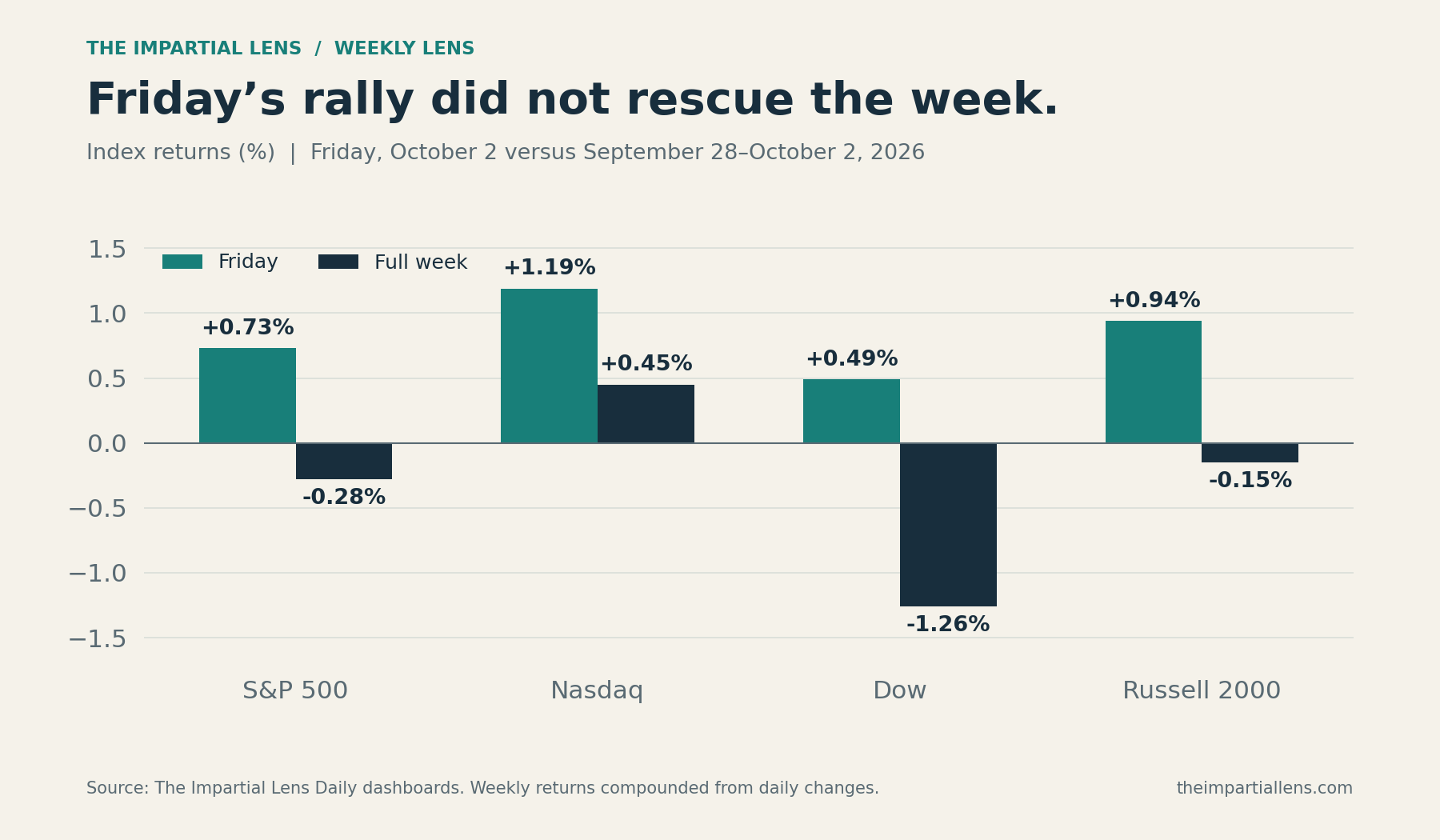
The United States added just 29,000 jobs in September, with July and August revised down by a combined 60,000. Unemployment stood at 4.2%. The Nasdaq rose 1.19%; the S&P 500 gained 0.73%.
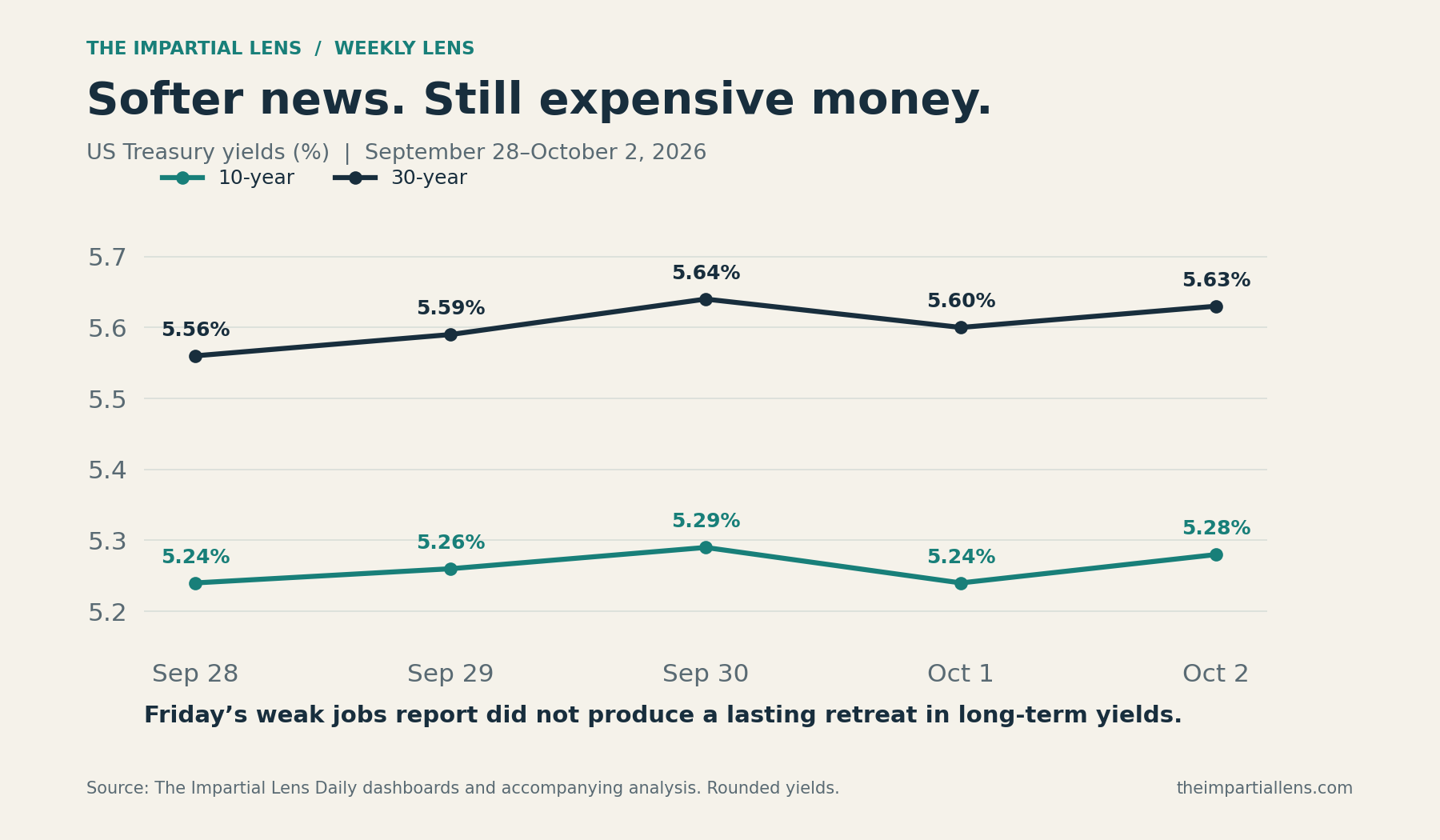
Treasury yields initially fell, then reversed higher. The 10-year finished around 5.28%; the 30-year around 5.63%.
For investors, the question reaches beyond whether the Fed pauses: who can keep growing when the cost of financing that growth refuses to fall?
Stocks bought the prospect of a pause. Creditors still wanted their pound of flesh.
The price of money outlasted the headlines.
Monday began with contradictory reports about negotiations between Washington and Tehran. Oil and Treasury yields rose. Defensive sectors held up while the major US stock indexes fell.
By Wednesday, softer inflation news had reduced the immediate case for another Fed increase. Yet long-term yields continued climbing: the 10-year reached approximately 5.29%, the 30-year 5.64%.
Thursday offered a retreat. Friday’s weak employment report offered another opening. Neither produced a durable escape from elevated borrowing costs.
This does not establish a buyers’ strike, nor does a yield above 5% turn Treasuries into junk. Higher yields belong in historical context: the exceptionally cheap money of the post-financial-crisis years was no permanent entitlement.
The pressure comes from the adjustment. Households, companies and governments built commitments around cheaper financing. Refinancing those commitments at today’s rates changes the arithmetic.
Long-term yields reflect several forces: expected inflation, future short-term rates, government issuance and compensation for holding bonds whose prices can swing sharply. As we explained in The Fed Hiked. The Bond Market Kept Tightening., the Fed influences that calculation. It cannot settle it by announcement.
Our reading of the week is straightforward: softer economic news has not yet persuaded long-term lenders that those risks deserve a lower price.
Friday was better than the week
Friday’s rally deserves credit. Industrials gained 2.56%, utilities 1.48% and consumer cyclicals 1.45%. All eleven sectors in our dashboard advanced.
Calling that session purely a Big Tech illusion would miss the evidence.
But one broad session did not erase four uneasy days. Compounding the daily moves in our dashboards, the S&P 500 finished the week approximately 0.28% lower. The Dow lost 1.26%, the Russell 2000 slipped 0.15%, and the Nasdaq gained about 0.45%.
Technology provided support during the week. Smaller companies and the Dow offered a less comfortable picture.
The distinction matters. A broad Friday bounce is encouraging; sustained participation would be more convincing. Investors need to see whether businesses exposed to credit costs and ordinary consumer demand can keep advancing alongside the technology leaders.
Emergency barrels bought time
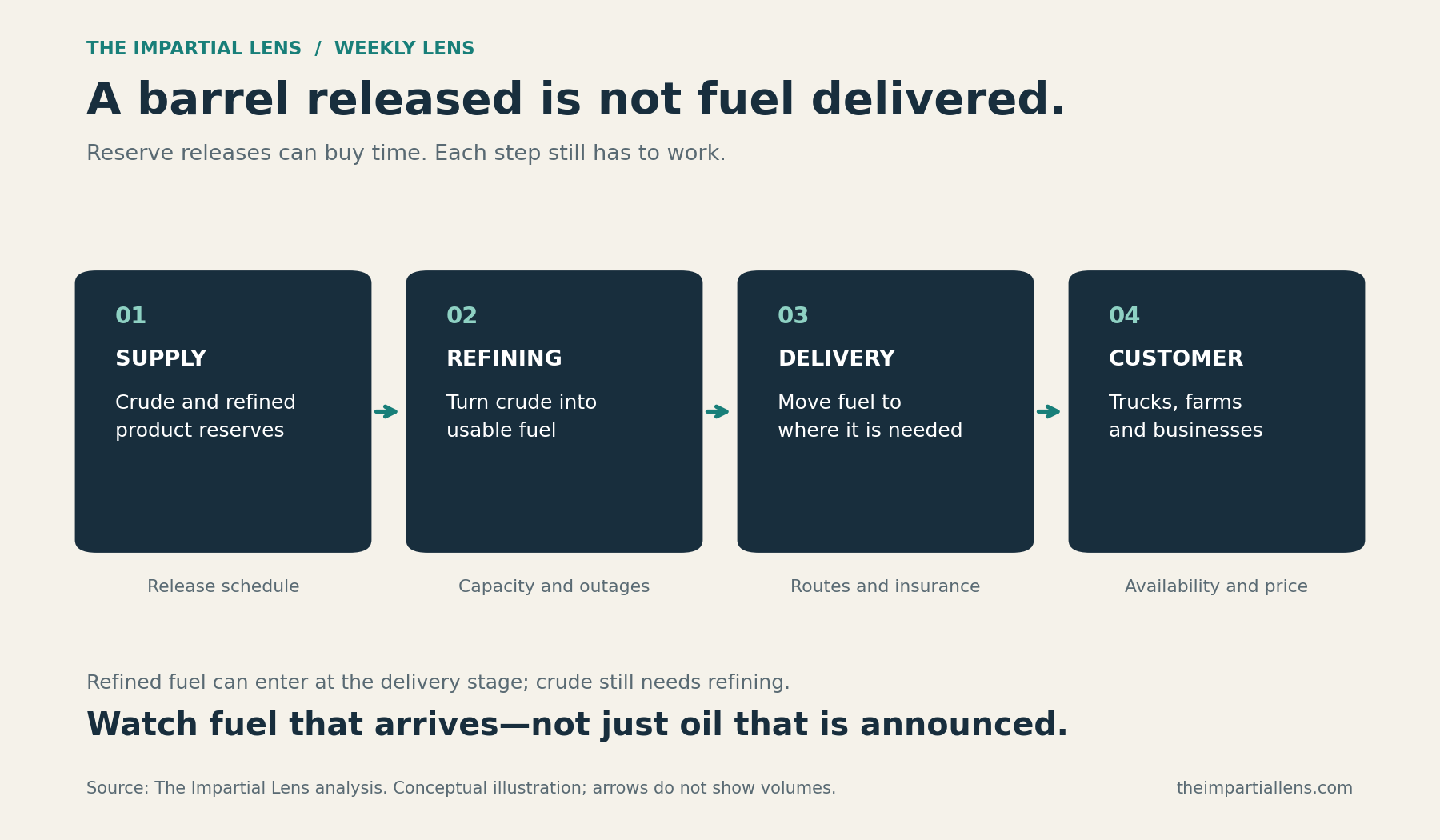
The G7 agreed to coordinate the release of 100 million barrels of crude and refined products over four months, with a significant diesel release in the first twenty days.
That is meaningful assistance. It is also a timetable, not an instantaneous delivery.
The emphasis on diesel tells us where the pressure sits. Crude must reach a refinery, become usable fuel and arrive where it is needed. A cheaper oil contract does not necessarily mean cheaper deliveries for a trucking company or a farm. That was also the central distinction in last week’s Weekly Lens.
Friday’s dashboard captured the split: WTI fell to roughly $91.26, while Brent finished near $102.70.
Different benchmarks have different supply conditions. The lesson is to watch the fuel system beyond a single crude price.
Reserve releases can bridge a disruption. Coordinating refinery maintenance and increasing production can help too. But emergency stocks cannot guarantee safe passage through Hormuz or make damaged infrastructure secure.
The bond market has reason to care. Persistent fuel costs can squeeze household spending and corporate margins while keeping inflation uncomfortable. Weaker growth does not automatically remove that pressure.
France made the financing problem political
France brought the same argument into sharper focus.
The premium investors demanded to hold French government bonds rather than German debt approached 150 basis points—about 1.5 percentage points. Credit protection became more expensive, and European bank shares came under pressure.
Paris needs fiscal restraint that can survive a divided parliament and public opposition. Bondholders need confidence that the government can deliver it.
Neither side disappears because satisfying the other is difficult.
Sovereign stress can spread through banks that hold government debt, through funding costs and through weaker lending. Rising interest bills also leave less room for governments to cushion an economic slowdown.
Europe’s problem therefore reaches beyond one unpopular budget. The ability to make political promises depends partly on the ability to finance them.
Japan belongs on the watch list for a different reason. Higher returns at home, currency movements and hedging costs can change the appeal of foreign bonds to Japanese investors. That is a potential shift in demand, not proof that capital is already abandoning the United States.
AI still has to earn the money
AI investment remains a source of demand, earnings and optimism. Chips, data centres and power infrastructure are supporting real activity.
But the spending is also somebody else’s revenue forecast.
A chip supplier can benefit immediately from construction. A data-centre developer may wait years for customer payments to justify its financing, electricity and equipment costs.
Those are different businesses with different risks. A revolutionary technology can create enormous value while some investors lose money funding it.
The question is becoming more specific: which companies can turn adoption into cash quickly enough to cover the bill?
The investor’s path
This week’s work points toward a sequence of checks, rather than a trade based on the next diplomatic headline.
Start with borrowing costs. Watch whether the 10-year can sustain a retreat from the 5.3% area. A brief dip after weak data offers less reassurance than several sessions of lower yields alongside stable credit conditions. The level is a reference point, not a magic boundary.
Then follow the physical fuel market. Look for delivered reserve barrels, improving diesel availability and safer shipping. Lower prices supported by restored supply mean more than lower prices supported by hopeful statements.
Check who can pay. In company results, look at cash generation, interest costs, upcoming refinancing and the timing of capital spending. Businesses needing fresh financing deserve different scrutiny from those able to fund themselves.
Demand broader confirmation. Friday supplied it for one session. Watch whether industrials, smaller companies and financials continue participating, while European sovereign stress stops worsening.
These checks also tell us what would change our view: easing borrowing costs, improving fuel supply and broader earnings-supported gains would strengthen the case for a durable advance. Continued high yields alongside weaker hiring and strained fuel markets would weaken it.
Friday showed that bad news can still lift stocks.
It did not show that the economy can afford everything those stocks are promising.
The Fed may pause. The creditors still want paying.
The Impartial Lens provides market commentary and education only. Nothing here constitutes personalized investment advice.
Sources: The Impartial Lens Daily dashboards and unpublished daily analysis, September 28–October 2, 2026; Bureau of Labor Statistics September employment report; G7 energy statement and reserve-release timetable; Reuters on French market stress.