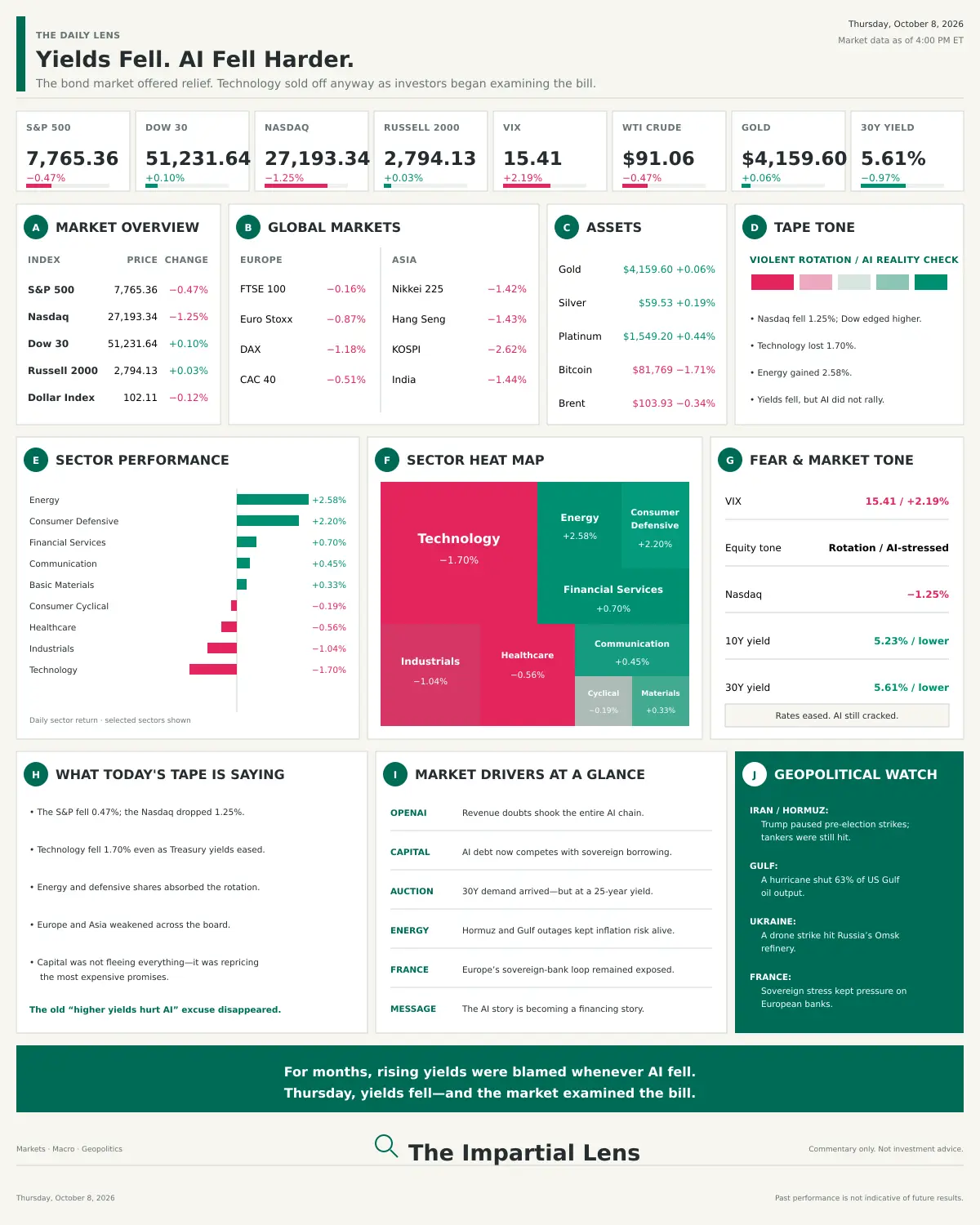
The bond market offered relief on Thursday. Technology sold off anyway as investors began examining the revenue, debt, and physical infrastructure behind the AI boom.
Thursday, October 8, 2026 | The Impartial Lens
What Today’s Tape Is Saying
For months, investors blamed rising bond yields whenever technology stocks fell.
Thursday removed that excuse.
The 10-year Treasury yield declined to 5.23%, while the 30-year retreated to 5.61%. Falling yields should have helped expensive growth stocks.
Instead, the Nasdaq dropped 1.25%, technology fell 1.70%, and several leading semiconductor shares suffered much larger losses.
The S&P 500 declined 0.47%. The Dow managed a 0.10% gain, while energy rose 2.58% and consumer defensive stocks advanced 2.20%.
This was not indiscriminate selling. It was a rotation away from the most expensive and capital-hungry part of the market.
The bond market offered relief.
AI fell harder anyway.
OpenAI Shook the Entire AI Chain
The immediate catalyst was a report that OpenAI’s annualised revenue was approximately $20 billion below the level previously signalled.
The company had reportedly told investors that revenue was approaching $50 billion on an annualised basis at the end of September—well below the $70 billion figure reported by several media organisations.
Some of that difference may reflect how competing AI companies calculate revenue. But the market’s reaction revealed a deeper concern.
The AI investment case depends upon extraordinary future demand justifying extraordinary present spending.
Data centres require chips, electricity, cooling equipment, land, transmission infrastructure and enormous amounts of financing. If expected revenue is even slightly weaker, the return required from that infrastructure becomes harder to achieve.
OpenAI sits near the centre of an ecosystem connecting chipmakers, cloud providers, data-centre developers, utilities and lenders. Doubts about one part of that chain immediately raise questions about the others.
The market is no longer asking whether AI is transformative. It is asking whether the revenue will arrive quickly enough to pay for everything being built.
AI Is Becoming a Financing Story
The first stage of the AI boom was largely financed by the cash balances of the world’s richest technology companies.
The next stage is increasingly being financed with bonds, special-purpose vehicles and off-balance-sheet structures.
AI companies are now competing for the same capital needed by governments, utilities, manufacturers, homeowners and ordinary businesses.
The United States must finance large deficits. Europe must refinance heavily indebted governments. Energy systems need new generation and transmission capacity. AI developers want hundreds of billions of dollars for chips and data centres.
All of them want the same thing: long-term capital.
As we argued in Wall Street Bought the Ceasefire. The Bond Market Asked Who Pays, the defining market question is no longer simply whether capital is available. It is the price required to obtain it.
The AI boom may produce extraordinary growth. It can simultaneously make money more expensive for everyone else.
The Treasury Found Buyers—At a Price
Thursday’s 30-year Treasury auction was solid.
The government sold $22 billion of long bonds at 5.618%, with healthy participation from institutional and foreign buyers. The auction helped yields retreat from their intraday highs.
That was reassuring. It was not cheap.
The sale carried the highest 30-year auction yield since August 2000.
The Treasury found buyers because the return became attractive enough.
Washington can issue more debt, but every additional basis point eventually appears in the government’s interest bill. The same benchmark yields also influence mortgages, corporate borrowing and infrastructure finance.
The auction showed that the market is functioning. It also showed the price now required to make it function.
Two Energy Threats Arrived at Once
President Trump said the United States would not attack Iran before the November midterm elections.
The oil market did not treat that promise as peace.
Tankers were reportedly struck again near the Strait of Hormuz, while Tehran and Washington remained divided over nuclear enrichment and the conditions required to reopen the shipping route.
At the same time, Hurricane Isaias forced producers to shut down approximately 63% of US Gulf of Mexico oil production.
One threat came from geopolitics. The other came from weather.
Together they helped push oil prices approximately 4% higher, with Brent settling above $104.
Ukraine remained part of the wider supply-risk backdrop, with another reported drone strike hitting Russia’s Omsk refinery. But Thursday’s immediate market pressure came from Hormuz and disrupted US Gulf production—not from the Russia–Ukraine war.
Higher fuel costs enter transportation, agriculture, manufacturing, and household inflation. Persistent energy pressure makes it harder for central banks to reduce interest rates, even if other parts of the economy weaken.
Energy disruption → inflation pressure → restrictive policy → expensive capital.
Europe Remained the Weak Link
European markets weakened again as investors continued examining sovereign debt, political instability, and the exposure of banks to government bonds.
France remains the most visible pressure point, but the problem is broader.
European governments need substantial borrowing while economic growth remains weak and political support for spending restraint is limited. Banks hold large quantities of sovereign debt, tying the health of the financial system to the credibility of governments.
There is no full sovereign crisis yet. But capital is becoming more selective, and Europe is increasingly being asked to prove that its political promises can still be financed.
What to Watch
- Can technology recover while yields remain above 5%?
- Do further AI revenue disclosures support the spending forecasts?
- Does debt-financed AI infrastructure begin widening credit spreads?
- Can Gulf production restart quickly after the hurricane?
- Do tanker attacks continue despite Trump’s temporary pause?
- Does European sovereign stress spread further into banks?
The Lens
Thursday was important because the usual explanation stopped working.
Yields fell, but AI stocks did not rally.
That suggests the market is beginning to examine the AI boom on its own terms: revenue, leverage, power availability, and the cost of constructing the physical system.
AI may still change the world. That does not mean every project will be profitable, every promise will be fulfilled, or every dollar required to build it will remain cheap.
For months, the bond market was blamed whenever AI fell.
On Thursday, yields fell—and the market examined the bill.
The Impartial Lens provides market commentary and education only. Nothing published here constitutes investment advice.