Silicon Valley’s AI boom hit a financing scare. French government bonds sold off while American Treasuries rallied. And Iran said seven tankers had been damaged in the Strait of Hormuz. On Thursday, the world went looking for safety—and discovered that safety has a price.
The Daily Lens | Thursday, October 22, 2026
In California, investors reconsidered the price of AI. In Paris, lenders demanded more from France. And in Hormuz, tankers navigated a war zone.
Three different problems. One old-fashioned question: who is taking the risk, and who gets paid for taking it?
Thursday’s answer was written across stock markets, bond markets and the price of oil. It wasn’t particularly comforting.
Silicon Valley’s Credit Card Came Due
Meta recorded $64.6 billion in quarterly revenue, up 26% on a year earlier.
But investors have started asking a different question. Not how much AI might change the world. How much will it cost to build, and when does the money come back?
Meta reported $34.91 billion in capital spending, including finance-lease principal payments, and negative $2.12 billion in free cash flow. It still held more than $82 billion in cash, cash equivalents and marketable securities. This isn’t a company running out of money. It’s a profitable company committing extraordinary sums to its next act.
Meta also announced a new class of non-voting stock that could help finance expansion while preserving Zuckerberg’s control, as The Information explained. It hasn’t announced a specific sale of those new shares.
Meta shares fell more than 7% on Thursday, while the cost of insuring its debt against default rose to a record, according to market reporting. That insurance-like price, known as a credit-default swap, signals what protection buyers are willing to pay. It does not establish that Meta will default.
Remember the late-1990s telecom boom? The internet changed everything, but some companies financing its infrastructure failed. Being right about a technology isn’t enough. The investment must earn its keep.
We examined the electricity bottleneck in Tuesday’s Lens. Now the financing is getting its own examination.
France Discovered That Safety Has a Passport
While technology shares fell, investors bought American government bonds. Their prices rose and yields fell. The US 10-year Treasury yield was around 4.95% on Thursday.
Across the Atlantic, French government bonds were going the other way.
France’s 10-year yield reached about 5.14% during trading, while the extra yield investors demanded over equivalent German bonds widened to roughly 1.73 percentage points, according to Dow Jones market reporting.
How can two government bond markets behave so differently on the same frightening day?
Because government bonds aren’t equally safe in investors’ eyes. US Treasuries attract buyers during financial turbulence. Investors are increasingly worried about France’s budget, debt and political deadlock.
Here’s the useful vocabulary: the yield spread is the difference between two borrowing rates. France’s spread over Germany has reached levels last seen during the eurozone debt crisis of 2011, as Le Monde documented.
A widening spread isn’t proof of an imminent French default. But it means refinancing debt is becoming more expensive at a time when the government can least afford another bill. And when public finances tighten, households and businesses eventually feel the squeeze through taxes, services or weaker investment.
Investors ran toward one government’s IOUs and away from another’s. Same day. Different borrowers. Very different prices for reassurance.
Seven Tankers and One Very Narrow Strait
Meanwhile, geography was refusing to cooperate with diplomacy.
Associated Press reported that Iranian state media claimed seven oil tankers were damaged or set alight overnight in the Strait of Hormuz. The claim’s full details were not independently established in that initial reporting. Iranian forces also warned about the consequences of US efforts to escort shipping through the passage.
Hormuz is a narrow passage between Iran and Oman. The International Energy Agency estimates that a quarter of global seaborne oil trade normally passes through it.
War makes shipping expensive even when oil keeps flowing. Ships need crews, escorts and insurance. Those costs can reach consumers.
Brent traded around $113 a barrel—a reminder that distant shipping risks can reach a manufacturer’s fuel bill or a household’s petrol pump.
A conflict thousands of miles away has a remarkable talent for finding its way onto a local invoice.
Wall Street’s Falling Index Had a Twist
Thursday looked ugly if you watched only the Nasdaq: −2.60%. The S&P 500 fell 1.21%, and the VIX jumped 14.09%. Yet the Dow was almost unchanged, up 0.02%, and the Russell 2000 edged higher by 0.11%.
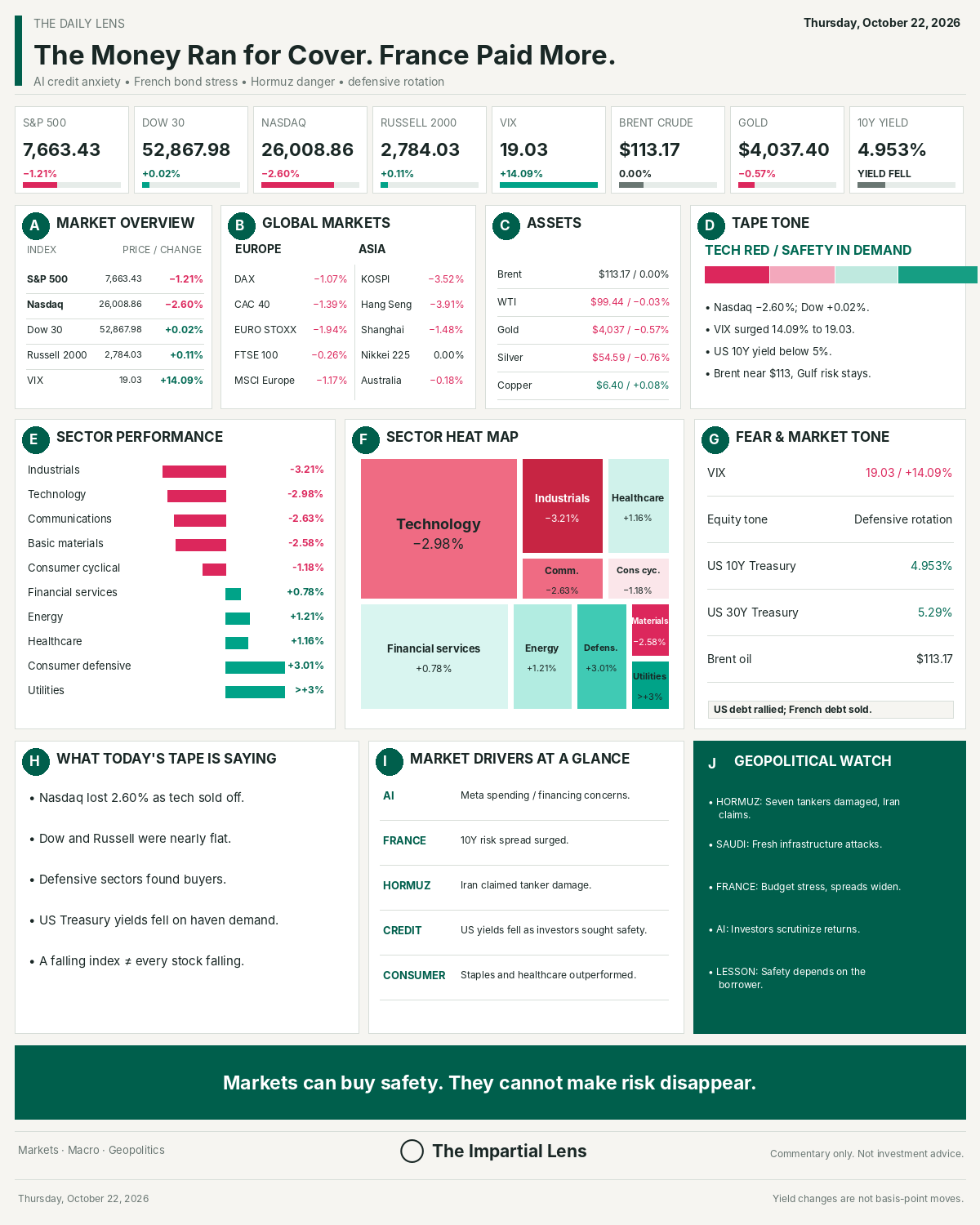
Here’s a lesson worth keeping: the S&P 500 is weighted by company size. Bigger companies move the index more. According to AP’s market recap, most individual US stocks actually rose Thursday, even as the big indexes sank under the weight of technology losses.
That’s market breadth in action: how widely gains and losses are shared. A falling index does not mean every stock is falling.
Investors favoured consumer staples, utilities and healthcare—businesses selling things people still need when the economy becomes uncertain. This is called a defensive rotation. Treasury prices rose too, driving US yields lower.
The lesson: don’t just watch the index. Look underneath it to see who is buying, who is selling and where the shelter is.
What We’re Watching
1. AI’s financing bill. Will big technology spending begin producing enough cash to justify the investment?
2. French borrowing. Can Paris agree on a credible budget before the higher yields become an even bigger problem?
3. Hormuz. Do vessels keep moving safely, or does the danger lift fuel and delivery costs further?
4. Defensive stocks. Will investors keep favouring necessities over technology, or was Thursday only a one-day escape?
5. The bond-market divide. Will US Treasuries continue attracting buyers while France struggles to retain theirs?
The Lens
Technology companies need investors willing to fund their ambitions. Governments need creditors willing to finance their debts. Oil companies need shipowners and insurers willing to move their cargo.
On Thursday, the price of that willingness changed.
Wall Street discovered that yesterday’s favourite trade can suddenly become tomorrow’s crowded exit. France discovered that a government bond does not automatically qualify as a safe haven. And the Strait of Hormuz reminded us that the world’s essential arteries remain vulnerable to people with missiles and mines.
Markets can buy safety. They cannot make risk disappear. Someone always sends the bill.
The Impartial Lens provides market commentary and education only. Nothing here constitutes investment advice.
Featured image: Editorial illustration created for The Impartial Lens, depicting an AI data centre alongside a falling market chart. Not a documentary photograph or actual market-price chart.