Oil disruption, doubts about the speed of AI development, and a 10-year yield near 5% collided on Monday. Stocks weakened as Wall Street discovered that its two biggest assumptions—cheap energy and unstoppable technology—were no longer cooperating.
What Today’s Tape Is Saying
Wall Street began the week with three problems and nowhere comfortable to hide.
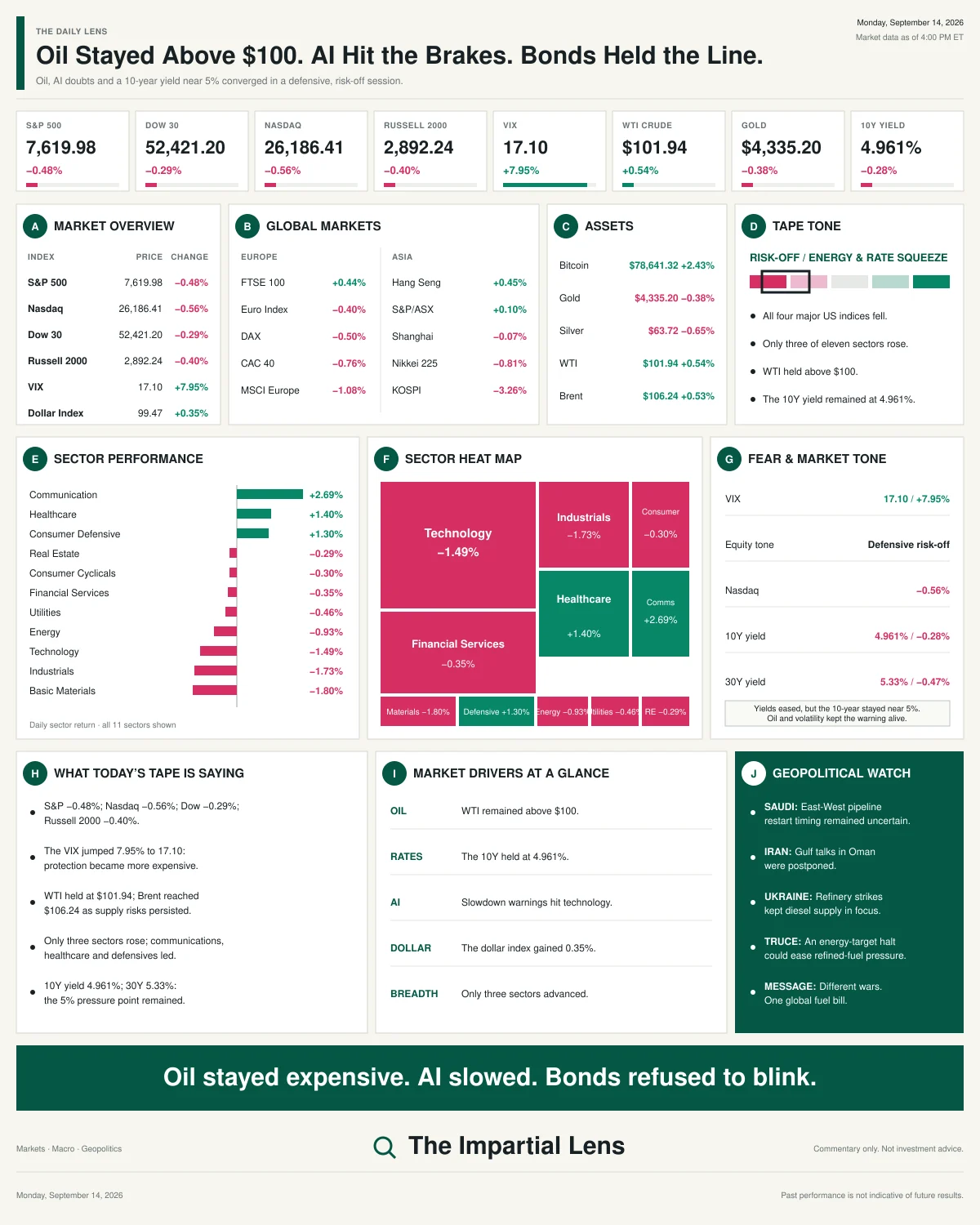
The S&P 500 fell 0.48%, the Nasdaq lost 0.56%, the Dow declined 0.29% and the Russell 2000 dropped 0.40%. Those were not catastrophic losses, but the VIX jumped 7.95% to 17.10.
Investors were not panicking.
They were paying more for protection.
The pressure came from multiple directions. Oil remained above $100 as disruption surrounding Saudi Arabia’s East-West pipeline and the postponement of talks between Iran and Gulf states kept the energy risk premium alive.
Attacks on Russian refining infrastructure added another layer to the fuel problem.
At the same time, renewed warnings about the speed and safety of artificial-intelligence development hit technology shares.
Then there was the bond market.
The 10-year Treasury yield eased slightly but remained at 4.961%. The 30-year ended at 5.33%, while the five-year held near 4.79%.
The market’s 5% line in the sand did not disappear.
It simply waited.
Two Wars Are Feeding One Energy Problem
WTI rose 0.54% to $101.94, while Brent gained 0.53% to $106.24.
The daily changes were modest, but the level matters more than Monday’s percentage move. Oil above $100 is no longer a distant geopolitical scenario. It is a current economic input.
The planned meeting between Iran and Gulf states in Oman was postponed after Saudi Arabia reportedly objected because of the situation in Yemen. Separately, Saudi Arabia’s East-West pipeline remained at the center of conflicting reports about how quickly operations could resume.
The pipeline carries crude from the kingdom’s eastern fields to the Red Sea, allowing some exports to bypass the Strait of Hormuz.
That alternative was supposed to provide redundancy.
Instead, the market is discovering that the bypass can also become a target.
US Energy Secretary Chris Wright said the pipeline could restart “very soon,” while other reports suggested that parts of the system could remain impaired for weeks. That uncertainty helps explain why oil held above $100 despite expectations of a rapid restoration.
Then there is Ukraine.
President Trump said Russia and Ukraine had agreed to halt attacks on energy targets. If observed, that could reduce pressure on Russian refining capacity and provide some relief to diesel markets.
But an announcement is not the same thing as restored supply.
Ukrainian attacks have already damaged Russian refineries and contributed to a tightening market for refined products. Russia can continue producing crude while losing some of its ability to turn that crude into diesel, gasoline and other fuels.
That distinction matters.
Consumers do not put crude oil into trucks, tractors or delivery vans. They buy refined products. A barrel can remain available while the fuel made from it becomes scarce and expensive.
Ukraine therefore cannot be separated from the Middle East energy story.
Iran threatens the movement of crude through Hormuz. The conflict in Yemen threatens Red Sea access and Saudi infrastructure. Ukraine threatens refining capacity and diesel supply.
Different wars.
Different infrastructure.
One global fuel bill.
AI Met the Cost of the Physical World
Technology fell 1.49% after leading much of the market’s advance this year.
The immediate catalyst was a renewed call from prominent AI executives to slow the development of the most advanced systems. President Trump rejected that argument and insisted that the United States must continue pushing ahead to win the global AI race.
The political argument is about national power.
The market argument is about cost.
AI does not exist in a weightless digital cloud. It requires data centers, semiconductors, transmission lines, cooling systems, and enormous quantities of electricity. Reports that developers are considering steam technology because gas turbines are unavailable until the next decade illustrate how quickly the buildout is colliding with physical constraints.
Now place that infrastructure race beside $100 oil, rising natural-gas demand and Treasury yields near 5%.
AI’s technological potential has not disappeared. Its financing assumptions are becoming harder to defend.
A project that looks attractive when capital is cheap and energy is abundant looks different when borrowing costs remain elevated and every major developer is competing for the same equipment, electricity, and construction capacity.
Monday’s technology decline was not a verdict against AI.
It was a reminder that even revolutionary technologies must pay ordinary bills.
The Bond Market Refused to Provide Relief
The decline in longer-term yields might normally have helped growth stocks. It did not.
A 10-year yield of 4.961% is not meaningfully different from 5% for companies, households, or the federal government. It still means expensive mortgages, costly corporate refinancing and rising interest charges on public debt.
The federal deficit had already reached approximately $1.97 trillion with one month remaining in the fiscal year, while year-to-date interest costs had risen 13%.
Against that backdrop, Washington is discussing sending households $5,000 “dividend” checks through a program reportedly costing approximately $1.2 trillion.
The label does not change the arithmetic.
A government running a deficit does not possess surplus cash to distribute. Unless the program is matched by spending cuts or new revenue, the money must ultimately be borrowed.
That would mean issuing more debt into a market already demanding nearly 5% for ten-year financing.
Calling borrowed money a dividend does not make it income.
It makes it another liability presented as a gift.
More borrowing increases Treasury supply. More Treasury supply can require higher yields to attract buyers. Higher yields raise future interest costs, adding to deficits and requiring still more borrowing.
That is the feedback loop investors are watching.
Oil can fall three dollars in a day.
The debt does not.
Defensive Leadership Told the Story
Only three of the eleven major sectors finished higher.
Communication services gained 2.69%, healthcare rose 1.40%, and consumer defensive added 1.30%. Every other sector declined.
Basic materials fell 1.80%, industrials lost 1.73%, technology dropped 1.49%, and energy declined 0.93%. Financial services, utilities, real estate and consumer cyclicals also finished lower.
That is not the composition of a market confidently pricing faster growth.
It is a market selectively seeking perceived resilience while selling sectors most exposed to capital spending, global trade and higher input costs.
International markets reinforced the caution. The KOSPI plunged 3.26%, the Nikkei declined 0.81% and MSCI Europe fell 1.08%. Britain’s FTSE 100 gained 0.44%, but broader European performance remained weak.
Bitcoin was the conspicuous exception, climbing 2.43% as optimism surrounding US cryptocurrency legislation improved.
Gold, however, fell 0.38% to $4,335.20 despite the geopolitical tension. A stronger dollar and stubbornly high Treasury yields likely limited its appeal. Gold had the crisis narrative, but interest-bearing assets still offered investors a substantial return.
What to Watch
The week now belongs to the central banks.
The Federal Reserve, Bank of England and Bank of Japan all have decisions approaching. For the Fed, the problem is especially uncomfortable.
Raise rates and borrowing costs increase across an economy already carrying enormous public and private debt.
Hold rates steady, and the bond market may question whether policymakers are responding forcefully enough to the inflationary threat from energy.
Promise easier policy and longer-term yields could rise if investors conclude that inflation will be tolerated.
Watch whether the Russia–Ukraine agreement actually reduces attacks on energy infrastructure. Watch whether Saudi Arabia restores its East-West pipeline. Watch whether delayed Iran–Gulf talks can be revived.
Above all, watch the 10-year.
The Fed controls the overnight rate. It does not control the price at which the world is willing to finance Washington for ten or thirty years.
AI needs more power.
Two wars are making energy more expensive.
Washington needs more money.
The bond market is making money more expensive.
Monday was not a collection of separate stories.
It was one bill arriving from four directions.
The Impartial Lens provides market commentary and education only. Nothing published here constitutes investment advice.