Wednesday was not a clean risk-off day.
It was more complicated than that.
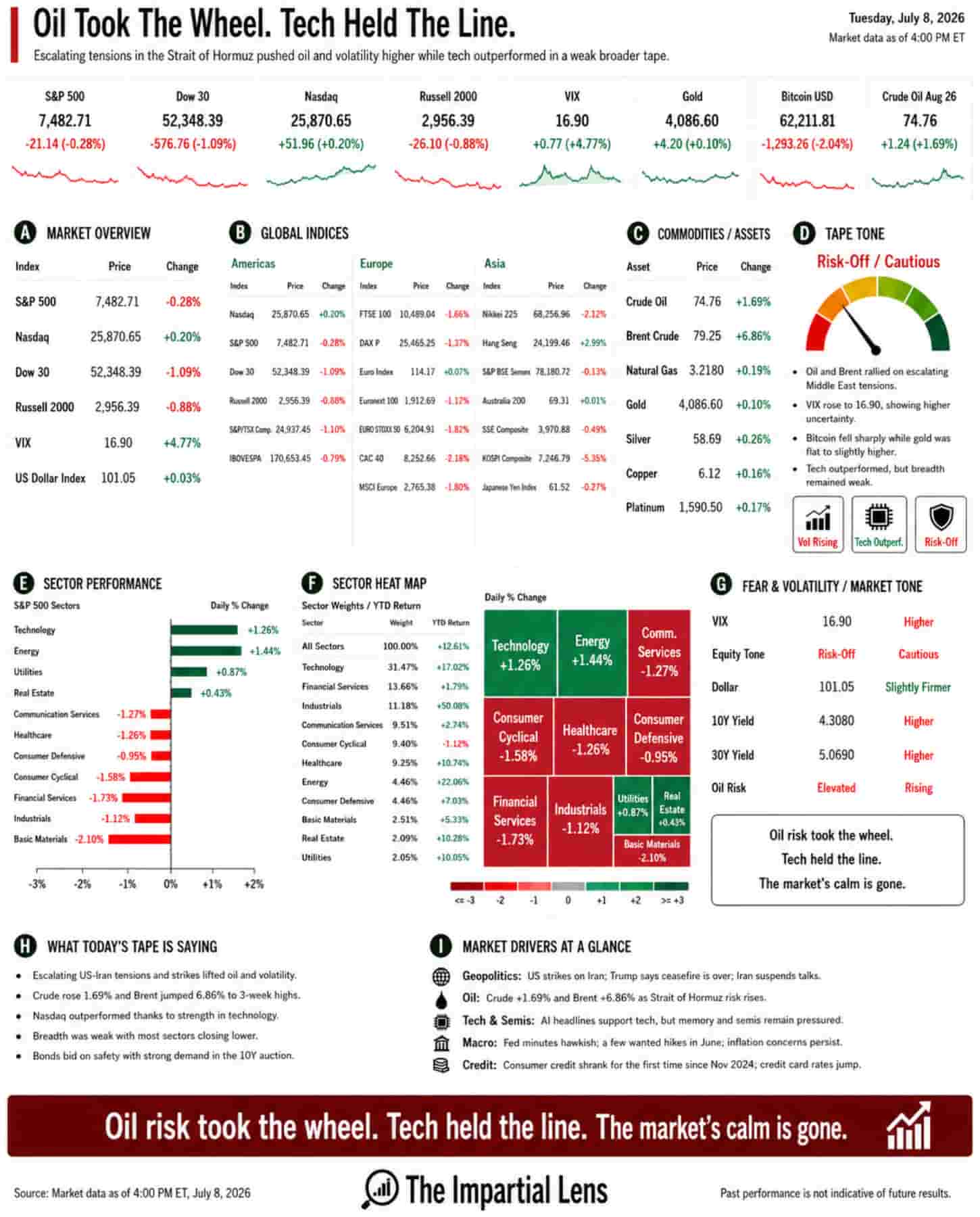
The S&P 500 fell 0.28%. The Dow dropped 1.09%. The Russell 2000 lost 0.88%. But the Nasdaq managed to rise 0.20%.
That matters.
After Tuesday’s tech selloff, big tech did not fully break. It held up better than the broader market. But the rest of the tape looked stressed.
The VIX rose 4.77% to 16.90. Bitcoin fell 2.04%. Gold edged up 0.10%. Crude oil rose 1.69% to $74.76, while Brent jumped sharply to $79.25.
So the market’s message was clear:
Oil risk is back.
Volatility is rising.
But tech is still trying to hold the line.
Hormuz Is Back In The Driver’s Seat
The biggest story was not earnings.
It was not even AI.
It was Hormuz.
U.S. strikes on Iran escalated again after attacks on commercial shipping. Trump warned that further Iranian attacks would bring “much worse” bombing. Reports suggested the ceasefire may be effectively over. Iran reportedly suspended talks on a final settlement. U.S. Central Command announced additional strikes aimed at degrading Iran’s ability to threaten freedom of navigation in the Strait of Hormuz.
That is why oil moved.
This is not just another geopolitical headline.
Hormuz sits directly on top of the inflation story. It affects crude, shipping, insurance, diesel, gasoline, trade routes, and central-bank expectations.
The market had been trying to price a messy but manageable Middle East outcome.
Wednesday made that harder.
The two key assumptions behind the temporary calm are now under pressure:
Safe passage for vessels.
And some form of oil-sanctions relief.
When those two assumptions weaken, oil does not need much imagination to rally.
The Peace Dividend Got Smaller
For a few weeks, the market wanted to believe the worst had passed.
Oil had eased. Shipping seemed to be normalizing. Talks were still alive. The market could focus again on AI, earnings, rates, and quarter-end flows.
That version of the story is now weaker.
The market does not have to price a full war to become more cautious. It only has to admit that the path from ceasefire to durable peace is longer and more fragile than hoped.
That is what happened.
Oil rallied. VIX rose. The Dow and Russell sold off. Bitcoin weakened. The broader market became more defensive.
This is the uncomfortable part:
A ceasefire headline can calm markets quickly.
But a broken ceasefire can reprice risk even faster.
Tech Held Up, But The Tape Was Narrow
The Nasdaq rising while the S&P, Dow, and Russell fell is important.
It tells us investors were still willing to own parts of big tech, even with oil risk back on the table.
Technology was one of the few bright spots, up 1.26%. Energy also held up, rising 1.44%, helped by the oil move.
But the rest of the sector tape was weaker.
Communication services fell 1.27%. Financial services dropped 1.73%. Consumer cyclical lost 1.58%. Healthcare fell 1.26%. Industrials declined 1.12%.
That is not broad strength.
That is narrow support.
Tech held the line. Energy caught the oil bid. Almost everything else looked tired.
That makes the day more cautious than the Nasdaq alone suggests.
AI Is Still The Market’s Lifeline
Big tech did enough to keep the Nasdaq green.
Apple’s chip-supply deal with Broadcom helped. NVIDIA remained in focus. China may allow some of its biggest AI companies to purchase a limited number of Nvidia H200 chips. OpenAI model headlines kept the AI story alive. Hedge funds reportedly bought the big-tech dip again.
That kept the AI trade from cracking further.
But it did not erase the pressure.
Momentum remains under stress. Korea has been weak. Memory euphoria is fading. Goldman is telling clients to rotate toward China’s AI value chain. Reports point to AI being unwound beneath the surface. Semiconductor pressure has not gone away.
So tech held.
But the AI trade is still being tested.
The market is still asking the same question:
Is AI leadership durable?
Or is the trade becoming too crowded, too expensive, and too dependent on perfect execution?
Bonds Sent A Different Signal
The bond market also mattered.
Despite the oil spike and hawkish Fed undertones, there was strong demand at the 10-year auction. That suggests bond investors were willing to buy duration even with inflation risk back in the headlines.
That is a meaningful signal.
The market is not simply saying “oil up, sell everything.”
It is saying something more nuanced:
Oil risk is rising.
Growth risk may be rising too.
That leaves equities stuck between two forces: higher energy prices and a bid for protection.
This is why the tape felt conflicted.
Oil says inflation pressure is back.
Bonds say investors still want safety.
Tech says growth is not dead.
The broader market says caution is returning.
The Fed Is Still Not Gone
The Fed stayed in the room.
The FOMC minutes showed that a few members wanted to hike in June, while a majority remained worried about inflation. The hawkish tone was tied to Middle East risk and AI investment pressure.
That matters.
If oil keeps rising, the Fed has less room to be friendly.
If AI investment keeps pushing power, chips, and infrastructure costs higher, the Fed has another reason to worry about sticky inflation.
That combination is not ideal for markets.
The market wants rate relief.
But the Fed is still watching inflation.
And now oil is making that job harder.
The Real Read
Wednesday was messy.
Oil jumped because the Middle East story got worse. The VIX rose. Bitcoin fell. The Dow and Russell sold off. The S&P slipped.
But the Nasdaq held up.
That makes the message more interesting.
The market is not in panic.
But it is not comfortable either.
The old peace-dividend trade is breaking down. Oil is back in focus. The Fed is still hawkish enough to matter. AI is still the market’s main growth engine, but the leadership is narrow and crowded.
That leaves the market with two big problems:
Energy risk.
And AI concentration.
One raises inflation risk.
The other raises market-structure risk.
The rally can survive one of those problems at a time.
It gets harder when both are active.
Oil took the wheel.
Tech held the line.
But the market’s calm is gone.
The next move depends on whether Hormuz risk cools — and whether AI can keep carrying the tape while everything else gets louder.