Brent pushed above $95, Treasury yields rose, and mega-cap technology sold off as investors questioned whether AI spending can outrun energy and financing costs.
Wednesday, July 22, 2026
Tuesday’s momentum surge did not last long.
By Wednesday, technology was falling again, oil had reached a six-week high, and Treasury yields were moving higher.
The S&P 500 declined only 0.14%, but that understated the pressure underneath. Technology fell almost 2%, communication services dropped 1.33%, and small-cap stocks lost nearly 1%.
Meanwhile, utilities, basic materials and energy rallied.
This was not indiscriminate selling. It was a clear rotation away from expensive growth and toward assets connected to energy, infrastructure and physical scarcity.
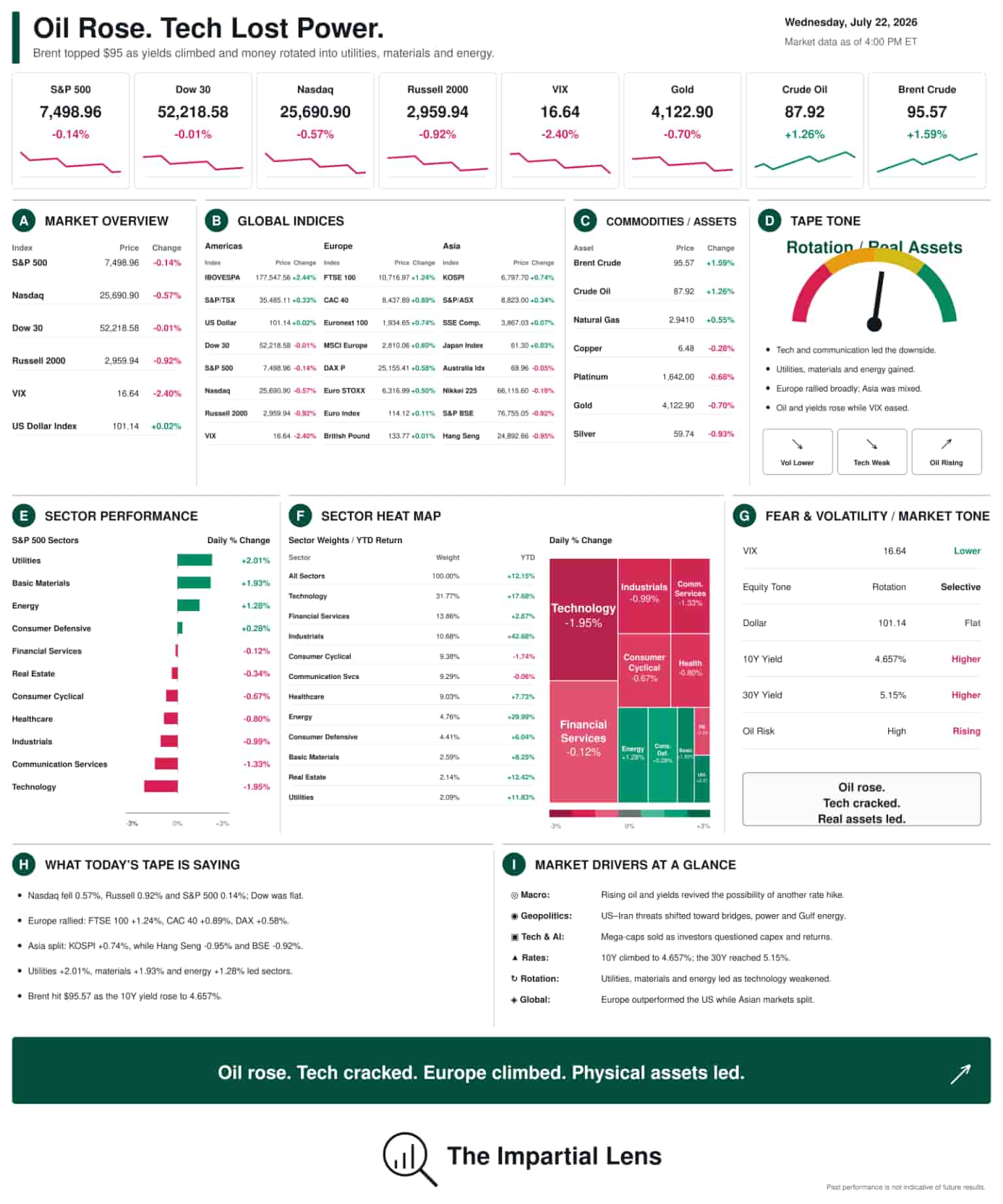
The Tape: What Actually Happened
The Nasdaq fell 0.57%, while the Russell 2000 lost 0.92%. The S&P 500 declined 0.14%, and the Dow was almost unchanged.
The VIX dropped 2.40% to 16.64. That suggests the market was uncomfortable, but not panicking.
Sector performance showed a sharp divide:
- Utilities: +2.01%
- Basic materials: +1.93%
- Energy: +1.28%
- Consumer defensive: +0.28%
- Financial services: -0.12%
- Consumer cyclical: -0.67%
- Healthcare: -0.80%
- Industrials: -0.99%
- Communication services: -1.33%
- Technology: -1.95%
Brent crude rose 1.59% to $95.57, while WTI gained 1.26% to $87.92.
Treasury yields also climbed. The 10-year reached 4.657%, while the 30-year moved to 5.15%.
Gold fell 0.70% to $4,122.90, silver lost 0.93%, and copper slipped 0.28%.
Europe Rose While Asia Split
European markets were broadly stronger.
The FTSE 100 gained 1.24%, France’s CAC 40 rose 0.89%, the Euronext 100 added 0.74%, and Germany’s DAX climbed 0.58%.
Europe’s market contains more banks, energy companies, industrial businesses and commodity exposure than the technology-heavy US indices. That helped as investors rotated toward physical assets and away from expensive growth.
Asia delivered a mixed picture.
South Korea’s KOSPI gained 0.74%, but the Hang Seng fell 0.95%, India’s Sensex lost 0.92%, and Japan’s Nikkei slipped 0.18%.
The global message was not simply “risk-off.” It was more selective:
Technology struggled. Energy and materials attracted money. Markets with less dependence on mega-cap technology generally held up better.
Oil Is Becoming a Rates Problem
Higher oil prices do more than raise costs at the gas pump.
Energy affects transportation, agriculture, manufacturing, electricity and the price of moving goods around the world. If oil remains elevated, it can slow the decline in inflation—or push inflation higher again.
That is why rising oil pushed the possibility of another Federal Reserve rate increase back into the conversation.
The Fed cannot produce more oil or reopen a shipping lane. Raising interest rates in response to a geopolitical energy shock would not solve the supply problem.
But the Fed may still react if higher energy costs spread into wages, services and consumer expectations.
This creates an unpleasant choice: tolerate higher inflation or tighten financial conditions into a slowing economy.
The simultaneous rise in oil and Treasury yields shows that markets are beginning to price that dilemma.
Big Tech Must Now Defend the AI Bill
Alphabet and Tesla entered earnings with investors focused less on revenue growth and more on spending and returns.
Alphabet reportedly increased its 2026 capital-expenditure guidance again. Tesla delivered stronger-than-expected revenue, but its shares still fell after the report.
That tells us something important.
Investors are no longer rewarding companies simply for spending more on AI. They want evidence that the spending will create revenue, margins and free cash flow.
The AI debate has changed from:
“How large can the buildout become?”
to:
“Who can prove the buildout will pay?”
Data centers require chips, electricity, cooling, land and debt. If hyperscalers increasingly use borrowing or off-balance-sheet financing, the risk does not disappear. It moves somewhere less visible.
Equity investors can celebrate future growth. Credit investors still want to know who pays the interest.
Geopolitics: Infrastructure for Infrastructure
The US-Iran conflict continued for an eleventh consecutive night.
President Trump threatened strikes against Iranian bridges and power facilities if Iran attacked shipping in the Strait of Hormuz.
Iran responded with its own warning: strike Iranian infrastructure, and Gulf energy infrastructure could lose power.
Reports also described attacks on US bases in Saudi Arabia, Bahrain and Jordan. Shipping companies were reportedly offering sailors large bonuses to cross Hormuz.
That is a revealing signal.
Governments issue statements. Markets place bets. But insurers, shipowners and crews put actual prices on physical danger.
The threat is no longer limited to oil tankers. Ports, bridges, power grids, LNG facilities and military bases are becoming part of the escalation ladder.
The market may still expect diplomacy to prevail. Brent above $95 suggests it is becoming less confident.
What to Watch
Watch Brent near $100. A sustained move above that level would increase inflation pressure and complicate the Fed outlook.
Watch the 10-year yield near 4.66% and the 30-year above 5%. Higher financing costs are especially dangerous for companies promising distant profits.
Watch technology’s response to Alphabet and Tesla. Good revenue will not be enough if spending keeps rising faster than returns.
Finally, watch Gulf shipping and power infrastructure. Physical disruption—not rhetoric—would mark the next stage of escalation.
The Bottom Line
Wednesday was not a broad market collapse.
It was a warning about changing leadership.
Technology weakened. Utilities, energy and materials strengthened. Europe outperformed. Oil and Treasury yields rose together.
The market is beginning to ask whether the next phase will be driven less by digital promises and more by physical constraints.
AI still needs chips.
But chips need power.
And power is becoming both more expensive and more geopolitical.
For educational and informational purposes only. Not investment advice.
— The Impartial Lens