Technology jumped 5.05%, Korea surged 14.65%, and volatility collapsed. The celebration was real. So was the renewed rise in long-term yields.
Thursday, July 30, 2026
Yesterday looked like a liquidation. Today looked like everyone trying to buy back the same trade at once.
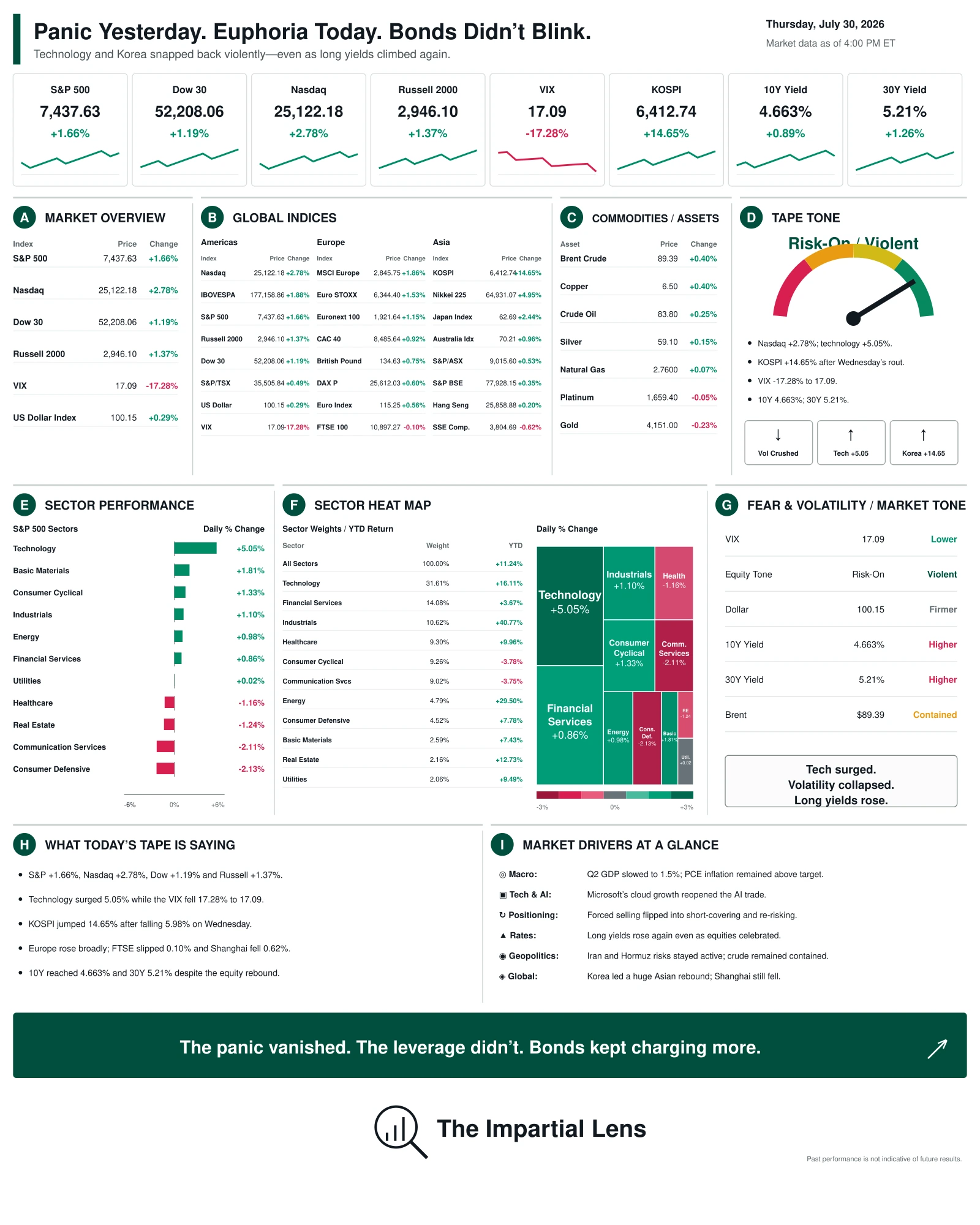
The Nasdaq gained 2.78%. Technology surged 5.05%. South Korea’s KOSPI rocketed 14.65%—one day after falling 5.98%—and the VIX collapsed 17.28%.
That is not a market calmly reaching a new conclusion. It is a market changing its mind at speed.
The Tape: What Actually Happened
U.S. stocks rebounded sharply:
- S&P 500: +1.66%
- Nasdaq: +2.78%
- Dow: + 1.19%
- Russell 2000: +1.37%
- VIX: 17.09, -17.28%
Technology led with a 5.05% gain. Basic materials rose 1.81%, consumer cyclicals gained 1.33%, industrials added 1.10%, and financials advanced 0.86%.
The rally was not universal. Consumer defensive shares fell 2.13%, communication services lost 2.11%, real estate declined 1.24%, and healthcare dropped 1.16%.
Europe was broadly stronger. MSCI Europe gained 1.86%, the Euro Stoxx index rose 1.53%, France’s CAC 40 added 0.92%, and Germany’s DAX gained 0.60%. The FTSE 100 was the exception, slipping 0.10%.
Asia delivered the real fireworks. The KOSPI jumped 14.65%, and the Nikkei 225 rose 4.95%. Australia, India and Hong Kong also gained, while China’s Shanghai Composite fell 0.62%.
Oil moved only modestly: Brent rose 0.40% to $89.39, and U.S. crude gained 0.25% to $83.80. Gold slipped 0.23% to $4,151.
But long-term Treasury yields rose again. The 10-year yield climbed to 4.663%, while the 30-year reached 5.21%.
That last line matters.
The Lens: A Fundamental Rebound—or a Positioning Reversal?
Microsoft gave investors a genuine reason to return to technology. The company reported quarterly revenue of $90.0 billion, up 18%, while Microsoft Cloud revenue grew 27% to $59.3 billion. Microsoft’s contracted backlog rose 84% to $678 billion, giving the company unusually strong visibility into future revenue—even though that money will be recognized gradually over several years. Those numbers helped reassure investors that at least one hyperscaler can convert enormous AI spending into visible growth.
But fundamentals alone do not explain the violence of the move.
Reports of a heavily leveraged AI investor unwinding positions added another possibility: Wednesday’s selling may have been intensified by forced liquidation. Once that pressure faded, short-covering and rapid re-risking could push the same crowded names sharply higher.
In plain English: some investors may not have bought because the long-term debate was settled. They may have bought because the urgent seller was gone.
Korea makes the point beautifully—and brutally. A market that falls 5.98% one day and gains 14.65% the next has not suddenly become 20% more certain about the future. It is displaying the effects of leverage, thin liquidity and forced positioning.
The Bond Market Refused to Celebrate
Stocks behaved as though the danger had passed. Long bonds did not.
The 10-year yield rose from 4.622% to 4.663%, while the 30-year moved from 5.14% to 5.21%. That leaves the long end uncomfortably close to the level at which borrowing costs begin to pressure housing, corporate finance and richly valued stocks.
Stocks and yields can rise together when earnings optimism overwhelms rate concerns. They cannot ignore one another indefinitely.
Higher yields reduce the present value of future profits. That matters most for companies whose valuations depend on years of expected growth—and no group currently carries more future expectations than AI.
Thursday’s rally therefore answered one question: buyers were still willing to return.
It did not answer the harder one: what happens if the 30-year yield keeps climbing?
Slower Growth, Still-Sticky Inflation
The macro data did not deliver a clean “Goldilocks” story.
U.S. real GDP grew at a 1.5% annualized rate in the second quarter, below expectations. Consumer spending, investment, and exports increased, while lower government spending and higher imports weighed on the result. (Bureau of Economic Analysis)
June personal consumption expenditures rose 0.3% from May, while personal income and disposable income each increased 0.2%. (Bureau of Economic Analysis)
Inflation cooled, but it did not disappear. Headline PCE inflation eased to 3.7% year over year from 4.1%, while core PCE slowed to 3.3% from 3.4%. (Headline PCE; core PCE)
The educational takeaway is simple: slower growth does not automatically produce lower interest rates when inflation remains above target. That is why equities could celebrate Microsoft while the bond market continued demanding more compensation for time and inflation risk.
Geopolitics Stayed in the Background—For Now
Reports of renewed U.S. strikes on Iran and Iranian threats of retaliation kept the Gulf risk channel open. Hormuz traffic reportedly improved, but shipping constraints remained.
Yet Brent remained below $90 and gained only 0.40%. The market was acknowledging geopolitical risk without pricing an immediate supply catastrophe.
That is an important distinction. Oil is no longer flashing panic. It is still carrying a war premium.
What Today’s Tape Is Saying
- The AI trade is alive, but it is not calm. A 5.05% technology surge immediately after a sharp selloff looks as much like a positioning event as a sober revaluation.
- Microsoft restored credibility to AI spending. Investors rewarded measurable cloud growth and a large contracted-revenue backlog.
- Korea’s rebound was relief, not proof of stability. A 14.65% one-day gain following a leveraged rout is a volatility signal.
- The VIX said, “all clear.” Long yields did not. That disagreement is now one of the market’s most important tells.
- The index rally concealed meaningful rotation. Defensive sectors, communication services, healthcare and real estate all fell.
Market Drivers at a Glance
- Earnings: Microsoft’s cloud and AI results reopened the door to the technology trade.
- Positioning: Reports of forced AI liquidation raised the possibility that the removal of a large seller amplified the rebound.
- Rates: The 10-year yield reached 4.663%; the 30-year hit 5.21%.
- Macro: Q2 growth slowed to 1.5%, while PCE inflation remained well above the Fed’s target.
- Asia: Korea staged a historic reversal, but China’s mainland market lagged.
- Geopolitics: Iran and Hormuz risks remained active, though crude prices were relatively contained.
What to Watch Next
First, can technology hold the rebound after the forced buying fades?
Second, does Korea stabilize—or simply begin another violent swing?
Third, can the S&P 500 keep rising if the 30-year yield pushes farther above 5%?
And finally, will the next round of mega-cap earnings validate Thursday’s enthusiasm or expose how selective the AI payoff really is?
Wednesday’s panic disappeared. The questions about leverage did not. And while stocks celebrated, the bond market kept raising the price of time.
The Impartial Lens separates observable market data from interpretation. This article is for information and education, not personalized investment advice.