July opened with a market that looked quiet on the surface.
It was not quiet underneath.
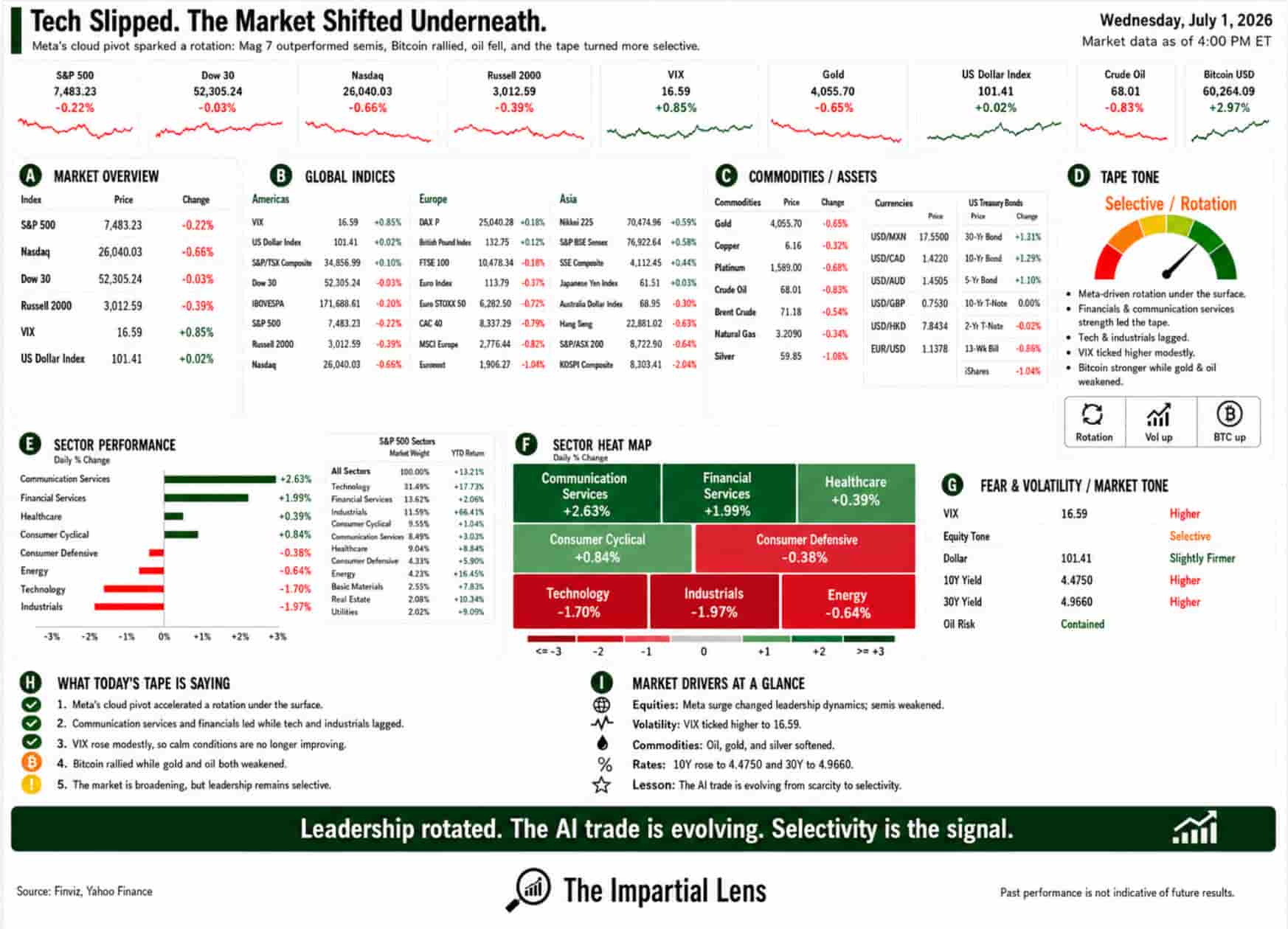
The S&P 500 slipped 0.22%. The Nasdaq fell 0.66%. The Russell 2000 lost 0.39%. The Dow managed a small gain of 0.03%.
The VIX rose 0.85%, so volatility did not panic, but it did stop falling. Gold dropped 0.65%. Crude oil fell 0.83%. Bitcoin was the standout, jumping 2.97%.
So this was not a broad risk-off day.
It was a rotation day.
And the rotation was important.
Technology fell 1.70%. Industrials dropped 1.97%. But financials rose 1.99%, communication services gained 2.63%, and healthcare finished positive.
That tells us the market did not simply sell everything.
It started choosing.
Meta Changed The Conversation
The biggest story was Meta.
Meta rallied hard after reports that it plans to build a cloud business and sell excess AI compute capacity. That sounds technical, but the implication is simple:
The AI scarcity story may be changing.
For months, the market has treated compute as scarce. Chips were scarce. Data-center capacity was scarce. Power was scarce. Memory was scarce. If you owned the bottleneck, the market rewarded you.
But if one of the largest AI spenders can turn excess compute into a business, the market has to ask a different question.
What if some parts of the AI buildout are moving from scarcity toward abundance?
That is why the reaction mattered.
Meta surged. The Mag 7 held up better. But semiconductors and memory names came under pressure. The market started to separate the owners of platforms, users, distribution, and cloud from the companies that had been treated as pure bottleneck winners.
That is a meaningful shift.
The AI trade is not dead.
But it is changing shape.
Semis Took The Hit
The market’s message was not anti-AI.
It was more precise than that.
It was anti-crowding.
Semis and memory have carried a lot of the AI enthusiasm. The logic was easy to understand: if AI demand explodes, the hardware suppliers win. Chips, memory, networking, power, cooling, and data-center infrastructure become the toll roads.
But Tuesday showed the danger of a crowded trade.
When the market starts to believe compute supply may be less scarce than assumed, or that hyperscalers may optimize rather than accelerate spending, the pressure moves quickly into the stocks that were priced for scarcity.
That is why the “Mag 7 versus semis” move matters.
It suggests investors are not abandoning AI.
They are reassessing who captures the economics.
That is a much more mature phase of the trade.
Early AI rallies reward everything.
Later AI rallies ask who actually gets paid.
Oil Kept Sliding
Crude oil fell again, down 0.83%.
That should be supportive for the macro backdrop. Lower oil helps inflation expectations, consumers, transport costs, and central-bank pressure.
But the geopolitical picture is still messy.
Indirect U.S.-Iran technical talks were reportedly underway in Doha with Qatar and Pakistan acting as mediators, but the headlines remained contradictory. Vance warned that the U.S. still has options. Trump said diplomacy was “very good.” Iran rejected direct Doha talks. There were also fresh headlines around Hormuz, ship movement, and energy transit.
So oil is lower, but the risk is not gone.
The market is still treating the energy shock as contained.
That may be right.
But contained does not mean solved.
Bitcoin Ripped While Gold Fell
Bitcoin’s move stood out.
While the major indices were mixed and tech slipped, Bitcoin rose almost 3%. Gold fell. Silver remained weak.
That is a strange mix.
Bitcoin strength suggests speculative risk appetite is still alive. Gold weakness suggests investors are not scrambling for classic protection. But the weakness in tech and semis says the market is no longer simply buying every high-beta asset.
Again, the word is selectivity.
This is not a market where everything risky is going up together.
It is a market where capital is rotating toward specific stories and away from crowded assumptions.
Bitcoin had a bid.
Semis did not.
That is the kind of detail that matters.
The Fed Still Matters
Warsh remained part of the background.
Markets are no longer getting easy forward guidance from the Fed. That makes every inflation print, labor signal, and policy comment more important.
The economic data was mixed. Manufacturing disappointed in some areas. ADP was short of consensus. Job cuts eased. Challenger data improved. Oil is lower, but services and AI-related costs remain a concern. Power demand is rising. Data-center politics are getting louder. The largest U.S. grid has already had to issue emergency alerts during the heat dome.
That matters because AI is not just an earnings story.
It is an infrastructure story.
Power, chips, data centers, labor, cooling, land, regulation, and local politics are all becoming part of the valuation equation.
The market wants AI to be clean software economics.
The real world keeps reminding us it is also concrete, copper, electricity, water, zoning, and debt.
The Real Read
July started with a shift.
The indices were not dramatic. The S&P slipped. The Nasdaq fell. The Dow held. The VIX barely rose.
But under the hood, the market changed.
Meta’s move suggested the AI story is no longer just about buying the bottleneck. Semis came under pressure. Mag 7 names held up better. Software caught attention. Bitcoin rallied. Oil fell. Gold weakened. Financials and communication services carried the tape while technology lagged.
That is not panic.
It is repricing.
The market is asking a more sophisticated question now:
Who actually captures the economics of AI?
Is it the chip suppliers?
The cloud platforms?
The software layer?
The companies using AI to cut costs?
The power and grid providers?
Or the firms that can turn compute from a cost center into a revenue stream?
That question matters because the first half of the year was built on belief.
Belief in AI.
Belief in capex.
Belief in scarcity.
Belief in growth.
Belief that the market’s biggest companies could keep carrying the load.
July opened by testing that belief.
Tech slipped.
Meta changed the conversation.
Bitcoin caught a bid.
Oil kept falling.
But the real story is under the surface:
The AI trade is no longer one trade.
The market is starting to ask who gets paid.