Traders on the floor of the New York Stock Exchange. Archival photograph by Carol M. Highsmith, Library of Congress.
Wall Street gave back Wednesday’s rally and then some. Oil rebounded as reports of tanker incidents came in, and a bank collapse brought down Paraguay’s president.
Thursday, November 5, 2026 | The Daily Lens
On Wednesday, the Dow gained more than 1,500 points. On Thursday, it lost more than 1,800.
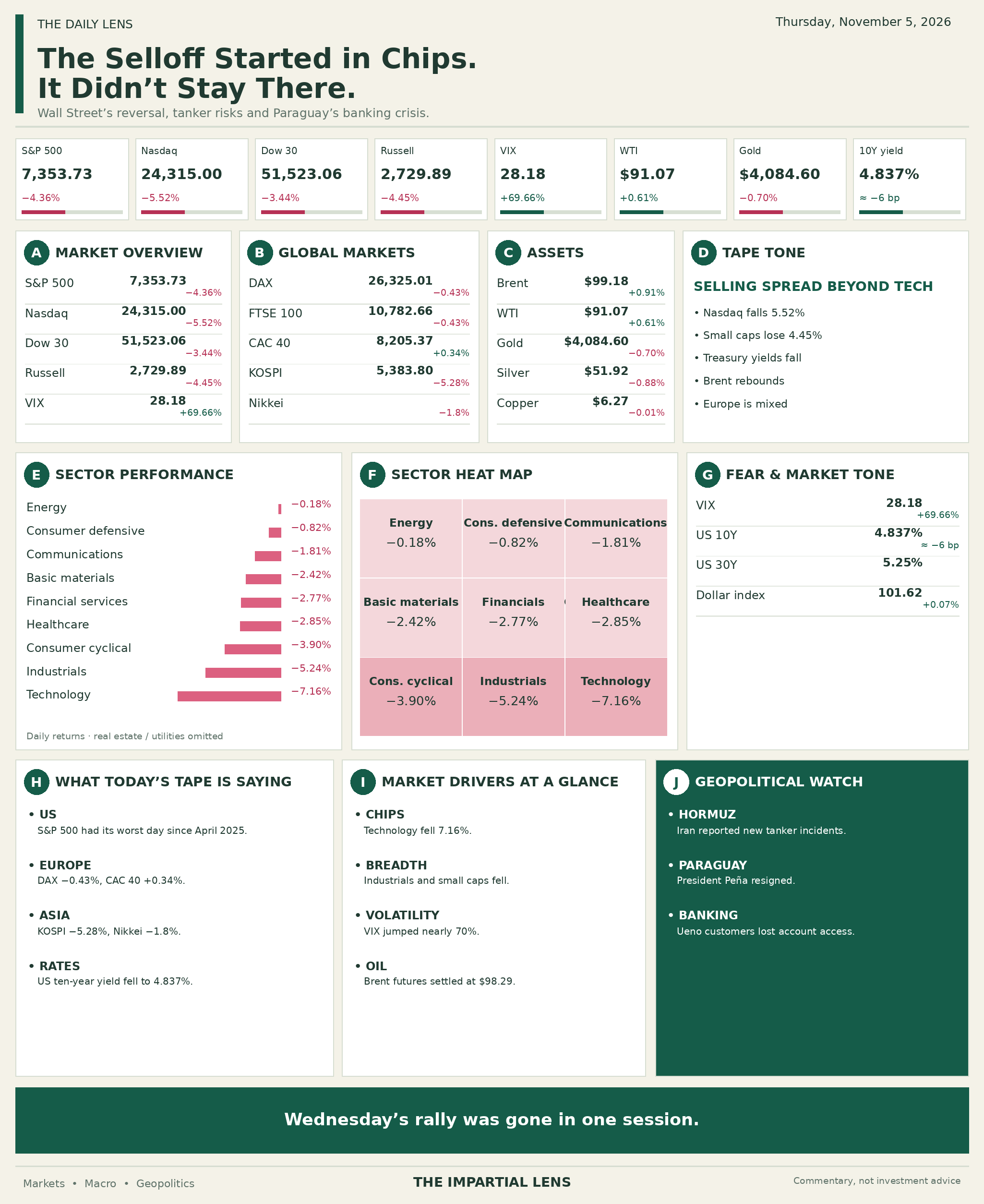
Chip stocks led the fall, but by the close small companies, industrials and financials had all taken heavy losses. The S&P 500 had its worst day since the April 2025 tariff shock. The VIX, which measures how much volatility traders expect over the next month, jumped nearly 70%.
The Selling Spread Well Beyond Chips
The Nasdaq fell 5.52%, leaving it almost 12% below last month’s record. The Russell 2000 lost 4.45%. Industrials fell 5.24% and financials lost 2.77%. Treasury yields fell as shares dropped. A disappointing day for chipmakers had turned into a day when investors were cutting exposure across much of the US market.
The Russell 2000 is worth a closer look. Its smaller companies sit well outside the handful of tech giants that can pull the big indices around. When it falls 4.45% on the same day the Nasdaq drops 5.52%, you can see how little shelter there was in owning a different slice of the US market.
The VIX tells us what that felt like in the options market. Investors can buy contracts that gain value if the S&P 500 falls, a bit like taking out insurance against a drop. By Thursday’s close, options prices implied much bigger swings ahead. Anyone who waited until the selling was underway to buy that protection faced a dearer bill.
By the end of Thursday, it was hard to tell that Wednesday had been Wall Street’s best day in three months. The entire gain was gone, and the market closed below where it had started before the rally. It took one session to undo the relief that followed the election.
Brent Bounced. The Tankers Still Have to Get Through.
Brent settled below $95 on Wednesday as traders saw a better chance of a deal with Iran. On Thursday, it settled at $98.29, up 3.88%, as reports of tanker incidents put supply concerns back in focus. Iran’s Revolutionary Guard said two tankers and a tugboat caught fire in separate incidents and said one tanker had struck a mine.
Imagine being the person booking the next voyage. You need a route the crew can sail, an insurer willing to cover it and a delivery date the buyer can work with. Traders can act on the prospect of a deal in seconds. The person booking the tanker still has to make those three calls.
The Bank Failed. Then Paraguay’s President Resigned.
For customers of Paraguay’s ueno bank, the immediate question was whether they could get to their money. The lender had grown to serve about three million people in a country of roughly 6.5 million. It also administered about $850 million in public funds. Customers lost access to their accounts after the central bank intervened over solvency concerns.
A frozen account can quickly become somebody else’s cash problem. A shopkeeper who can’t reach the weekend’s takings still has a supplier to pay. That supplier may be counting on the payment to make payroll. Each has to find cash while waiting for the bank to reopen access. In Paraguay, that wait was playing out across a customer base of about three million people.
President Santiago Peña resigned on Thursday as lawmakers moved towards impeachment and support within his own party fell away. Opponents accused him of conflicts of interest and misuse of pension funds. He denied wrongdoing. Paraguay’s currency fell nearly 5% against the dollar.
The political timetable moved quickly. Depositors have a timetable of their own. Rent, wages and supplier bills still come due while authorities work out when people can use their accounts again.
How Global Markets Responded
The S&P 500 fell 4.36%, the Dow lost 3.44%, and the VIX closed at 28.18. The ten-year Treasury yield fell to 4.837%. Gold slipped 0.70% in the Yahoo Finance snapshot, even as Treasuries rallied.
Europe held up better. The DAX and FTSE 100 each fell 0.43%, while France’s CAC 40 rose 0.34%. Asia was mixed. Japan’s Nikkei fell 1.8%, South Korea’s KOSPI fell 5.28%, and India’s Sensex rose to 79,310.01.
What We’re Watching
- Markets. Whether small caps, industrials and financials stabilise after Thursday’s selloff.
- Hormuz. Whether incident reports ease and insurers return to ordinary terms for voyages through the strait.
- Paraguay. When depositors can use their money again, and what happens to the public funds ueno administered.
The Lens
Wednesday’s relief lasted one session. By Thursday’s close, the losses had reached smaller companies, industrials and financials. The next session will tell us more about the selloff if we look at what happens to those companies alongside the chip stocks.
Oil has already swung several dollars in both directions while shipowners still have to make the next voyage work. In Paraguay, a president has resigned and depositors are still waiting to use their accounts. I’d keep watching the things people need to do after the headline moves on. Book the voyage. Pay the bill. Get on with business.
The Impartial Lens provides market commentary and education only. Nothing published here constitutes investment advice.