
The Nasdaq barely moved, but technology fell 2.11%, bond yields climbed and several parts of the market weakened. The headline numbers hid a much messier day.
Monday, July 20, 2026
At first glance, Monday looked uneventful.
The Nasdaq fell only 0.05%. The S&P 500 slipped 0.19%, and the VIX moved slightly lower.
That sounds like a quiet day.
But underneath the major indices, technology fell more than 2%. Industrials and healthcare dropped more than 1%. Small-cap stocks weakened, and Treasury yields rose across the curve.
The market looked calm because different groups were moving in opposite directions—not because the risks had disappeared.
The Tape: What Actually Happened
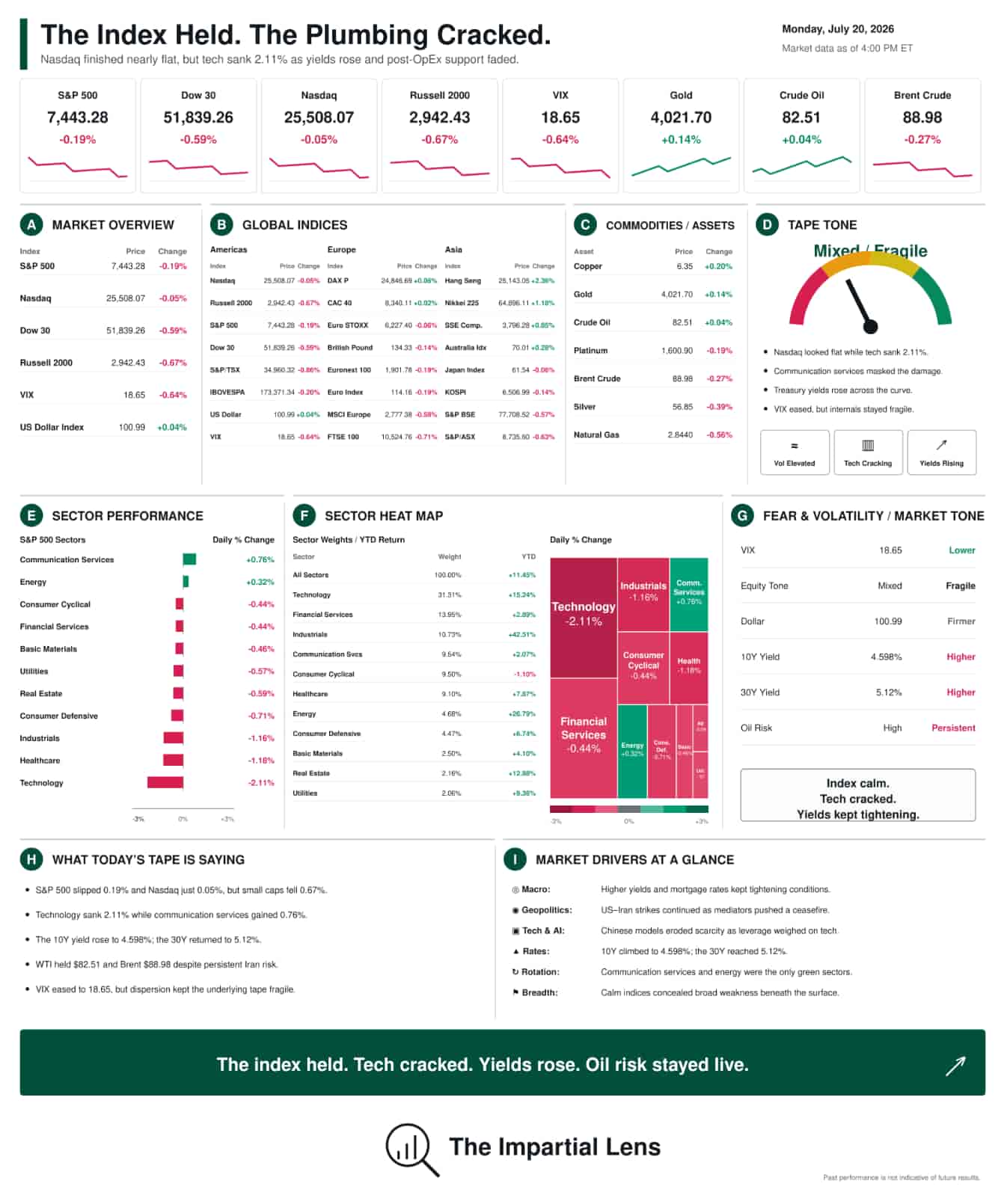
The S&P 500 closed down 0.19%, while the Nasdaq finished almost unchanged at -0.05%.
The Dow fell 0.59%, and the Russell 2000 lost 0.67%.
The VIX declined 0.64% to 18.65. That does not indicate panic, but volatility remains higher than it was during the calmer stages of the rally.
The sector numbers showed a more difficult session:
- Technology: -2.11%
- Healthcare: -1.18%
- Industrials: -1.16%
- Consumer defensive: -0.71%
- Real estate: -0.59%
- Communication services: +0.76%
- Energy: +0.32%
Treasury yields moved higher. The 10-year yield reached 4.598%, while the 30-year returned to 5.12%.
Gold gained 0.14% to $4,021.70. WTI crude held near $82.51, while Brent slipped slightly to $88.98.
Asia Rallied While Europe Softened
Asian markets generally performed better.
The Hang Seng gained 2.36%, the Nikkei rose 1.18%, and China’s Shanghai Composite added 0.85%.
Europe was more subdued. The FTSE 100 fell 0.71%, while MSCI Europe lost 0.58%. Germany’s DAX and France’s CAC 40 finished only slightly higher.
This matters because the market is no longer moving as one global trade.
Investors appear to be reducing exposure to crowded US technology positions while reconsidering cheaper opportunities in China and other Asian markets.
That does not guarantee a lasting rotation. It does show that American technology is no longer the only game in town.
Why the Nasdaq Looked Better Than Technology
Here is the confusing part: How could the Nasdaq fall only 0.05% while the technology sector dropped 2.11%?
Because the Nasdaq is heavily influenced by a small number of enormous companies.
Communication services gained 0.76%, helping offset weakness in traditional technology shares. A few large stocks can therefore hold up the index even when many companies underneath it are falling.
This is why looking only at the index can be misleading.
The market was not stable. Its winners and losers were temporarily cancelling each other out.
Options positioning may also have helped suppress the headline move. After Friday’s options expiration, some of the automatic buying and selling connected to dealer hedging began to fade.
In plain English: one of the mechanisms that helped keep the market steady may now be providing less protection.
The AI Trade Has Two Problems
The AI story is facing pressure from two directions.
First, Chinese models are becoming more capable and less expensive. They do not need to prove that China has permanently defeated the United States in AI.
They only need to show that advanced models are becoming easier and cheaper to build.
That threatens the premium investors placed on a small group of US companies assumed to have an almost untouchable advantage.
Second, the AI trade has become heavily crowded.
Hedge funds, options traders and momentum investors piled into many of the same semiconductor and infrastructure names. That pushed prices higher on the way up, but it can accelerate losses when the trend reverses.
The AI boom does not need to be fake for the trade to become dangerous.
Investors only need to overestimate future profits, underestimate infrastructure costs and pay prices that leave almost no room for disappointment.
Upcoming hyperscaler earnings will therefore be important. Investors will want evidence that AI revenue is beginning to justify the enormous spending on chips, data centers and electricity.
Another promise that the profits will arrive “eventually” may not be enough.
Geopolitics: Talking Peace While Trading Strikes
Mediators reportedly proposed a 10-day pause in US-Iran strikes, and Iran said it remained open to negotiations.
But military activity continued.
Reports said two American service members were killed in an Iranian attack in Jordan. President Trump threatened a severe response, while the United States continued targeting Iranian infrastructure.
The Houthis also announced restrictions on Saudi-linked shipping, and reports of tanker explosions near the Strait of Hormuz kept the energy risk alive.
Oil barely moved by the close. That suggests traders are waiting for proof of sustained supply disruption before pushing prices sharply higher.
For now, the market is treating the war as dangerous but containable.
That is a judgment—not a guarantee.
The Household Squeeze Continues
Higher bond yields feed directly into borrowing costs.
Thirty-year mortgage rates reportedly reached their highest level in almost a year. Nearly 30% of vehicle trade-ins carried negative equity, meaning owners owed more than their cars were worth.
Gasoline crossing the politically sensitive $4 level adds another burden.
The economy can avoid an official recession while ordinary households still feel squeezed by housing, transport, food and debt costs.
That gap between strong economic headlines and weak household confidence remains one of the market’s biggest political and economic risks.
What to Watch
Watch the 10-year yield around 4.60% and the 30-year above 5%. Higher yields make mortgages, business loans and market speculation more expensive.
Watch upcoming technology earnings for real AI revenue—not just bigger spending plans.
Watch whether weakness spreads beyond semiconductors into the remaining mega-cap leaders.
Finally, watch actual shipping activity through Hormuz. Threats move headlines; physical disruption moves oil.
The Bottom Line
Monday was not a crash.
It was a reminder that major indices do not always show what is happening underneath them.
Technology weakened. Bond yields rose. Household borrowing costs remained high. The war risk stayed alive.
Yet the Nasdaq barely moved because strength in a few large companies disguised the damage elsewhere.
The market still looks calm.
But it is becoming increasingly dependent on a shrinking number of stocks to keep it that way.
For educational and informational purposes only. Not investment advice.
— The Impartial Lens