
Stocks surged across the US, Europe and Asia as volatility collapsed. But rising Treasury yields, expensive AI financing and widening geopolitical risk kept the celebration conditional.
Tuesday, July 21, 2026
After several ugly sessions, markets did what crowded trades often do: they snapped back violently.
The Nasdaq jumped 1.29%. Small caps gained 1.53%. The VIX dropped more than 8%. European stocks rallied, while South Korea and Japan surged.
Momentum reportedly enjoyed its strongest day on record.
But beneath the celebration, bond prices fell, Treasury yields rose, and oil continued climbing. Communication services and consumer defensives finished lower, while credit tied to the AI infrastructure boom remained under pressure.
Tuesday was a powerful rebound.
It was not an all-clear.
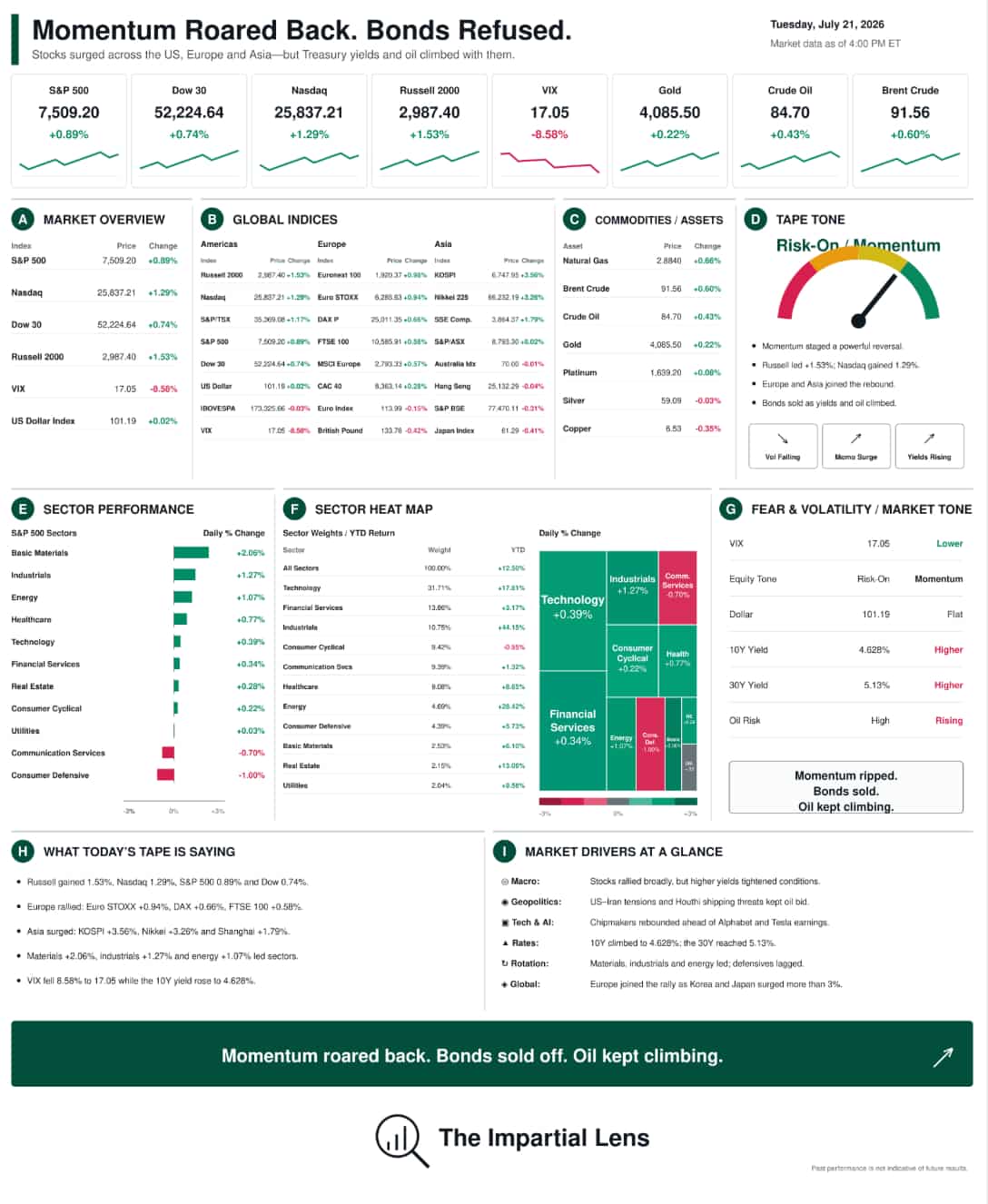
The Tape: What Actually Happened
The Russell 2000 led the US indices, gaining 1.53%. The Nasdaq rose 1.29%, the S&P 500 added 0.89%, and the Dow gained 0.74%.
The VIX fell 8.58% to 17.05, showing that immediate fear was leaving the market.
Most sectors finished higher:
- Basic materials: +2.06%
- Industrials: +1.27%
- Energy: +1.07%
- Healthcare: +0.77%
- Technology: +0.39%
- Financial services: +0.34%
- Communication services: -0.70%
- Consumer defensive: -1.00%
Oil continued rising. WTI gained 0.43% to $84.70, while Brent climbed 0.60% to $91.56. Gold added 0.22% to $4,085.50.
Treasury yields also moved higher. The 10-year reached 4.628%, and the 30-year climbed to 5.13%.
That combination—stocks, oil and bond yields all rising—is not a simple “risk-on” signal. It suggests investors were buying the rebound while still pricing inflation and geopolitical risk.
The Global Rebound
The rally extended well beyond Wall Street.
In Europe, the Euronext 100 rose 0.98%, the Euro Stoxx gained 0.94%, Germany’s DAX added 0.66%, and the FTSE 100 climbed 0.58%.
Asia was even stronger.
South Korea’s KOSPI surged 3.56%, Japan’s Nikkei gained 3.26%, and China’s Shanghai Composite rose 1.79%.
These were substantial moves, but they followed heavy selling. The strongest rebound often appears in the areas that suffered the most damage.
That makes Tuesday encouraging—but not conclusive.
Momentum Came Roaring Back
The day was described as momentum’s best session on record.
In plain English, many of the stocks and strategies that had recently been punished suddenly reversed higher together.
That can happen when traders rush to cover short positions, options dealers adjust their hedges, and investors fear missing the rebound.
The buying becomes fuel for more buying.
But a violent bounce does not automatically repair the market. It can simply show how crowded the selling had become.
The important question is whether the rebound can continue once the forced buying and short covering fade.
Tuesday demonstrated that momentum was not dead.
It did not prove that the underlying problems had been solved.
AI Equities Bounced. AI Credit Didn’t.
Technology recovered, helped by bullish semiconductor headlines and anticipation ahead of Alphabet and Tesla earnings.
TSMC reportedly plans to raise chipmaking prices by as much as 10%, while Nvidia said its new Vera processor would outperform AMD’s Turin chip.
Those headlines supported the idea that AI demand remains real.
But demand was never the only question.
The harder question is whether revenue, profit margins and cash flow can justify the extraordinary amount being spent on chips, data centers, power and financing.
That is why weakness in hyperscaler credit matters. Equity investors are buying the growth story. Bond investors are examining the bill.
China adds another complication.
Increasingly capable Chinese and open-source models could make AI more widely available while reducing the scarcity premium enjoyed by proprietary US systems.
AI can transform the economy while still becoming a more competitive, lower-margin business.
Both statements can be true.
Geopolitics: The Oil Risk Keeps Growing
The US-Iran conflict showed little sign of cooling.
President Trump threatened heavy strikes against Iran’s Pickaxe Mountain nuclear facility and dismissed the idea of meeting Iranian officials.
Iran reportedly proposed a 10-day ceasefire, while the United States demanded a longer pause and partial reopening of navigation through the Strait of Hormuz.
Meanwhile, the Houthis warned shipping companies against using Saudi ports, and several Saudi vessels were reportedly forced to turn back near Bab-el-Mandeb.
Kazakhstan also halted oil flows to a Black Sea terminal after Ukrainian drone attacks.
This means energy risk is no longer concentrated in one location. Hormuz, the Red Sea and the Black Sea are all carrying disruption risk.
Oil’s continued rise reflects that expanding map.
What to Watch
Watch Alphabet and Tesla earnings for evidence that AI revenue is catching up with AI spending.
Watch whether the rally broadens after the momentum surge. A durable advance needs more than a one-day reversal in heavily traded names.
Watch the 10-year yield at 4.63% and the 30-year above 5%. Higher yields make expensive growth stocks harder to justify.
Finally, watch oil and physical shipping. Diplomatic headlines can move prices briefly; actual vessel traffic determines whether the disruption is real.
The Bottom Line
Tuesday’s rally was genuine. So were the warning signs.
Stocks surged. Volatility fell. Europe and Asia joined the rebound.
But bonds sold off, yields rose, oil climbed, and the cost of financing the AI boom remained visible.
The market celebrated the comeback.
The bond market kept reading the invoice.
For educational and informational purposes only. Not investment advice.
— The Impartial Lens