Long yields fell after the Treasury doubled its bond-buyback support. But $40 trillion of federal debt, hawkish Fed minutes and stubbornly high oil prices suggest the relief may be temporary.
Wednesday looked calm—provided you only glanced at the major indexes.
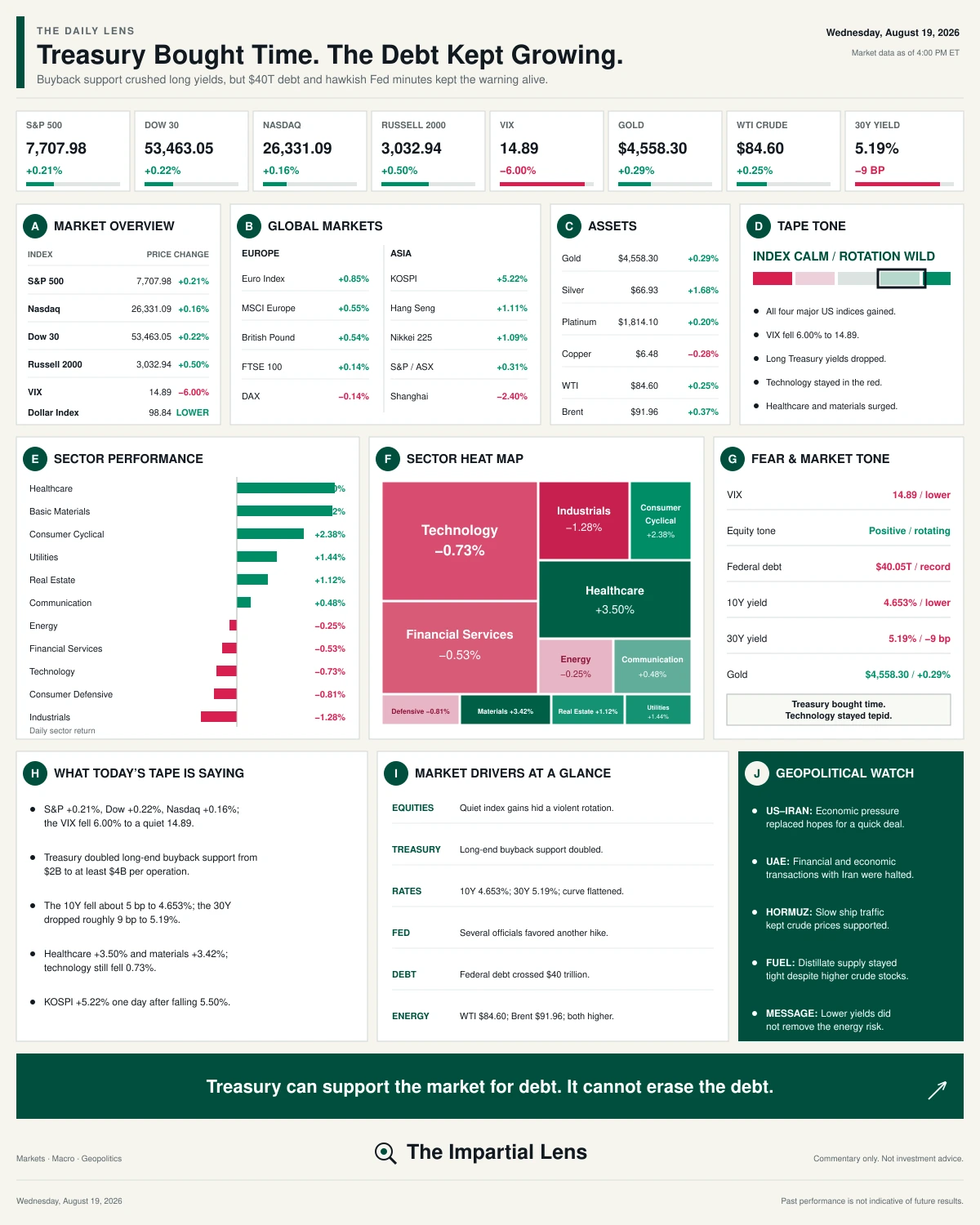
The S&P 500 gained 0.21%, the Dow added 0.22%, and the Nasdaq rose just 0.16%. The Russell 2000 performed slightly better, climbing 0.50%, while the VIX fell 6.00% to 14.89.
Nothing dramatic there.
Underneath the surface, however, bonds surged, the dollar weakened, precious metals gained, and leadership inside the stock market changed violently.
The trigger came from an unexpected place: the United States Treasury.
Treasury Stepped into the Long End
After the 30-year Treasury yield reached its highest level since 2007 on Tuesday, the Treasury announced that it would at least double the size of its liquidity-support buybacks for longer-dated government bonds.
The maximum purchase will rise from $2 billion to at least $4 billion per operation, covering bonds in the 10-to-30-year maturity range. The larger operations will run from September 9 through November 4.
The market reacted immediately.
The 10-year yield dropped from roughly 4.71% to 4.65%, while the 30-year fell from 5.28% to 5.19%. Those may look like small changes, but moves of that size matter in a market that influences mortgage rates, corporate borrowing, government financing, and the value of nearly every other asset.
When the Treasury becomes a larger buyer, demand for those bonds rises. Their prices go up, and their yields come down.
In simple terms, Treasury told the bond market: we see the pressure, and we are prepared to push back.
This Is Not Quite QE
The announcement was quickly described as “QE Lite,” but that needs clarification.
Quantitative easing normally involves the Federal Reserve creating reserves and using them to purchase securities. Treasury buybacks work differently. The government repurchases older, less-liquid bonds and finances those purchases with cash or by issuing other debt.
No debt magically disappears.
It changes how the debt is managed. It does not reduce the amount owed.
The operation can improve trading conditions and temporarily reduce the amount of long-duration debt investors must absorb. But it does not reduce the budget deficit, lower government spending, or eliminate the need for future borrowing.
That distinction became difficult to ignore because total federal debt crossed $40 trillion on the same day. Treasury’s own daily data show the total at approximately $40.05 trillion. U.S. Treasury Fiscal Data
Treasury therefore intervened to support the long-bond market just as the quantity of debt requiring support reached another historic milestone.
That is a treatment for the symptom—not the cause.
The Fed Wasn’t Offering a Rescue
The Federal Reserve minutes delivered a very different message.
Most policymakers supported leaving rates unchanged at July’s meeting. However, several favored another quarter-point increase, while many believed further tightening could become necessary if inflation failed to decline.
The minutes said inflation risks remained tilted to the upside, partly because of tariffs, energy disruptions and demand associated with the AI construction boom. Officials also discussed the growing use of borrowed money to finance AI infrastructure and the risk of a broader repricing if expectations surrounding AI profits disappoint.
That creates an unusual policy tension.
Treasury is attempting to calm long-term borrowing costs, while the Fed is warning that financial conditions may not be restrictive enough to return inflation to 2%.
One arm of government pushed yields lower. The other reminded investors that rates could still go higher.
The Index Hid a Huge Rotation
Lower bond yields would normally provide immediate relief for expensive technology shares.
That did not happen.
Technology fell 0.73%, financial services lost 0.53%, and industrials dropped 1.28%. Meanwhile, healthcare surged 3.50%, basic materials gained 3.42%, consumer cyclicals rose 2.38%, utilities added 1.44%, and real estate climbed 1.12%.
The S&P 500’s small gain therefore concealed an enormous amount of movement underneath.
Investors were not simply buying the market. They were leaving yesterday’s winners, covering crowded positions and moving toward sectors that benefit from lower yields or offer more defensive earnings.
That is why Wednesday felt quiet at the index level but chaotic beneath it.
Korea’s Whiplash Continues
South Korea offered the clearest example of how unstable positioning has become.
The KOSPI rebounded 5.22% after falling 5.50% on Tuesday. SK Hynix announced plans to repurchase and cancel 40 trillion won—roughly $28.6 billion—of its own shares following the technology selloff.
A nearly complete reversal in two sessions is not evidence of a calm market. It is evidence that crowded trades are being unwound and rebuilt at remarkable speed.
Japan and Hong Kong gained roughly 1.1%, while Shanghai moved in the opposite direction and fell 2.40%. Asia was no more unified than Wall Street.
Oil Refused to Cooperate
The bond rally also failed to remove the energy problem.
WTI crude gained 0.25% to $84.60, while Brent rose 0.37% to $91.96. Continued pressure on Iran and uncertainty surrounding the Strait of Hormuz are keeping the inflation channel open.
That matters because falling yields are more difficult to sustain if energy and transportation costs continue climbing.
The Treasury can support bond-market liquidity. It cannot manufacture diesel, reopen shipping lanes or force inflation back to target.
What to Watch Next
The immediate question is whether long-term yields remain lower once the initial excitement surrounding the buyback announcement fades.
Watch:
- Whether the 30-year yield can stay near or below 5.20%.
- Whether technology begins responding positively to lower yields.
- Whether gold and silver continue rising as the dollar weakens.
- Whether oil moves higher as economic pressure on Iran intensifies.
- Whether the market’s violent internal rotation begins affecting the headline indexes.
The Wrap
Wednesday was not a straightforward risk-on rally.
It was a policy-assisted bond rally accompanied by a weaker dollar, stronger hard assets and an enormous rotation beneath almost unchanged stock indexes.
Treasury demonstrated that it can calm the long end—at least temporarily.
But it cannot buy back the deficit, erase $40 trillion of debt or remove the inflation risks still worrying the Federal Reserve.
Treasury bought time.
The real question is how expensive that time will become.
The Impartial Lens provides market commentary and education, not investment advice.