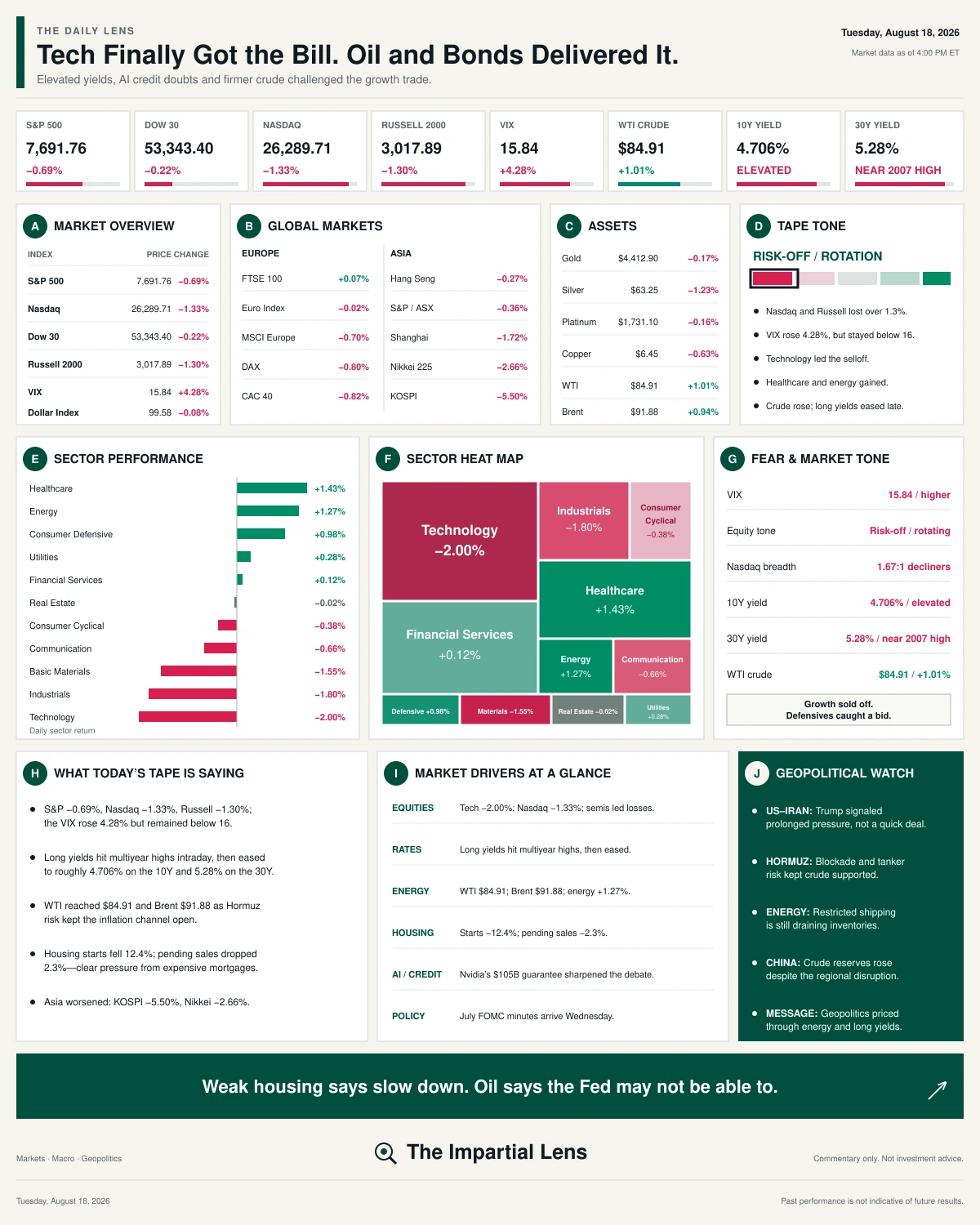
The Nasdaq fell 1.33% as elevated borrowing costs, questions surrounding AI financing, and worsening housing data challenged the market’s most comfortable assumptions.
Tuesday was not a market crash. It was an overdue reality check.
Technology shares have spent months behaving as though high interest rates were somebody else’s problem. Oil has been treated as a geopolitical nuisance rather than an inflation threat. Weak economic data has routinely been welcomed because it might encourage the Federal Reserve to ease policy.
On Tuesday, those stories collided.
The Nasdaq fell 1.33%, the Russell 2000 lost 1.30%, and the S&P 500 declined 0.69%. The Dow escaped with a relatively modest 0.22% loss.
The VIX rose 4.28%, but finished at just 15.84. Investors became more nervous, but they were hardly running for the exits.
That distinction matters. This looked less like panic and more like a reassessment of what investors should be willing to pay for growth.
Technology Meets the Cost of Money
Technology was the clear casualty, falling 2.00%. The semiconductor index sank roughly 5%, while Nvidia lost 2.3% and Micron fell 7%.
The explanation is surprisingly simple: stocks weakened because bond yields rose.
Long-term yields reached multiyear highs during the session. The 30-year Treasury briefly touched its highest level since 2007, while the 10-year reached its highest since January 2025. Both eased later, with the dashboard showing the 10-year around 4.71% and the 30-year at 5.28%.
Higher yields hurt expensive technology shares in two ways.
First, investors can earn a respectable return from government bonds without accepting the uncertainty of a high-priced stock. Second, higher rates make profits expected many years from now less valuable today.
That matters enormously for AI companies, whose valuations assume years of rapid growth.
The financing behind that growth is also becoming harder to ignore. Nvidia has agreed to provide guarantees of up to $105 billion to support an enormous Ohio data-centre project for OpenAI. The commitment may help the project borrow more cheaply, but it also shows how deeply chip suppliers, data-centre developers and AI customers are becoming financially intertwined.
The AI boom is no longer simply about selling more chips. It is becoming a vast financing operation—and investors are beginning to ask who carries the risk if demand disappoints.
Housing Is Showing the Damage
Tuesday’s housing numbers showed what expensive borrowing already looks like in the real economy.
Housing starts plunged 12.4% in July and were 13.5% lower than a year earlier. Single-family starts declined 9.9%. Building permits rose, which offered some hope, but a permit is a plan. A housing start is actual construction. U.S. Census Bureau
Pending home sales also fell 2.3% in July and 2.2% from a year earlier, reaching their lowest level since January. Contract signings declined in every region.
Perhaps the most revealing number is this: pending contracts remain 30% below their 2019 level, even though employment is 5% higher.
There are potential buyers. They simply cannot comfortably afford today’s combination of high prices and high mortgage rates.
The broader economy is not collapsing. Industrial production and manufacturing output both increased 0.2% in July. But housing is sending a clear message: elevated rates are biting.
Oil Complicates the Rescue Plan
Normally, weaker housing would pull yields lower and make easier Fed policy more likely.
Oil is complicating that calculation.
Crude gained 1.01% to $84.91, while Brent rose 0.94% to $91.88. The continuing confrontation over the Strait of Hormuz means energy prices are carrying a geopolitical premium that monetary policy cannot easily remove.
The Energy Information Administration expects restricted Hormuz shipments to keep inventories under pressure and oil prices elevated in the coming months.
That leaves the Fed facing an unpleasant mix: interest-sensitive parts of the economy are weakening, while higher energy costs threaten to keep inflation alive.
Cut rates too readily, and inflation could regain momentum. Keep policy tight and housing, consumers and highly leveraged businesses face more pressure.
There is no painless option.
This Was a Rotation, Not Capitulation
Underneath the red indexes, investors were making clear choices.
Technology fell 2.00%, industrials lost 1.80%, and basic materials declined 1.55%. Meanwhile, healthcare gained 1.43%, energy rose 1.27%, and consumer defensives added 0.98%.
Money moved away from expensive growth and toward businesses considered more resilient—or likely to benefit from higher energy prices.
The weakness was also global. Korea plunged 5.50%, Japan fell 2.66%, and Shanghai declined 1.72%. European markets were broadly lower, although the FTSE 100 managed a fractional gain.
What to Watch Next
Wednesday’s Federal Reserve minutes will show how concerned policymakers are about the tension between inflation and slowing growth. The minutes cover a meeting at which the Fed held rates steady, while three officials preferred another increase. Federal Reserve
Investors should also watch three things:
- Whether the 10-year and 30-year yields resume climbing.
- Whether oil and diesel prices continue feeding inflation concerns.
- Whether weakness spreads beyond semiconductors and other crowded technology trades.
The Impartial Lens
Tuesday’s decline was not frightening because the S&P 500 lost 0.69%.
It was important because several assumptions were challenged simultaneously.
High rates are hurting housing. Rising oil is limiting the Fed’s freedom to respond. AI investment increasingly depends upon enormous and complicated financing arrangements. And technology valuations still leave very little room for disappointment.
For months, technology ignored the cost of money.
The bill may finally have arrived.