
Oil remained above $105, a weak Treasury auction exposed fragile demand for US debt, and stocks fell ahead of the Federal Reserve. Wall Street’s inflation problem is no longer coming from one direction.
What Today’s Tape Is Saying
The bond market finally reached the line Wall Street had spent weeks watching.
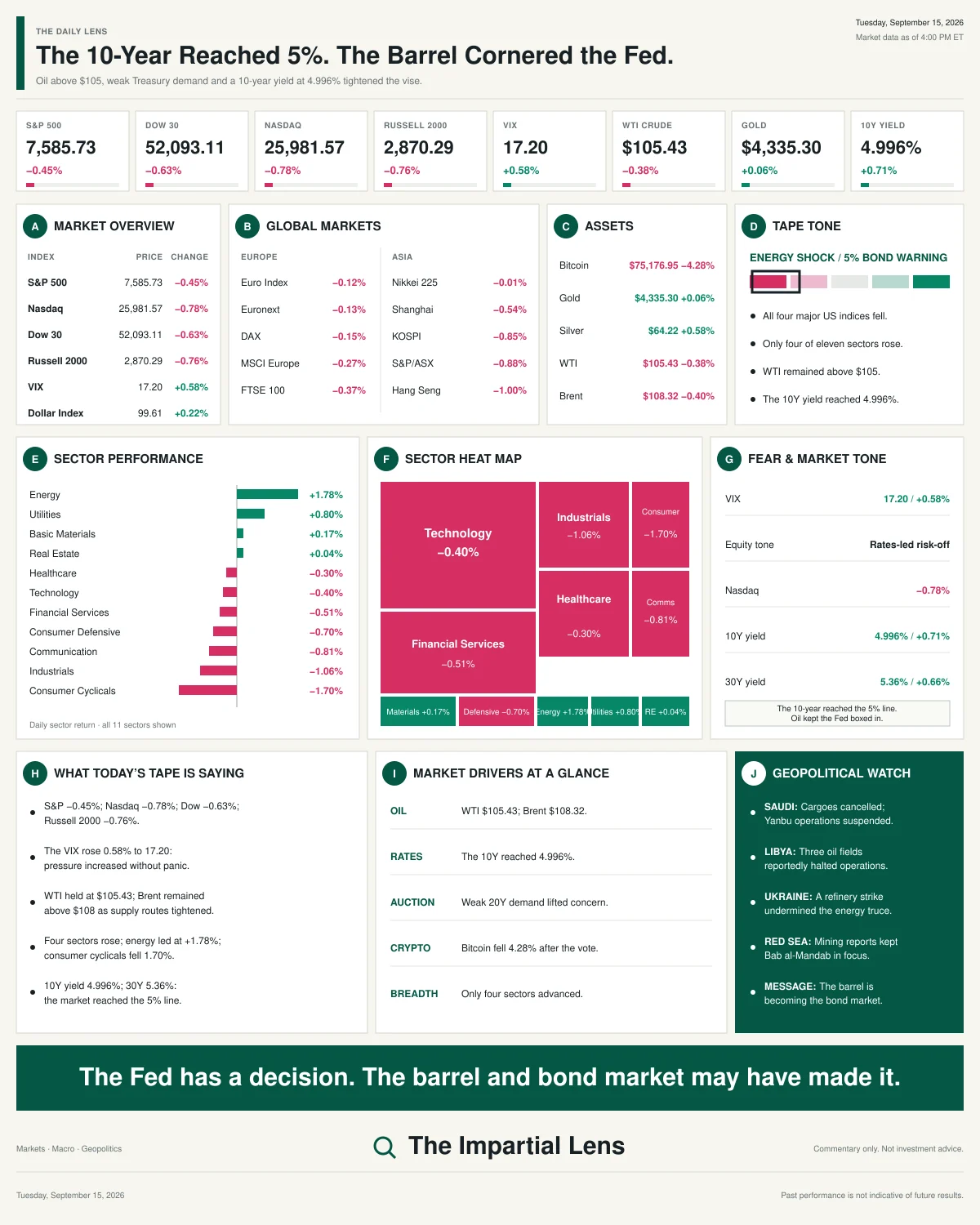
The 10-year Treasury yield closed at 4.996%—5% in everything but typography. The five-year reached 4.826%, while the 30-year climbed to 5.36%.
Stocks responded accordingly.
The S&P 500 fell 0.45%, the Dow lost 0.63%, the Nasdaq declined 0.78%, and the Russell 2000 dropped 0.76%. The VIX rose only 0.58% to 17.20, suggesting pressure rather than panic.
But the pressure was widespread.
Technology, financial services, industrials, communication services, healthcare, consumer cyclicals and consumer defensive stocks all finished lower. Only four of the eleven major sectors advanced.
Energy gained 1.78%. Utilities rose 0.80%. Basic materials added 0.17%, and real estate managed a 0.04% increase.
This was not a market embracing economic acceleration.
It was a market seeking protection from expensive energy and expensive money.
The Oil Price Fell. The Energy Problem Grew.
WTI slipped 0.38% to $105.43, while Brent declined 0.40% to $108.32.
Those small losses create the wrong impression.
Oil did not become cheap on Tuesday. It remained extremely expensive while the infrastructure required to produce, refine and transport it encountered new problems.
Newsquawk’s market wrap reported that Libya’s National Oil Corporation suspended production and operations at three oil fields. Saudi Arabia also cancelled some European crude cargoes and suspended activity at the Red Sea port of Yanbu.
The significance extends beyond the temporary loss of individual barrels.
Saudi Arabia’s East-West pipeline was designed to move crude from the kingdom’s eastern fields to the Red Sea, allowing exports to bypass the Strait of Hormuz. Yanbu is the outlet that makes that alternative route useful.
The pipeline has been attacked.
The port has suspended operations.
Hormuz remains exposed.
The same market report said Houthi forces were digging trenches near Bab al-Mandab and placing mines in surrounding waters, introducing another threat to the southern entrance of the Red Sea.
The routes intended to provide redundancy are becoming part of the same conflict.
That is why the market cannot evaluate each incident separately. Libya, Hormuz, Yanbu, and Bab al-Mandab are different locations, but they all feed the same global energy system.
Damage one route and cargoes can be redirected.
Pressure several routes simultaneously and the spare capacity of the entire network begins to shrink.
Ukraine Broke the Energy Truce
The other pressure point sits farther north.
Ukraine reportedly struck another Russian refinery despite President Trump’s announcement that Russia and Ukraine had agreed to stop targeting energy infrastructure.
If confirmed, the attack matters for more than the credibility of the proposed truce.
The global market does not have only a crude-oil problem. It has a refining problem.
Russia may continue pumping oil while losing some capacity to convert that crude into diesel, gasoline and other usable fuels. Saudi Arabia may have crude available while damaged pipelines and suspended port operations limit where it can be loaded.
Consumers cannot put crude oil into trucks, tractors, ships or delivery vans.
They need refined products.
That is why US lawmakers are reportedly considering proposals to restrict diesel exports.
Restricting exports may appear to protect domestic consumers, but it would not create additional refining capacity. It would redistribute a shortage and potentially shift price pressure onto allies already paying heavily for fuel.
An export ban can move the pain.
It cannot refine another barrel.
Iran threatens passage through Hormuz. The Houthis threaten access through Bab al-Mandab. The Saudi pipeline attack threatens the bypass. Ukraine’s refinery campaign threatens the supply of finished fuel.
Different wars.
Different infrastructure.
One global fuel bill.
The Treasury Auction Delivered Its Own Warning
Energy was only half of Tuesday’s problem.
A weak auction of 20-year US Treasury bonds reportedly produced a large pricing concession and exceptionally poor foreign demand.
That matters because the United States must continuously refinance existing debt while issuing additional debt to fund new deficits. Washington does not merely need buyers. It needs buyers at prices the government can afford.
When demand weakens, yields rise until investors are persuaded to participate.
Those higher yields then flow through the economy.
Mortgage rates remain elevated. Corporate refinancing becomes more expensive. Commercial-property valuations face greater pressure. Growth companies must discount future profits at a higher rate. The federal government pays more to service its debt.
The 10-year yield reaching 4.996% was therefore not just another market milestone.
It was the market assigning a higher price to time, risk and credibility.
Monday’s article argued that the bond market was standing on the 5% line.
Tuesday showed why the line mattered.
Oil can create the inflation pressure that keeps yields elevated. Weak demand for government debt can push those yields higher independently. When both occur together, the Federal Reserve loses the luxury of addressing one problem at a time.
The Fed Can Change a Rate. It Cannot Repair the System.
The barrel is setting the inflation risk.
The auction is setting the price of money.
The Fed is being asked to control both.
The Federal Reserve now approaches its decision with the market pulling in opposite directions.
Raise rates and the Fed reinforces tightening already occurring through the Treasury market. Borrowing becomes more expensive for households, businesses and the government.
Hold rates steady, and investors may question whether policymakers are responding strongly enough to an energy-driven inflation threat.
Signal easier policy and the long end of the bond market may revolt, pushing yields higher if investors believe inflation will be tolerated.
The Fed controls the overnight policy rate.
It cannot reopen Libya’s oil fields.
It cannot repair Saudi Arabia’s pipeline.
It cannot guarantee safe passage through Hormuz or Bab al-Mandab.
It cannot stop Ukrainian refinery attacks.
It cannot force foreign investors to buy 20-year Treasury bonds.
The barrel is setting the inflation risk.
The auction is setting the price of money.
The Fed is being asked to control both.
Crypto Received a Washington Reminder
Bitcoin fell 4.28% to $75,176.95 after the Senate failed to advance the CLARITY Act.
The legislation was expected to provide a clearer regulatory framework for digital assets. Its failure to secure the required votes removed some of the optimism that had supported Bitcoin on Monday.
The reversal was sharp.
Bitcoin rose 2.43% on Monday as expectations for legislative progress improved. It surrendered that gain and more on Tuesday when the political path narrowed.
That was a useful reminder that crypto does not trade outside the system.
It may be decentralized in design, but its market value still responds to legislation, liquidity, interest rates and political decisions in Washington.
What to Watch
Wednesday belongs to the Federal Reserve, but the announcement alone will not settle the argument.
Watch the 10-year yield after the decision. A policy-rate increase accompanied by falling long-term yields would suggest the market believes the Fed is restoring inflation credibility.
A rate increase followed by another rise in long-term yields would send a more troubling message: the bond market believes the Fed remains behind the problem.
Also watch Brent near $110, Saudi operations at Yanbu, Libyan production, Russian refinery capacity and any evidence of mining or military escalation near Bab al-Mandab.
Yesterday, the 10-year stood at the 5% line.
Today, the oil network tightened, and Treasury demand weakened.
The Fed still has a decision to announce.
The barrel and the bond market may already have made it.
The Impartial Lens provides market commentary and education only. Nothing published here constitutes investment advice.