
The Federal Reserve raised rates for the first time since 2023. The 10-year Treasury crossed 5% anyway, the dollar surged, and Wall Street discovered that one rate increase cannot repair an energy shock.
What Today’s Tape Is Saying
The Federal Reserve finally did what the bond market had been demanding.
It raised the federal-funds target range by 25 basis points to 3.75%–4.00%, delivering its first rate increase since 2023. Policymakers also signaled that another increase could follow before the end of the year.
Wall Street sold the news.
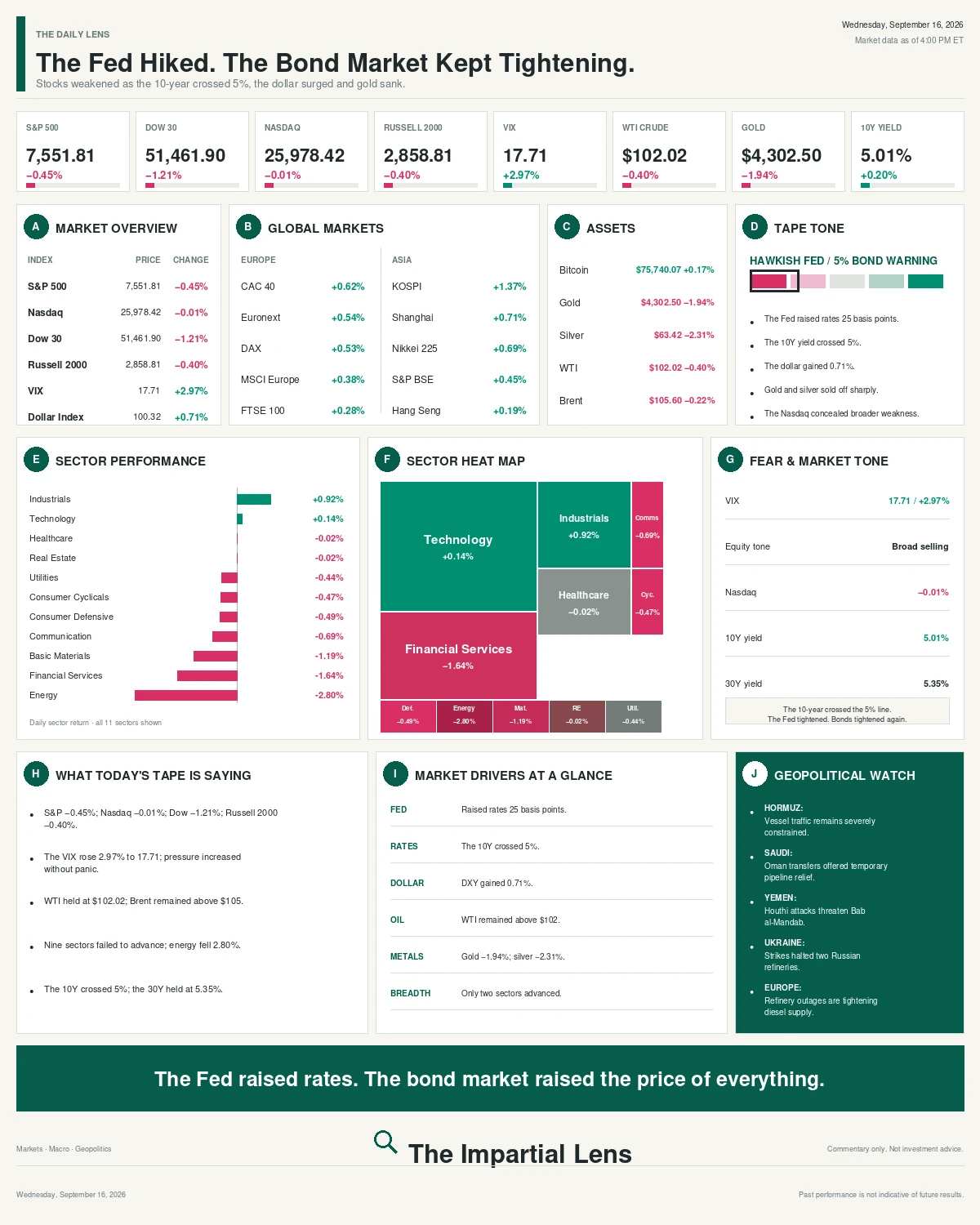
The S&P 500 fell 0.45%, the Dow dropped 1.21%, and the Russell 2000 declined 0.40%. The Nasdaq finished almost perfectly flat, slipping just 0.01%, but that apparent resilience concealed much broader weakness.
The VIX rose 2.97% to 17.71. The dollar index jumped 0.71% to 100.32.
Then came the number that mattered most.
The 10-year Treasury yield crossed 5%, reaching 5.01%. The five-year climbed to 4.859%, while the 30-year remained at 5.35%.
The Fed raised the overnight rate.
The bond market raised the price of money across the economy.
The Fed Can Raise Rates. It Cannot Reopen a Strait.
The Fed’s problem is not simply that inflation remains above target. It is where the inflation pressure is coming from.
August retail sales increased 1.2% to $773.9 billion, according to the US Census Bureau. That suggests consumers are still spending despite falling confidence and rising borrowing costs.
Meanwhile, Bureau of Labor Statistics data showed import prices rising 0.7% in August and export prices increasing 0.6%. Over twelve months, import prices were up 7%, and export prices had climbed 8.6%.
That is an uncomfortable combination for the Fed: demand has not broken, imported inflation is accelerating, and energy remains vulnerable to war.
WTI crude slipped 0.40% on Wednesday but remained at $102.02. Brent fell 0.22% to $105.60.
Oil declined because traders received evidence that Saudi Arabia was finding ways to move additional crude through Oman and could partially restore its damaged East–West Pipeline. Reuters reported that Saudi crude was being offered through ship-to-ship transfers near Sohar, providing an alternative to the disrupted route toward Yanbu.
That is relief.
It is not resolution.
Visible vessel passages through the Strait of Hormuz reportedly fell to four on Tuesday, compared with a ten-day average of 18. Yanbu loadings were disrupted after attacks damaged the pipeline that Saudi Arabia had been using to bypass Hormuz.
The market celebrated an improvised workaround while the world’s most important oil artery remained severely constrained.
A central bank can suppress demand. It cannot repair a pipeline, escort every tanker or negotiate peace in the Gulf.
The Market Did Not Believe This Was One and Done
Wednesday’s reaction exposed the difference between a policy rate and financial conditions.
The Fed controls the interest rate banks charge one another overnight. Longer-term Treasury yields are determined by investors weighing inflation, economic growth, government borrowing, and the compensation required to hold US debt.
Those investors pushed the 10-year through 5% even after the Fed tightened.
That matters because the 10-year influences mortgage rates, corporate borrowing costs and the discount rate applied to future earnings. A company does not need to borrow directly from the Fed to feel the effect. A homebuyer does not need to understand the yield curve to receive a more expensive mortgage quote.
The sector map showed that pressure was spreading.
Energy fell 2.80% as oil retreated. Financial services lost 1.64%, basic materials dropped 1.19%, communication services declined 0.69% and consumer cyclicals fell 0.47%.
Industrials gained 0.92%, while technology edged 0.14% higher. Technology’s enormous market weight helped keep the Nasdaq near flat even as most of the market weakened.
That is not a healthy broadening of the rally.
It is an index being protected by its largest components.
Gold Met the Stronger Dollar
Gold fell 1.94% to $4,302.50, while silver dropped 2.31%.
That does not mean geopolitical risk disappeared. It means gold faced two immediate competitors: a stronger dollar and higher bond yields.
Gold produces no income. When investors can earn approximately 5% from a 10-year Treasury while the dollar is rising, holding gold becomes more expensive in opportunity-cost terms.
The same asset can still benefit from war, fiscal anxiety, and distrust of paper currencies over the longer term while falling sharply when monetary conditions tighten.
Gold did not reject the geopolitical story.
It reacted to the interest-rate story first.
Ukraine and Iran Are Feeding the Same Diesel Market
Iran and Ukraine are not separate market stories.
One is constraining shipping routes. The other is damaging refining capacity.
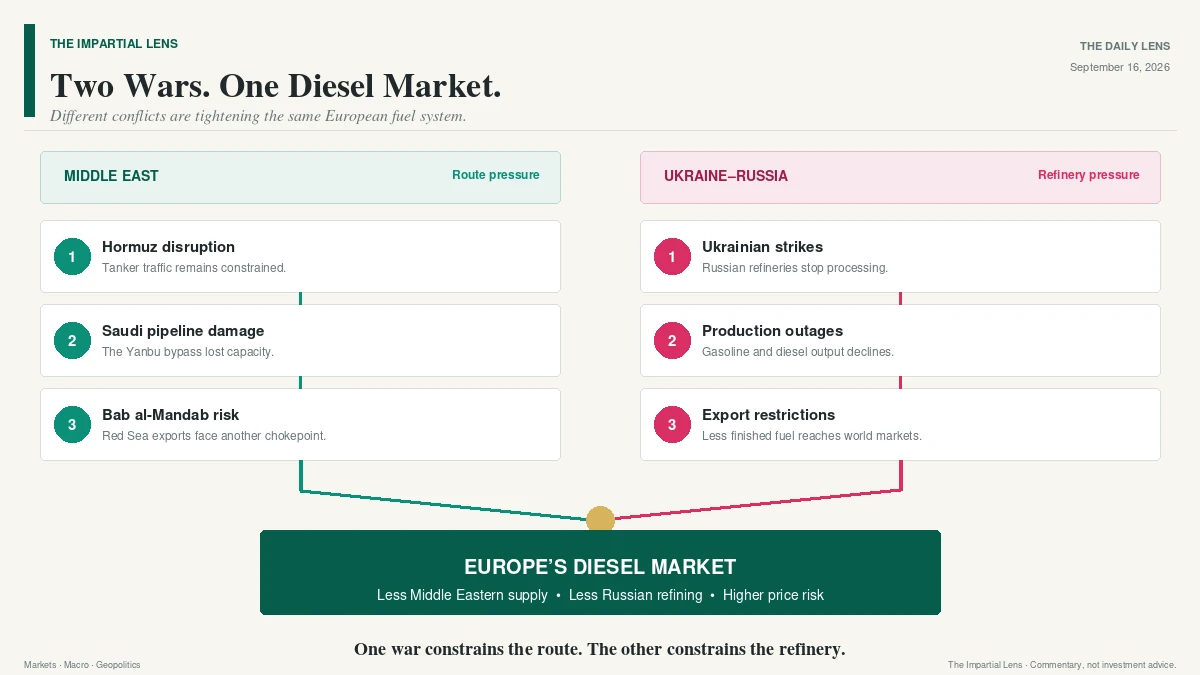
Reuters reported that Russia’s Syzran and Saratov refineries stopped processing after Ukrainian drone attacks. Syzran’s main crude-distillation unit, which represents roughly 71% of its capacity, was damaged, and repairs are expected to take at least a month.
The shutdowns add to Russian domestic fuel shortages and complicate supplies of gasoline, diesel and jet fuel. Moscow has already restricted fuel exports.
At the same time, Europe has lost part of its normal diesel and jet-fuel supply from the Middle East. European gasoil futures—a key diesel benchmark—reached record levels this week.
That is the connection markets cannot afford to miss.
The Strait of Hormuz affects crude moving out of the Gulf. Bab al-Mandeb threatens the route into the Red Sea. Attacks on Saudi Arabia’s East–West Pipeline threaten the principal land-based bypass. Ukrainian strikes on Russian refineries reduce the supply of finished fuels reaching the market from the other direction.
One war constrains the route.
The other constrains the refinery.
Europe sits between them.
European equities finished Wednesday higher, with France gaining 0.62%, the DAX rising 0.53%, the Euro Stoxx advancing 0.48% and the FTSE 100 adding 0.28%. But that market performance should not be confused with energy security.
Europe can rally for a day while its diesel problem worsens structurally.
The War Is Spreading Beyond the Barrel
The geopolitical risk also moved beyond energy infrastructure.
Saudi Arabia said it intercepted a Houthi drone south of Mecca before it entered restricted airspace. The Saudi-led coalition called the security of Islam’s holy sites a red line, while the Houthis denied threatening Mecca. Reuters reported that the confrontation followed a week of attacks drawing Saudi Arabia more deeply into the regional conflict.
The Houthis now control sections of Yemen’s Red Sea coast overlooking Bab al-Mandeb. That means the same forces pressuring Saudi territory are positioned beside the shipping route Saudi Arabia needs when Hormuz is constrained.
This is why a modest decline in crude should not be mistaken for normalization.
Oil fell because an alternative route appeared more workable.
The number of vulnerable routes did not decline.
What to Watch
Three signals matter next.
First, watch whether the 10-year holds above 5%. Crossing the line is important. Remaining above it would begin repricing mortgages, corporate debt and equity valuations more decisively.
Second, watch Saudi export flows rather than repair promises. Partial pipeline capacity and ship-to-ship transfers can relieve pressure, but neither replaces normal passage through Hormuz.
Third, watch diesel. Crude oil attracts the headlines, but diesel moves trucks, farms, factories, and military logistics. If refinery outages and export restrictions keep diesel elevated, inflation can continue spreading even if crude temporarily falls.
Wednesday was supposed to be about the Fed reclaiming control.
Instead, the day revealed the limits of monetary policy.
The Fed can raise rates.
It cannot reopen Hormuz, secure Bab al-Mandeb, rebuild a Saudi pipeline, or stop Ukrainian drones from striking Russian refineries.
Washington tightened by 25 basis points.
The world tightened everything else.
The Impartial Lens provides market commentary and education only. Nothing published here constitutes investment advice.