Stocks surged as the 10-year retreated below 5% and crude eased toward $100. But the energy system remained under pressure, reminding investors that relief is not the same as resolution.
What Today’s Tape Is Saying
Wall Street bought the reprieve.
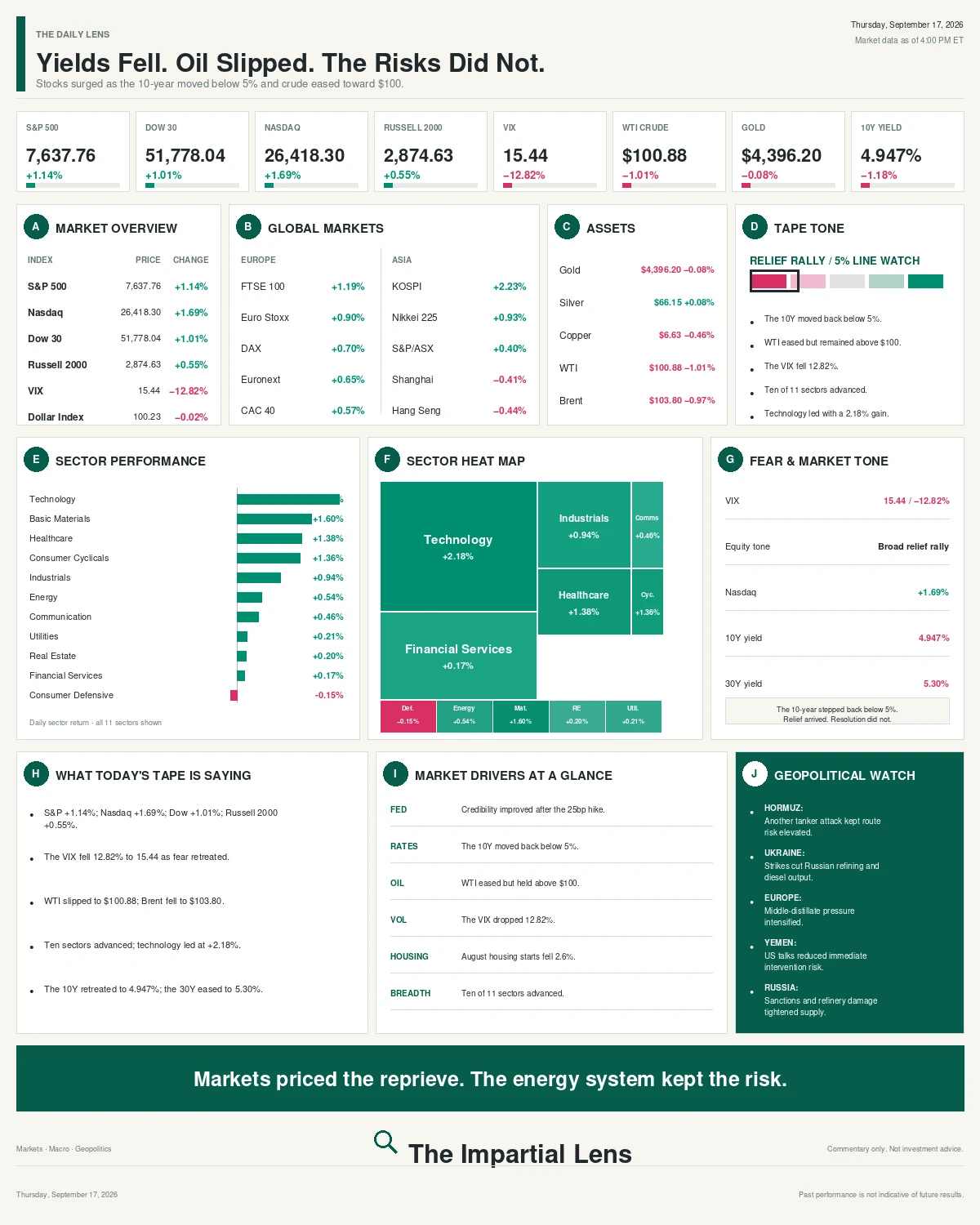
The Nasdaq climbed 1.69%, the S&P 500 gained 1.14%, and the Dow advanced 1.01%. The Russell 2000 added a more modest 0.55%, while the VIX fell 12.82% to 15.44.
The rally was broader than technology alone. Ten of the eleven major sectors advanced. Technology led with a 2.18% gain, followed by basic materials at 1.60%, healthcare at 1.38% and consumer cyclicals at 1.36%. Consumer defensives were the only sector to finish lower.
That matters because it contradicts the easy claim that the index was simply being carried by a handful of technology companies. Thursday’s participation was real.
But it was also conditional.
WTI crude fell 1.01% to $100.88. Brent declined 0.97% to $103.80. The 10-year Treasury yield retreated to 4.947%, moving back below the 5% line that had unsettled markets one day earlier.
Oil reduced inflation pressure.
Bonds reduced the valuation pressure.
Stocks responded to both.
The Fed Bought Credibility. The Market Bought Duration.
The Federal Reserve raised its target range by 25 basis points to 3.75%–4.00%, stating that economic activity remained solid, domestic spending resilient and inflation elevated. The decision was unanimous, according to the Federal Reserve’s September statement.
The initial reaction was hostile. Treasury yields rose, gold fell, and equities weakened as investors confronted the possibility that the hike would not be a one-time event.
Thursday reversed much of that move.
The bond market appeared more willing to believe that the Fed would defend price stability. Lower yields then gave growth stocks—and especially technology—room to recover.
That does not invalidate Wednesday’s warning in The Fed Hiked. The Bond Market Kept Tightening. It clarifies it.
The Fed controls the overnight rate. The market controls the rates that reprice mortgages, corporate debt, and equity valuations. On Thursday, those two forces temporarily moved in the same direction.
The Economy Is Sending Conflicting Signals
The Fed’s task remains difficult because the economy is not weakening evenly.
New housing starts fell to an annualized rate of 1.275 million in August, a 2.6% monthly decline, according to the U.S. Census Bureau’s economic indicators. Housing is already absorbing the effects of high borrowing costs through weaker construction, reduced affordability, and depressed builder confidence.
Other parts of the economy remain considerably firmer.
That leaves the Fed facing an awkward combination: enough resilience to preserve inflation pressure, but enough rate sensitivity to create stress in housing and other credit-dependent sectors.
The economy is not simply strong or weak.
It is dividing according to who needs to borrow.
Oil Fell. The Physical Risk Did Not.
Crude’s decline permitted markets to relax, but it did not repair the energy system.
The U.S. Energy Information Administration has documented how disruptions around Bab al-Mandeb lengthen shipping routes and raise freight costs. The International Energy Agency continues to monitor the Strait of Hormuz because of its importance to global oil and gas flows.
Those waterways are only one side of the problem.
Ukraine is attacking the refining capacity that turns crude into gasoline, diesel and jet fuel. The International Energy Agency reported that Russian refinery throughput fell to 3.8 million barrels per day in June—roughly 30% below the previous year—while diesel production was estimated to have fallen by nearly 30%.
Russia historically exported approximately half of its diesel and gasoil output. It has now restricted those exports to defend domestic supply.
The consequences extend well beyond Russia.
The IEA estimates that combined Middle Eastern and Russian diesel exports fell 75% from a year earlier in August. Diesel refining margins climbed above $100 per barrel in both the U.S. Gulf Coast and Northwest Europe.
That is the connection markets cannot afford to miss.
Iran and the Middle East threaten the routes.
Ukraine threatens the refineries.
Europe sits between them.
As we argued in The World’s Arteries Are Now in Focus, the global economy depends on a surprisingly small number of ports, straits, pipelines and processing facilities. The current crisis is no longer concentrated in one chokepoint. Pressure is spreading across the alternatives.
What to Watch
Three signals matter next.
First, watch whether the 10-year can remain below 5%. A one-day retreat changes positioning; a sustained retreat changes financial conditions.
Second, watch WTI around $100. Falling below that level would improve the inflation narrative. Remaining above it would preserve the risk that energy works its way through transportation, manufacturing, and consumer prices.
Third, watch diesel rather than crude alone. Crude attracts the headlines, but diesel moves trucks, factories, farms and military logistics. A falling barrel price cannot fully offset a shortage of refining capacity.
Thursday showed how quickly markets can reprice relief.
It did not show that the pressure had disappeared.
Yields fell. Oil slipped. Stocks rallied.
The system received a reprieve—not a repair.
The Impartial Lens provides market commentary and education only. Nothing published here constitutes investment advice.