Amazon was reportedly taking delivery of billions in AI hardware before some data centers had enough power to switch it on. Britain was sending fighters to defend Saudi Arabia. American homebuyers were disappearing from the market. On Wall Street, almost everyone except technology was having a good Tuesday.
The Daily Lens | Tuesday, October 20, 2026
Somewhere in America’s extraordinary artificial-intelligence construction boom, a very expensive piece of equipment is apparently waiting for something considerably less glamorous than a new algorithm.
Electricity.
According to internal documents reviewed by Business Insider, Amazon has been arranging early deliveries of Nvidia server racks to warehouses while some AWS data-center sites await the power capacity needed to run them.
It is an almost perfect image of the present economy: the technology is advancing at extraordinary speed, the money is moving almost as quickly, and the physical world is struggling to keep up.
The same tension appeared elsewhere on Tuesday. War was threatening energy infrastructure in the Middle East. Europe faced expensive gas ahead of winter. American homebuyers were backing away from mortgages. And investors were rediscovering an interest in businesses beyond the AI boom.
Tuesday was a good day to remember that you cannot borrow, promise or negotiate a megawatt into existence.
The $5 Billion Waiting Room
Business Insider’s report described an Amazon program intended to secure approximately $5 billion in Nvidia GB300 racks, with further deliveries anticipated. Some equipment was reportedly staged at intermediate locations because the intended facilities could not yet supply the required electricity.
That does not mean every Amazon AI server is sitting idle. The company already operates substantial computing infrastructure, and buying equipment before a facility opens can be a rational way to secure scarce supplies.
But it changes the question investors ought to ask.
Having the chips is not the same as having a functioning data center. You also need substations, transformers, cooling systems, grid connections, permits and somebody prepared to buy the computing power once it is available.
Axios reported on a Goldman Sachs analysis projecting a 170% increase in worldwide data-center electricity demand from 2025 to 2030. That is a forecast, not installed capacity. The actual construction of power infrastructure faces local opposition, long lead times and costs that do not fall just because a chip becomes faster.
AI may eventually deliver enormous economic value. But its physical foundations are proving considerably harder to scale than its promises.
The War Was Still Charging for Electricity
On Tuesday, Britain’s Ministry of Defence announced RAF Typhoon patrols to protect Saudi cities and infrastructure against aerial attacks by Yemen’s Houthis.
London said the aircraft would operate defensively rather than carry out offensive strikes against the Houthis. The support also includes advisers, a transport aircraft and continued refueling assistance to Saudi forces.
That distinction matters. A defensive deployment is not an announcement that Britain is launching a new bombing campaign. It is nevertheless another sign of how many governments are becoming entangled in a regional security problem.
Meanwhile, reports circulated of a possible compromise proposal intended to bring Washington and Tehran closer to an agreement. Iranian officials pushed back against suggestions that a deal was imminent. The underlying disputes over nuclear enrichment, sanctions and trust remain substantial.
Talk of a diplomatic breakthrough is welcome when it rests on something concrete. But an unaccepted proposal cannot escort a ship safely through the Gulf or protect an airport from a missile.
Nor does a brief fall in an oil quotation guarantee cheaper delivered energy. Brent was still about $109.95 a barrel, up 1.07% at that reading.
Europe’s Gas Bill Came With a Footnote
The war involving Iran was also finding its way into European homes and factories.
On Tuesday, Europe’s main wholesale natural-gas benchmark, the Dutch Title Transfer Facility (TTF), was trading around €88–€90 per megawatt-hour, far above its level before the war.
But what does a war in the Persian Gulf have to do with the price of heating a home in France or running a factory in Germany?
Quite a lot, as it turns out.
Qatar is one of the world’s largest exporters of liquefied natural gas (LNG). Its tankers must pass through the Strait of Hormuz to reach international markets. When conflict threatens that passage, buyers in Europe and Asia compete for the supplies available elsewhere.
And competition for scarce supplies tends to have one predictable consequence.
Higher prices.
Those wholesale costs can eventually work their way into European electricity bills, industrial production and household heating, just as winter approaches.
But there is an important distinction.
Europe is not necessarily heading for a repeat of the 2022 energy crisis. As the Financial Times noted, Europe has reduced its gas consumption, diversified its suppliers and become less dependent on gas-fired electricity in some countries. Additional LNG capacity could provide further relief.
Europe is better prepared than it was four years ago.
But better prepared does not mean immune.
A continent can diversify its suppliers, build new infrastructure and reduce consumption. Yet when a conflict thousands of miles away threatens one of the world’s most important energy routes, its businesses and households can still face the consequences.
Europe hasn’t run out of gas. It’s being reminded how expensive it can become to keep it arriving.
America’s Missing Homebuyers
Tuesday’s most sobering economic release concerned an industry considerably older than artificial intelligence.
According to the National Association of Realtors, pending US home sales fell 7.3% in September and were down 11.3% from a year earlier. The index reached 66.0, its lowest reading since the series began in 2001.
These are contracts signed in September, not sales completed on Tuesday. The report measures an earlier stage in the housing transaction process, which helps explain why it can warn of weakness before closed sales are reported.
The main obstacle was painfully familiar: mortgages had become too expensive for many would-be buyers.
Consider the symmetry. Some of the world’s largest companies are competing to finance facilities that may not receive electricity for years. At the same time, families are struggling to finance houses that already exist.
These are not the same credit risks. But both are exposed to the price and availability of capital.
Wall Street Looked Beyond AI
While European households confronted rising energy bills and American buyers struggled with mortgage payments, Wall Street was enjoying a rather better Tuesday.
The Dow rose 1.02%, the S&P 500 gained 0.28%, and the smaller companies in the Russell 2000 jumped 1.65%. Yet the Nasdaq, home to many of the big technology names, slipped 0.02%.
Healthcare gained 2.46% and energy 2.33%, while technology fell 0.14%.
It was a market with plenty of buyers—just not always for the companies that had led the previous rally.
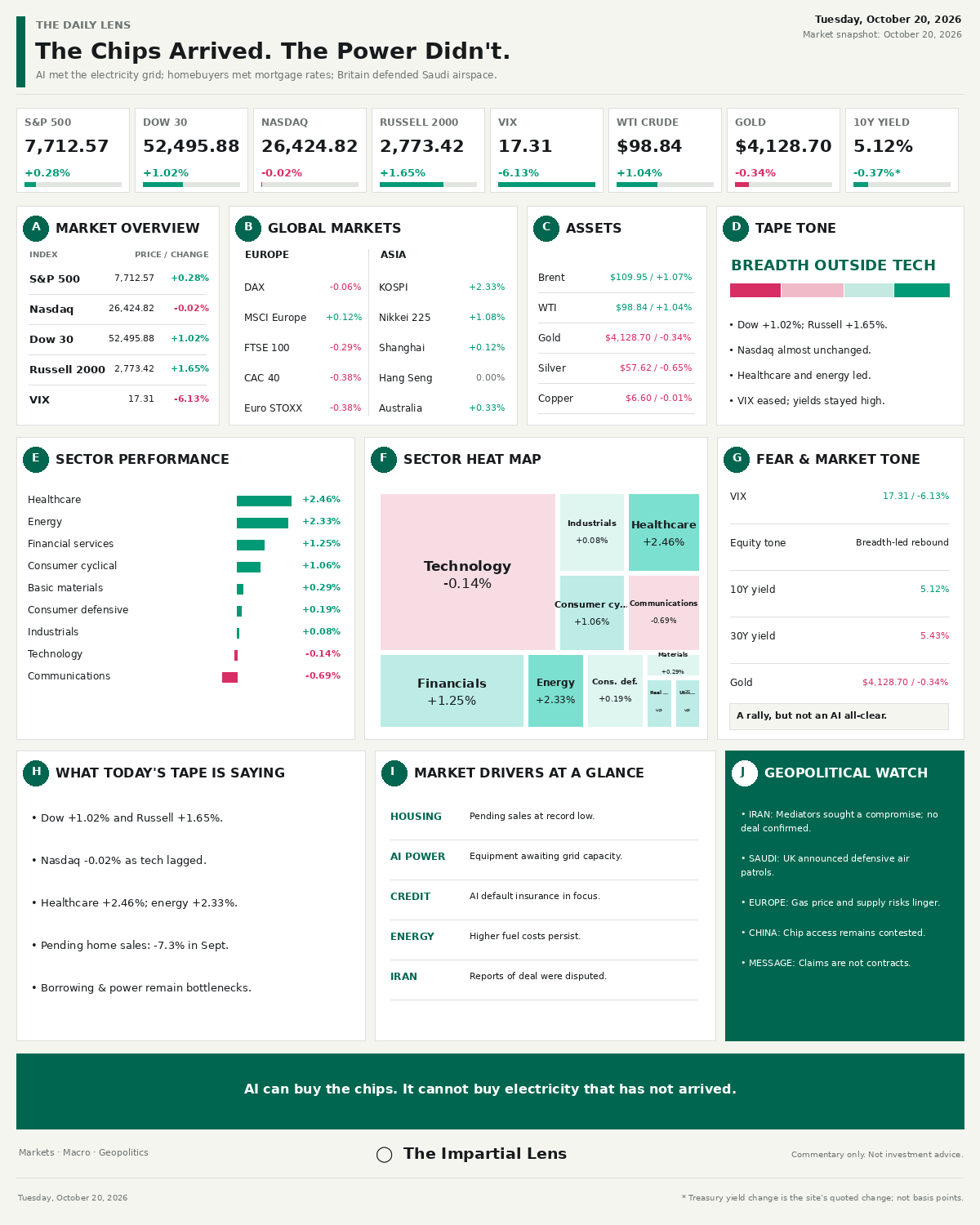
Traders have a name for that change of pace: rotation.
Money doesn’t always leave the stock market when investors lose enthusiasm for one group of companies. Sometimes it simply moves elsewhere.
Think of a relay race: the baton passes from technology to healthcare, energy or smaller businesses. The race continues, but the runners change.
Another useful word is breadth: how many stocks are rising, rather than how much a few giants are lifting an index.
The Dow beating the Nasdaq and several sectors outperforming technology suggest a shift in leadership. To measure breadth properly, though, we would also want to count the number of individual stocks advancing and declining. An index alone doesn’t tell the whole story.
There was a caution in the bond market, too.
The US 10-year Treasury yield was still about 5.12%. That is the return investors were demanding to lend to Washington for ten years—and an important reference point for borrowing costs throughout the economy.
Stocks may celebrate a change in mood; households and businesses still have to live with the price of credit.
One day of rotation doesn’t establish a lasting trend. But it teaches a habit worth developing:
Don’t just ask whether the market rose. Ask who led it, who lagged, and whether the change lasted.
What We’re Watching
Five developments that could make a difference to your money, your business and the cost of everyday life.
1. AI’s electricity bill. Can data centres get enough power to operate? Delays could hurt the companies funding the boom, while creating opportunities for power suppliers and infrastructure builders.
2. The price of peace. Real progress in the Middle East could ease pressure on oil and fuel prices. More attacks could send the bill in the opposite direction.
3. Europe’s winter. Expensive natural gas means higher costs for homes and factories. Can Europe keep supplies flowing without another painful energy squeeze?
4. America’s housing freeze. Lower mortgage rates might bring buyers back. If borrowing stays expensive, builders, banks and local businesses will feel it.
5. Wall Street’s changing favorites. Is money moving beyond big technology companies for more than a day? We’ll follow who’s leading the market—and what that might tell us about investor confidence.
The Lens
Tuesday was not a day when the stock market collapsed. Quite the opposite. The Dow rallied, small companies found buyers, and healthcare and energy outperformed.
But underneath the recovery, the economy’s hard constraints were still doing their work.
An AI company can order its next generation of processors. It still needs electricity and cooling. A diplomat can discuss a peace proposal. Ships and power stations still need security. A family can find a house it wants to buy. It still needs a mortgage it can afford.
We have become extraordinarily good at announcing the future and financing its construction.
Less good, perhaps, at acknowledging the plumbing that makes it possible.
You can promise a trillion dollars of tomorrow. You still have to connect it to the grid today.
The Impartial Lens provides market commentary and education only. Nothing published here constitutes investment advice.
Featured photograph: High-voltage substation at sunset, Salth Vader (2017), CC BY-SA 2.0. Illustrative photo, not an Amazon installation.
