Saudi Arabia postponed its grand investment gathering. France’s streets filled with protesters while investors demanded more to lend its government money. Washington loosened provisions of a new Russian sanctions law. Wall Street, meanwhile, found its appetite for technology stocks again.
The Daily Lens | Monday, October 19, 2026
The world’s financiers were supposed to be flying to Riyadh next week.
Bankers, executives and investors were preparing for Saudi Arabia’s Future Investment Initiative: four days of deals, introductions and reassurance that the kingdom’s future will involve rather more than pumping oil.
On Monday, the organizers postponed it until 2027.
It wasn’t a shortage of investment opportunities. It was a shortage of security.
Across the Mediterranean, France was struggling with another sort of confidence crisis. Violent unrest had damaged businesses and prompted curfews. Its government was already fighting over how to repair the public finances. Now bond investors wanted higher interest to finance them.
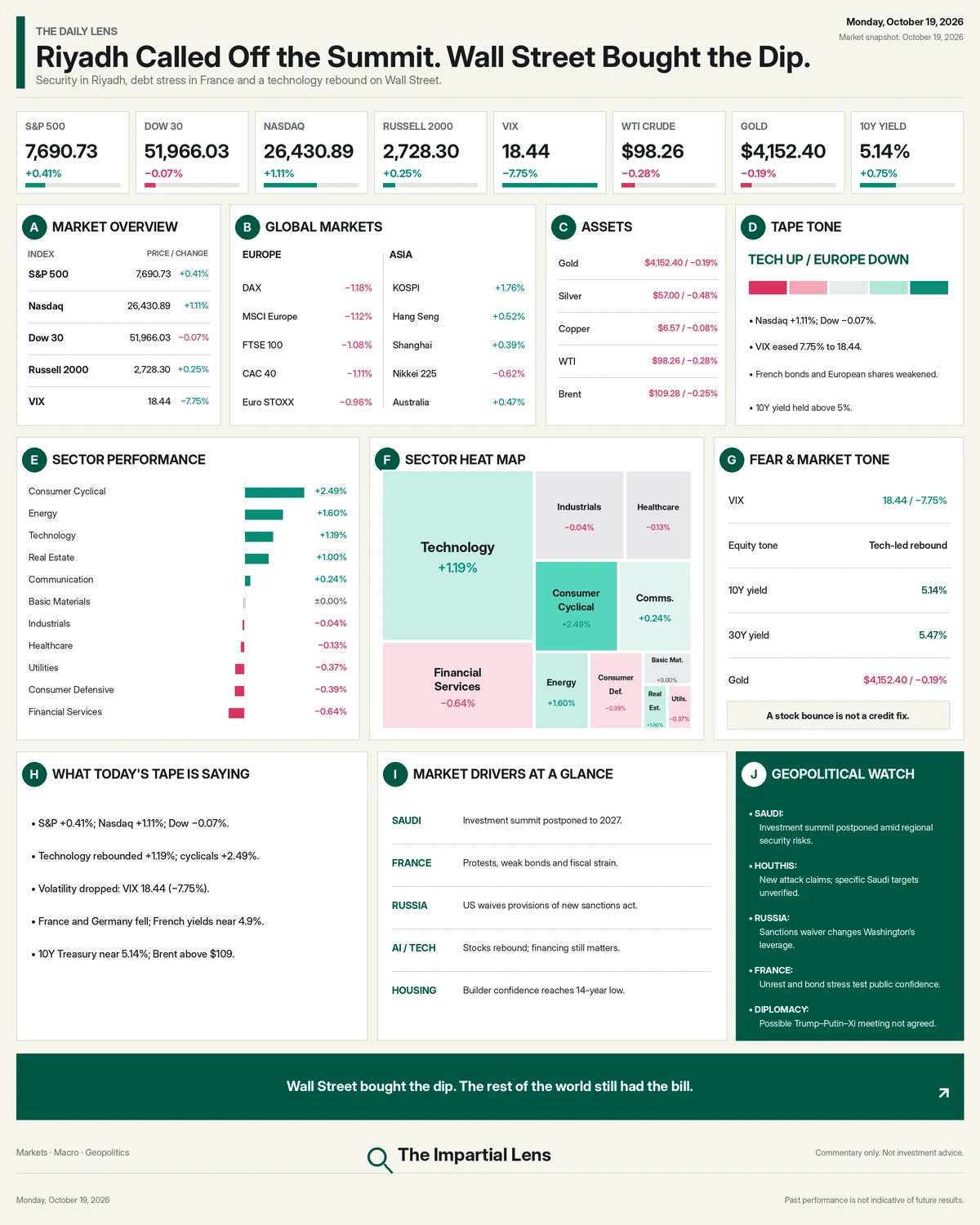
And across the Atlantic? The Nasdaq rose 1.11%. Investors were buying technology shares again after last week’s selloff.
Three scenes, one Monday, and a reminder worth keeping in mind: the stock market can regain its confidence in an afternoon. The physical economy doesn’t have that luxury.
Saudi Arabia’s Investment Party Meets Reality
The Future Investment Initiative — often described as “Davos in the Desert” — has become an important showcase for the kingdom’s ambitions. Saudi Arabia wants investment in tourism, technology, industry and finance to support its transformation beyond hydrocarbons.
It also needs international business leaders willing to travel, invest and believe that the country can provide a stable place to operate.
That was becoming a difficult promise to make.
Following a series of deadly attacks involving Yemen’s Iran-aligned Houthis, organizers confirmed that the October 26–29 conference would move to 2027. The decision followed mounting security concerns across the kingdom.
On Monday, the Houthis also claimed strikes against additional Saudi airports and energy facilities. Those specific claims had not been independently verified, so they should not be mistaken for confirmed damage.
But the widening regional conflict was hardly theoretical. In Yemen’s Shabwa province, a missile attack on a government security training camp killed dozens and injured more than 200 people. Reuters reported 58 deaths, citing the provincial governor; other contemporary reports put the toll lower. The Houthis claimed responsibility.
The economic damage extends far beyond oil prices. Airlines need safe airports. Construction companies need deliveries. International investors need confidence that people, equipment and contracts can cross borders without interruption.
Saudi Arabia has the capital and ambition to stage a major transformation. Monday showed that even an enormously wealthy government cannot buy its way out of every security problem.
Washington Discovered That Sanctions Have a Price
The geopolitical discomfort extended to Russia.
On October 16, President Trump signed an executive order waiving multiple sanctions and tariff provisions under the new Graham Act.
That does not mean the United States removed all its restrictions on Russia. Sanctions imposed under other authorities remain in force. But it does mean Washington has decided not to apply important measures created specifically to intensify economic pressure.
Only the previous week, the Treasury had authorized certain transactions involving Russian-origin diesel. The attraction was obvious: a world coping with disrupted refineries and dangerous shipping routes would welcome more usable fuel.
For Ukraine, the calculation looks different. Russian refineries help sustain Moscow’s military campaign and produce valuable revenue. Kyiv wants the freedom to damage them. Washington wants fuel prices contained.
Neither government is being irrational. Their priorities are simply colliding.
There was talk of another diplomatic opening on Monday. Trump said he was open to a meeting with Vladimir Putin and Xi Jinping, potentially on the sidelines of next month’s APEC gathering in China.
The president suggested nuclear weapons and denuclearization could be central topics. No meeting, agenda or peace settlement was agreed.
It would certainly be a remarkable photograph. It would be a mistake to treat the prospect of that photograph as an agreement to end a war.
France’s Problems Reached the Bond Market
Across Europe, a different confrontation was underway.
Protests over living costs, public services and other grievances escalated into violent disorder in several French cities. Businesses were looted, buildings were damaged and police imposed local restrictions to prevent further unrest.
Those who demonstrated peacefully and those who committed violent offences should not be casually lumped together. But the broader instability has placed enormous pressure on a government already struggling with debt, weak growth and an unsettled budget.
That pressure reached the bond market on Monday.
Reuters reported France’s 10-year government-bond yield climbing to around 4.9% intraday. Germany’s equivalent was around 3.45% at the time. That is a gap of roughly 1.45 percentage points between two governments borrowing in the same currency.
When bond prices fall, their yields rise. And when investors demand more compensation for lending to a government, refinancing debt can become more expensive.
France’s CAC 40 fell 1.11% in our Monday market snapshot, and Germany’s DAX lost 1.18%. Investors were not treating the unrest as a minor domestic inconvenience.
France cannot solve a budget problem merely by restoring order to the streets. Nor can it restore confidence in the public finances without dealing with the political backlash that spending and tax decisions can provoke.
The lesson is familiar to any indebted household: when borrowing becomes more expensive, yesterday’s financial decisions begin narrowing tomorrow’s choices.
Wall Street Bought a Different Story
For American shares, Monday looked much more cheerful.
| Market | Monday snapshot | Daily move |
|---|---|---|
| S&P 500 | 7,690.73 | +0.41% |
| Nasdaq | 26,430.89 | +1.11% |
| Dow Jones | 51,966.03 | −0.07% |
| Russell 2000 | 2,728.30 | +0.25% |
| VIX | 18.44 | −7.75% |
| Brent crude | $109.28 | −0.25% |
| 10-year Treasury yield | 5.14% | Yield level |
Source: supplied October 19 market overview. Figures reflect that market snapshot and may differ from official settlements or later readings.
Technology gained 1.19%. Consumer cyclical stocks climbed 2.49%. Energy rose 1.60%, even with crude oil a little lower on the day. Financial services fell 0.64%.
The VIX declined 7.75% to 18.44. Investors were less anxious about near-term equity-market swings. That is not the same thing as resolving the problems worrying them last week.
US Treasury yields made the distinction harder to ignore. The 10-year was around 5.14% on our screen and the 30-year near 5.47%. Borrowing remained expensive even as technology shares rallied.
Stocks can reprice hope much faster than debt can be repaid.
The AI Boom Still Needs Someone to Finance It
The previous week’s selling had brought the enormous financing needs of artificial intelligence back into focus. Advanced chips, data centres, cooling systems and electrical infrastructure do not pay for themselves.
On Monday, Goldman Sachs upgraded CoreWeave, a cloud-computing business whose heavy borrowing has become a barometer for the AI trade. Its shares initially rallied, yet finished slightly lower at $61.12. The broader Nasdaq rebound was real; a clean bill of health for every AI borrower was not.
There is a genuine argument on both sides. Demand for computing capacity is growing. Some customers are willing to make substantial commitments. But the lenders and shareholders funding that expansion need eventual returns, not simply exciting plans.
Another headline focused on a proposed $100 billion AI-and-energy development at the former uranium-enrichment site in Paducah, Kentucky. The scale is astonishing. The chronology matters: the Department of Energy announced the partnership in July, not on Monday.
The project remains a useful illustration of AI’s physical demands. Its proposed data centres would need dedicated power generation and infrastructure alongside the computers themselves.
It’s perfectly possible for artificial intelligence to change the world while some of the people financing it discover they’ve paid too much.
The American Dream Wasn’t Enjoying the Rally
While technology shares were recovering, American homebuilders delivered a far less cheerful assessment of the economy.
The National Association of Home Builders reported that builder confidence fell to 29 in October, its lowest reading since June 2012.
Mortgage rates above 7%, rising construction costs and weak buyer demand were weighing on the industry. In the survey, 43% of builders reported cutting prices and 65% were offering sales incentives.
Consider the contrast.
Investors can debate whether a hundred-billion-dollar data-centre plan is too ambitious. A family trying to buy its first house faces a much smaller but more immediate question: can we afford the monthly payment?
The technology boom and the housing market are not directly comparable investments. But they share one unavoidable constraint.
The price of money.
What to Watch
Saudi Arabia: Do attacks and airport disruptions ease enough for investors, airlines and businesses to regain confidence?
Russia, Ukraine and the United States: Do sanctions waivers and diesel licences actually change fuel supplies? Does the proposed trilateral diplomacy become anything more than a discussion?
France: Watch French government-bond yields and whether politicians can produce a credible budget without worsening the confrontation at home.
AI finance: Follow borrowing costs and actual contracts, not merely a one-day bounce in technology shares.
US housing: Builder sentiment, mortgage costs and buyer traffic will tell us how the wider economy is living with expensive credit.
The Lens
Saudi Arabia had investment ambitions to sell to the world. What it couldn’t promise on Monday was a risk-free journey to the meeting.
France had a budget to repair. Its citizens were protesting, its government was struggling and its lenders were charging more.
Washington wanted cheaper energy without giving up all its geopolitical leverage. Ukraine wanted to damage an adversary’s war economy. Those desires do not fit neatly together.
And Wall Street, after a punishing week, decided that the prospects for technology companies looked more attractive than they did on Friday.
Markets are allowed to look ahead. Sometimes they anticipate improvements long before those improvements are visible.
But Saudi Arabia still needs security. France still needs a credible budget. AI developers still need electricity and affordable financing. American families still need houses they can pay for.
None of those problems disappears because a share price has bounced.
Wall Street can buy the dip in an afternoon. The rest of the world still has to pay for the problems that caused it.
The Impartial Lens provides market commentary and education only. Nothing published here constitutes investment advice.
Featured image: Riyadh skyline (February 2018) by B.alotaby, CC BY-SA 4.0. Illustrative photograph; it does not depict the reported 2026 attacks. Image resized for publication.
