America told diplomats to leave Saudi Arabia. France’s lenders pushed its borrowing costs above 5%. And Meta revealed a quarterly investment bill approaching $35 billion. Wall Street looked at the same world and bought stocks.
The Daily Lens | Wednesday, October 21, 2026
In Riyadh, some American diplomats were packing their bags. In Paris, investors were demanding more interest to lend the government money. And in California, Meta was explaining what it costs to build the future.
Three places. Three very different problems. One question: who pays?
Meanwhile, the Nasdaq rose 1.05%. Markets were looking forward. The rest of the world was still paying for the present.
Riyadh’s Investors Needed More Than a Sales Pitch
Saudi Arabia wants to be known for technology, tourism and investment, not simply oil. But international business needs something even money cannot always guarantee: security.
That uncertainty had already forced the postponement of Riyadh’s international investment gathering, as we explored in Monday’s Daily Lens.
On Wednesday, the Associated Press reported that Washington had ordered nonessential diplomatic staff and some family members out of Saudi Arabia after attacks by Yemen’s Iran-aligned Houthis. Saudi authorities said debris from an intercepted drone killed two people at an Aramco-operated oil field.
Now look at the map. Oil and liquefied natural gas from the Persian Gulf travel through the narrow Strait of Hormuz before reaching customers around the world. When that passage becomes dangerous, the consequences don’t stay in the Middle East.
Goldman Sachs estimated that average crude-shipping costs had risen above $20 a barrel, compared with roughly $3 a year earlier. Its breakdown included war-risk costs, longer voyages and expensive fuel. Those figures are estimates, not a charge on every oil shipment.
That’s money spent getting oil to market before anyone fills a car or heats a factory. Producers, refiners and consumers can all end up sharing the bill.
Moscow also signalled willingness in principle to resume talks with Ukraine and the United States. Axios reported the diplomatic opening. But agreeing to talk isn’t agreeing to peace—and no proposed meeting makes a tanker safer tonight.
France’s Lenders Sent the Bill
France faced a different crisis. French bond yields told the story: the government’s 10-year yield briefly crossed 5%, the highest in roughly 24 years, as budget uncertainty and unrest rattled investors, according to the Guardian.
A bond is a government IOU. When investors become reluctant to buy it at yesterday’s price, the bond’s price falls and its yield rises. In plain English, lenders want more compensation for the risk.
France and Germany share the euro, but they don’t borrow at the same rate. The difference between their bond yields is called a spread. France’s widening spread tells us that investors are becoming more nervous about its finances.
Why should anyone outside a trading room care? Because higher government borrowing costs can eventually squeeze budgets for services, investment and tax relief. France’s debt agency forecasts a €339.7 billion financing requirement for 2027, much of it refinancing older debts.
France is not bankrupt. But borrowing has consequences, and the bond market doesn’t give governments an unlimited tab.
You can postpone a budget argument. You cannot postpone the interest clock.
Silicon Valley Opened the Bill
Then came Meta, with numbers that were both impressive and rather astonishing.
The company reported quarterly revenue of $64.6 billion, up 26% from a year earlier. It also spent $34.91 billion on capital investment, including finance-lease principal payments. Its full-year capital-spending forecast was $135 billion to $145 billion.
Capital expenditure, or capex, means spending on assets a company expects to use for years: servers, buildings, equipment and power infrastructure. The investment may be sensible. But it must eventually produce enough revenue and profit to justify the cost.
We’ve seen a version of this film before. In the late 1990s, companies built huge telecommunications networks for the internet revolution. The internet changed everything. That didn’t stop some of its financiers going bust.
Today’s technology giants have far stronger existing businesses than many dot-com-era hopefuls. Still, the lesson holds:
A technology can change the world without every investment in it making money.
In Tuesday’s Lens, we looked at the electricity needed to run AI. Wednesday gave us the invoice.
Wall Street Was Shopping for Tomorrow
Wednesday’s stock market looked happier than the headlines. The Nasdaq gained 1.05%, the S&P 500 rose 0.58% and the Dow added 0.69%. Technology rebounded 1.66%, but industrials climbed 2.44% and energy 2.39%. The VIX, a gauge of expected market volatility, fell to 16.68.
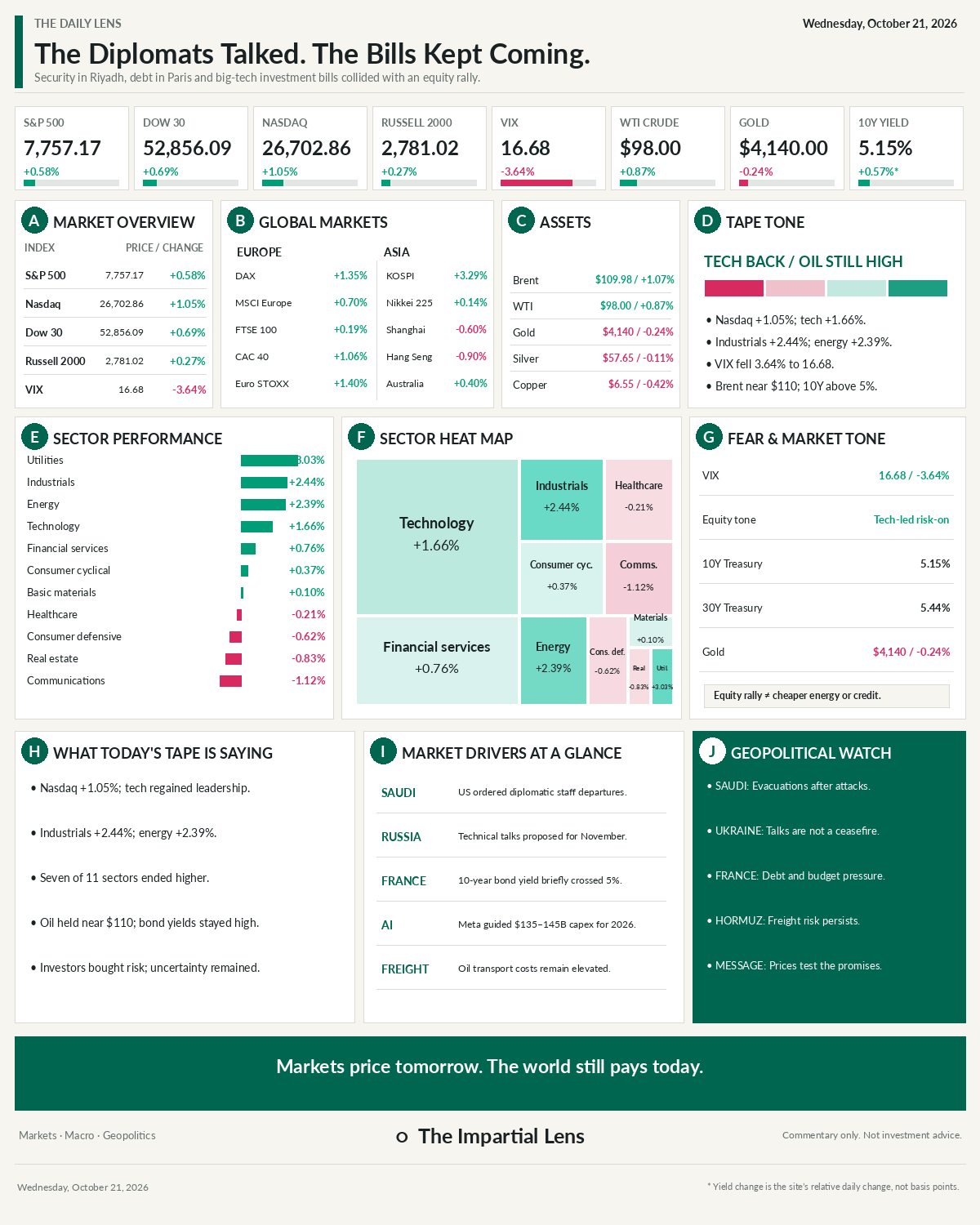
There’s a useful expression for this: risk-on. It describes a mood in which investors become more willing to own assets whose value depends on growth and future profits.
But watch the details. Technology rallied, yet industrials and energy rose even faster. Investors weren’t all making the same bet. And the US 10-year Treasury yield remained near 5.15%, while Brent crude was close to $110.
That’s the daily habit worth learning: don’t just ask whether stocks rose. Ask who led, who lagged and which risks remained.
What We’re Watching
1. Saudi security. Can airports and energy facilities operate reliably again? The answer matters for investment, shipping and fuel costs.
2. Ukraine diplomacy. Will the proposal to talk become an actual ceasefire? Negotiations are not yet peace.
3. France’s debt. Can the government restore confidence without deepening the political unrest?
4. AI’s payoff. Can enormous spending deliver enough earnings to justify it?
5. Market leadership. Will the rally spread beyond a few familiar technology giants?
The Lens
Wednesday brought three kinds of promises: diplomats promised more talks, France promised a path through its budget troubles, and technology executives promised extraordinary returns from today’s investment.
Any of those promises might be fulfilled. But a Saudi airport still needs protection. France must refinance its debt. An AI data center needs electricity—and paying customers.
Wall Street makes its living pricing tomorrow. The rest of the world must still settle today’s accounts.
Politicians can promise peace. CEOs can promise the future. The shipowner and the bondholder still expect to be paid.
The Impartial Lens provides market commentary and education only. Nothing here constitutes investment advice.
Featured photograph: Palais Bourbon, Paris, by Getfunky Paris (2012), licensed under CC BY 2.0. Illustrative historical photograph.
