The bankers helped keep the AI expansion moving. American consumers sounded more hopeful. In the Gulf, diplomats offered the prospect of safer shipping while missiles supplied a less reassuring update.
The Daily Lens | Tuesday, October 27, 2026
Broadcom has chips to sell. Anthropic wants computing power. Wall Street has found $63 billion to help bring them together.
That was welcome news for investors who spent last week worrying about how the AI industry would pay for its ambitions.
Elsewhere, American consumers offered a little encouragement, and oil eased as traders assessed diplomatic efforts involving Iran.
There were reasons for Tuesday’s better mood. Understanding how far that good news travels requires following the money beyond the announcement.
| Market | October 27 reading |
|---|---|
| S&P 500 | 7,722.60 · +0.60% |
| Nasdaq Composite | 26,477.81 · +1.18% |
| Dow | 52,377.57 · +0.03% |
| Russell 2000 | 2,818.87 · +1.16% |
| US 10-year Treasury yield | 4.993% |
| Brent crude | $109.40 |
| WTI crude | $99.90 |
The Chip Seller Brought the Bankers
On Monday, Bank of America, Citi, Morgan Stanley and Blackstone announced a financing arrangement to buy Broadcom equipment and lease it to Anthropic, the company behind Claude. Deliveries are expected to begin in 2027.
Broadcom is also providing support tied to the equipment’s future value, covering an amount equivalent to the senior financing portion. The announcement does not say it guarantees the entire $63 billion.
The supplier is therefore doing more than shipping equipment. It is helping make the financing possible and retaining some exposure to how the arrangement works out.
Leasing machinery is ordinary business. It allows a company to use equipment and earn income from it while spreading the payments over time.
For Anthropic, that means gaining access to computing capacity without purchasing everything outright. For Broadcom, it supports a substantial customer relationship. For the financiers, it offers income backed by negotiated protections.
The part worth watching is what happens when Anthropic starts using the equipment.
Its customers need results valuable enough to keep paying for: software developed faster, work completed more efficiently, or services that help their own businesses grow.
Those payments must support the cost of delivering the service. More usage is encouraging, but providing it consumes computing power and electricity.
If the economics improve as the business grows, this can support productive investment. If capacity expands faster than profitable demand, the lease payments and operating costs still arrive.
As last Tuesday’s Lens explored, getting the hardware is one stage. Making it work and earn its keep takes considerably longer than signing the order.
Consumers Sounded Less Miserable
There was encouragement outside the technology industry.
The Conference Board’s consumer confidence index rose to 91.7 in October from 84.2 in September, driven primarily by better assessments of current and expected business conditions.
That matters. Businesses announcing investment plans eventually need customers, and households feeling less anxious may be more willing to spend.
But confidence has to survive contact with the monthly budget.
Consider a household deciding whether to replace an appliance, or a delivery company considering another van. Lower fuel costs leave more money available. An expensive loan can swallow the saving.
This is why Wednesday’s Federal Reserve decision belongs in the same conversation as technology earnings and oil.
The AI developer wants financing for computing equipment. The small business wants working capital. The household wants a mortgage it can afford.
A pause in rate increases would give them something to assess. It would not, by itself, bring their borrowing costs down.
The Gulf Had Other News
Saudi authorities said they intercepted Houthi missiles over Riyadh on Tuesday. The Houthis also claimed a strike on Ras Tanura refinery, but that claim was not independently verified in AP’s reporting.
At the same time, Oman was describing a possible opening for safer shipping.
Foreign Minister Badr Albusaidi said Monday that discussions with Iran had produced an outline for a temporary arrangement to restore free navigation through Hormuz. Implementation, he said, required compromise from both Washington and Tehran.
For a shipowner, the next questions are practical. Which vessels can pass? Who provides the assurances? What does the insurer charge?
A refinery needs to know when its cargo will arrive. A crew needs confidence that accepting the voyage is a sensible decision.
Those details determine whether diplomatic progress becomes an economic benefit.
Israel’s election added another uncertainty. Exit polls left neither Netanyahu’s bloc nor the main opposition with a clear governing majority. Final results and coalition negotiations remained ahead.
Investors could welcome negotiations without assuming the region was becoming safe. Tuesday offered grounds for hope, alongside reasons to keep checking what was actually happening.
What the Dashboard Is Telling Us
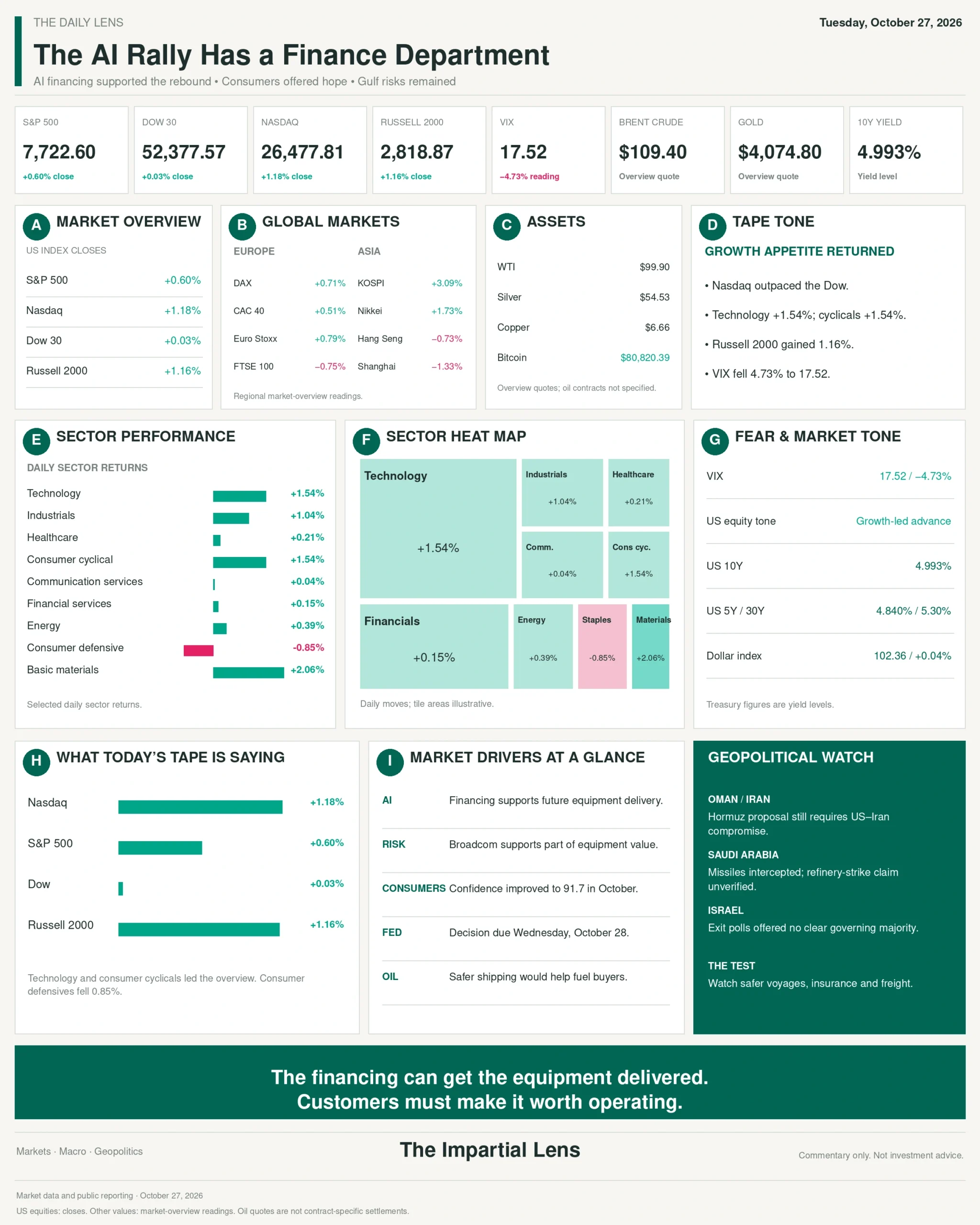
The Nasdaq’s 1.18% gain comfortably outpaced the Dow’s 0.03%. Technology and consumer cyclicals each rose 1.54% in our overview, while consumer defensives fell 0.85%.
The Russell 2000 gained 1.16%, showing that the improvement extended beyond the largest technology companies.
The VIX fell 4.73% to 17.52, indicating less anxiety in the options market. That tells us about investors’ expectations—not whether the underlying risks have disappeared.
The US 10-year yield remained near 5%. Expansion still has to justify an expensive cost of money.
What We’re Watching
- AI customers: Are revenues improving alongside the cost of providing the service?
- Household spending: Does better confidence translate into purchases without greater credit strain?
- Hormuz: Do negotiations produce safer passages and lower shipping costs?
- Israel: Can the parties assemble a government?
- The Fed: What would persuade officials that borrowing conditions can ease?
The Lens
Tuesday’s financing news deserves credit. It gives a major AI customer access to equipment and suppliers more confidence to plan production.
It also ties several businesses more closely to the same expectation: that customers will pay enough to make the expansion worthwhile.
The earnings reports should help us judge that expectation. In the Gulf, successful deliveries will tell us more than another round of hopeful statements.
For now, investors have found reasons to buy.
The useful question is whether the businesses and households behind the market are beginning to find more room to operate.
The Impartial Lens provides market commentary and education, not personalised investment advice.