Brazil’s voters delivered a result that sent traders scrambling. Anthropic opened its books to Wall Street. And Gulf diplomats met while the war they were trying to contain carried on outside the negotiating room. Monday was a reminder that the world doesn’t owe investors the future they’ve already priced in.
The Daily Lens | Monday, October 26, 2026
Financial markets have a peculiar talent for treating an election, an investment and a peace agreement as done deals before any of them is settled.
Then Monday arrives.
São Paulo’s stock exchange shut for half an hour after voters upset investors’ expectations. New York technology stocks climbed on an AI IPO filing. In Tehran, officials talked about ending a war that was making Gulf oil expensive to ship.
The markets weren’t all reacting to the same news. They were reacting to the difference between what they’d expected and what had actually happened.
Brazil Didn’t Vote for the Trade
Brazil re-elected Luiz Inácio Lula da Silva on Sunday. He took 51.79% of valid votes to Flávio Bolsonaro’s 48.21%, according to the country’s electoral court. That settled the election. It didn’t settle the argument investors had been having with themselves.
Many traders had positioned for Bolsonaro and a hoped-for friendlier approach to economic reform. Instead came Lula. Selling triggered Brazil’s circuit breaker, which halts trading temporarily during a steep fall.
By the close, the Ibovespa had lost 13.88%, finishing at 176,608.23, according to Brazil’s exchange operator, B3.
Now, I’m not suggesting Lula’s economic programme is irrelevant. Government decisions about spending, taxation and fiscal credibility have real consequences. But Brazil didn’t lose nearly 14% of its businesses overnight. Its farms were still there. So were its mines, factories, consumers and export contracts.
What changed was the price investors would pay for future profits. It’s one thing to worry about policy. It’s another to bet the electorate will deliver your preferred result.
The latter can get very expensive. Voters are under no obligation to protect anyone’s portfolio.
The Cost Goes Beyond the Stock Exchange
The Brazilian real took a beating too. By the close, the US dollar was up 8.25% against the real, near R$5.40, according to B3’s market report.
Picture a Brazilian manufacturer importing machinery priced in dollars. The invoice hasn’t changed, but its cost in reais has. The owner can absorb the difference, raise prices or delay the order.
Exporters earning dollars may benefit. The same exchange-rate shock creates winners and losers.
And before anyone declares the next four years a disaster, history offers a useful caution. Lula’s first presidential election in 2002 rattled Brazilian markets, yet his early administration pursued more orthodox economic policies than some investors feared. That doesn’t tell us what this administration will do. It tells us why the first day’s price action shouldn’t be mistaken for the final chapter.
Silicon Valley Found Its Appetite Again
Across the Americas, investors had something very different to celebrate. Anthropic filed its registration statement for a public offering, with plans to list under the ticker ANT. After last week’s anxiety over the cost of building artificial intelligence, the possibility of a major new listing was enough to help restore some enthusiasm.
The filing also gave us a rare look inside the finances of the company behind Claude. For the first half of 2026, it reported $16.286 billion in revenue and an operating loss of $693 million. Then came the number guaranteed to produce dramatic headlines: an $80.748 billion net loss.
But around $72.4 billion came from revaluing convertible notes and related instruments as the company’s valuation increased. That’s an accounting loss, not $72 billion spent running the business. The distinction is clear in the SEC filing.
The useful question is whether revenue can outgrow computing costs sufficiently to produce a sustainable profit.
Meta supplied the other half of Monday’s AI story. It announced a financing plan involving about $35 billion in current equity and preferred-share offerings, with the possibility of a further $60 billion share-sale programme later. That’s up to $95 billion in planned financing, not $95 billion already sitting in its bank account. The later programme has not yet been established.
That’s equity financing: selling ownership rather than relying entirely on debt. It can spare the balance sheet, but potentially dilutes shareholders. The data centres still need power and customers.
Saturday’s Weekly Lens asked who would finance the future. Monday’s answer appeared to be: quite a lot of people, provided the story remains attractive enough.
In Tehran, Conversation Wasn’t Yet Peace
While Wall Street took encouragement from a filing, Saudi Arabia, Turkey and Pakistan sent senior representatives to meet Iranian officials in Tehran. Reuters reported that they agreed to continue discussions aimed at reducing the regional conflict.
That’s welcome news, particularly for anybody whose business involves crossing the Persian Gulf. But a meeting is a beginning, not a ceasefire. Yemen’s Houthis were still claiming strikes against Saudi targets, some without independent confirmation, and the disputes between Iran and Washington remained unresolved.
Tankers need safe routes, affordable insurance and crews willing to sail. Even when oil keeps flowing, the extra transport costs reach petrol pumps, factories and delivery companies.
Our market screen showed Brent at $110.37 and WTI at $101.48, both slightly lower on the day. These are readings from the supplied market overview, not the official settlement for a specified futures contract. The distinction matters when comparing prices.
Diplomacy can improve the outlook. It cannot, by itself, unload a tanker safely at the refinery.
Wall Street: A Better Day, Not a Clean Bill of Health
The contrast with Brazil was extraordinary. The Nasdaq gained 0.82%, the S&P 500 advanced 0.70% and the Dow added 0.28%. The VIX, which measures expected stock-market volatility, fell 5.45% to 18.39. US investors looked rather more relaxed than their Brazilian counterparts.
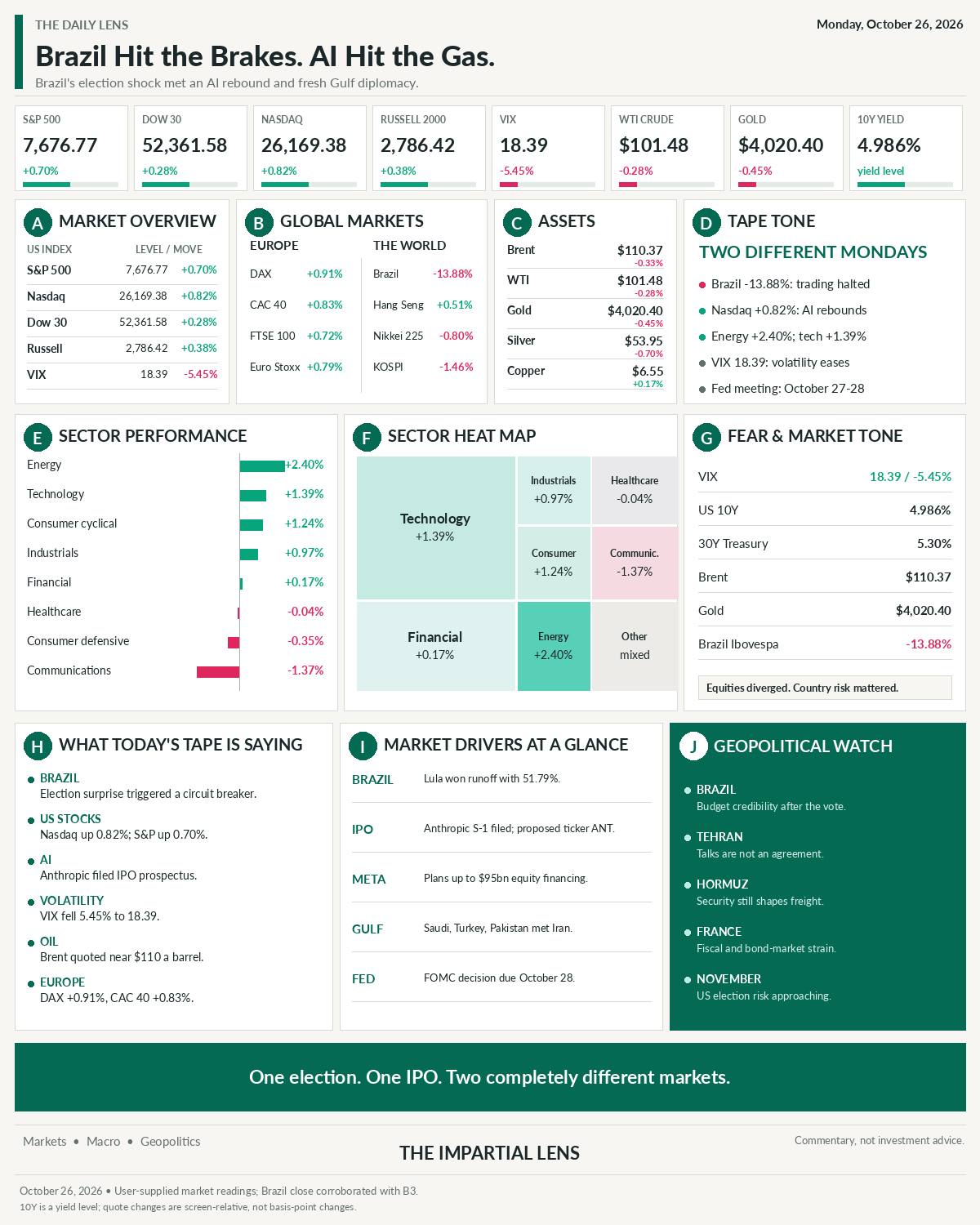
Underneath the index, technology rose 1.39%, energy gained 2.40%, and communication services lost 1.37%. Germany’s DAX and France’s CAC 40 rose too. Investors were being selective.
This is why we keep returning to market breadth and rotation. A rising index tells you the average direction of a weighted group of shares. It doesn’t tell you whether investors agree on what comes next.
And with the Federal Reserve meeting October 27–28, the price of money is about to get another examination. AI builders need funding, households need affordable credit and governments need buyers for their bonds. Everyone has an interest in what the Fed says.
What We’re Watching
Brazil: Who will run the finance ministry, and what will the next budget tell creditors?
The real: Does the currency regain ground once election positioning has unwound?
Anthropic: What will public investors actually pay, and how quickly are computing costs growing?
Meta: How much of the proposed fundraising goes ahead, and on what terms?
Iran and the Fed: Do negotiations bring safer shipping, and does the Fed offer any relief to borrowers?
The Lens
Brazil counted votes while New York traded on a corporate filing. Entirely different events, yet both revealed how much money rides on assumptions about tomorrow.
Brazil’s election is finished; the economic policy decisions are only beginning. Anthropic has filed its papers; it still has to persuade public investors. Meta can announce a financing programme; it still has to make the investment earn its keep. Tehran’s visitors can shake hands; tankers still need to get through the Gulf.
My conclusion from Monday is simple: the expensive mistake isn’t having a view about the future. It’s mistaking that view for a fact.
Ask the traders in São Paulo. They had thirty minutes to think about it.
The Impartial Lens provides independent market commentary and education, not personalised investment advice.
Featured image: Editorial illustration of Christ the Redeemer overlooking Rio de Janeiro and Guanabara Bay beneath storm clouds, created for The Impartial Lens.