Friday, November 6, 2026 | The Daily Lens
On Friday, a Greek ship manager reported that a seafarer had died after an explosion aboard a fuel tanker in the Gulf. The manager suspected a missile strike. Two days earlier, Brent had settled below $95 on hopes that the US midterms might make an end to the Iran war more likely.
Imagine you’re arranging the next crossing. Which piece of news changes your instructions to the captain?
That’s the test I’d apply to the talk of peace this weekend. The election changed who will run Congress. Qatar is trying to bring Washington and Tehran closer. Both matter. Neither has yet given the next ship a safer route.
Congress Can Ask Questions. Can It Change the War?
Democrats won both chambers this week. Once the new Congress takes office, they can call officials to testify about the Iran war: what the administration is trying to achieve, how much it has spent and what it thinks another round of strikes would accomplish. Those answers could change the politics of the war. The first test of whether Congress can change its conduct comes when there’s a bill the administration needs passed.
Suppose Democrats want to stop money being used for a particular operation. They have to agree which operation, write the restriction and get it through both chambers. Trump can veto the bill. That leaves room to bargain, especially if the restriction is attached to funding the White House wants. It also leaves room for a long argument in Washington while ships keep sailing.
Oil traders didn’t wait for the first hearing. They had a reason to think an electoral defeat might make Trump more willing to negotiate. What they couldn’t know was whether the terms he’d accept had moved any closer to the terms Tehran would accept. That’s the gap Qatar has to close.
What Would Qatar’s Talks Change at Sea?
Qatar can give each side a way to find out what the other is willing to concede. For the captain of a tanker, the useful part of any agreement is what it says about passage through Hormuz. Which routes can commercial ships use? Who do they call if they’re challenged? Who can make sure the people operating in those waters follow the agreement?
An insurer has to make its own judgment. A statement from a mediator may move oil futures that afternoon. An insurer deciding what to charge for the next crossing has something else to go on: how many ships have made it through safely, and how recently.
The Refinery Has a Schedule to Keep
The refinery has a decision to make before it knows how the talks will end. Does it book the Gulf cargo and put it on next month’s schedule? If the ship is late, the refinery can draw down its stocks or pay for a replacement cargo. Either way, the delay costs money. Brent can fall on the screen while the cost of securing the next delivery barely budges.
Follow that through to a haulage firm quoting a job for next month. If its fuel supplier can’t hold a price, the haulier can build a cushion into the quote or take the risk that diesel will cost more by the time the work starts. Either way, someone is paying for the uncertainty before a truck has left the yard.
That’s the part of the oil story I’d watch now. If crossings become dependable, freight and insurance costs can ease alongside crude. That gives a fuel supplier a better chance of passing on a lower price. Until then, $98.32 is what Brent settled at on Friday. It’s a long way from a firm quote for a delivery of diesel.
How Markets Responded
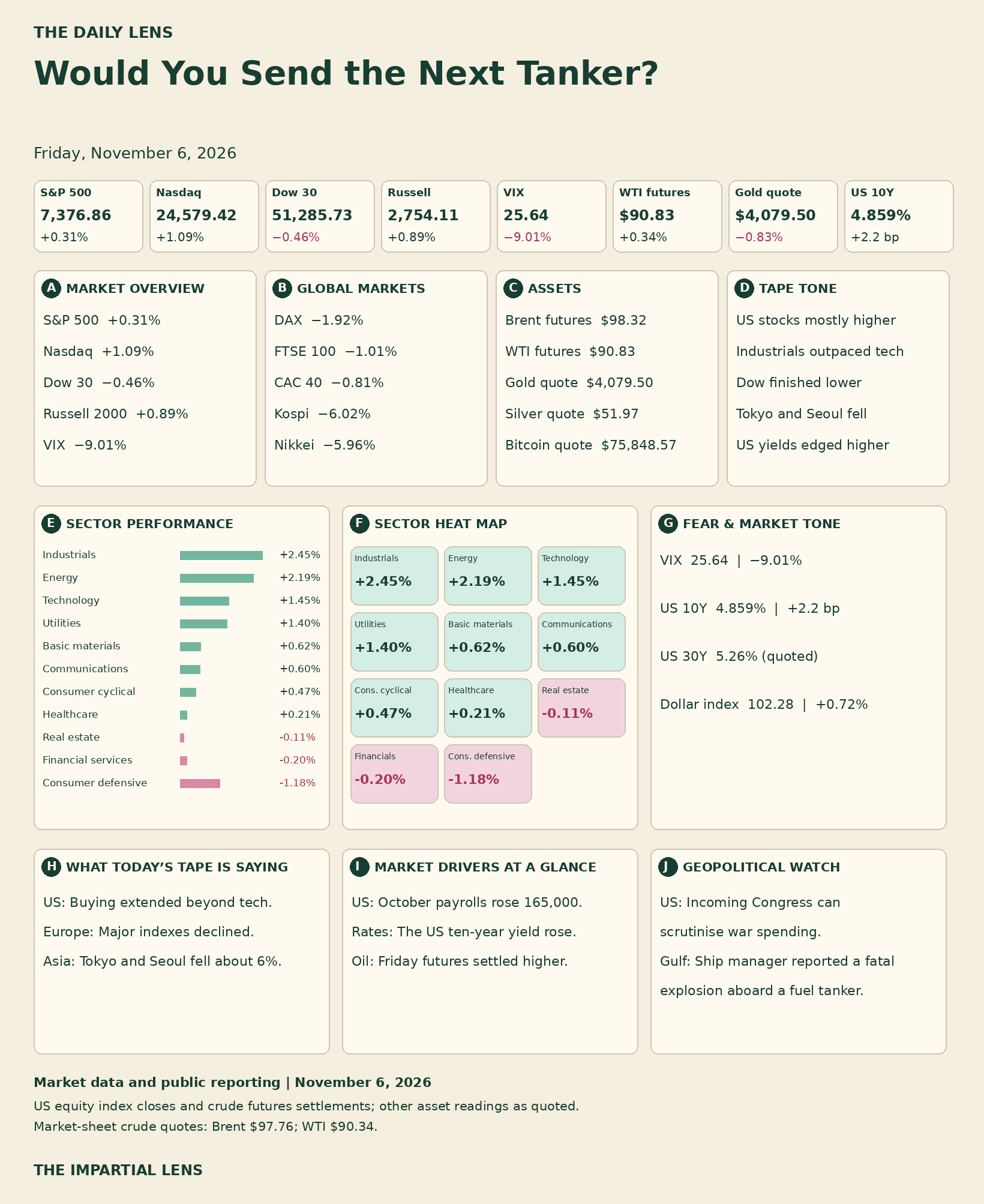
New York recovered some ground after a bruising session in Asia. The Nasdaq rose 1.09%, the Russell 2000 gained 0.89%, and the S&P 500 added 0.31%. The Dow fell 0.46%. Industrials gained 2.45%, ahead of technology’s 1.45%. The VIX fell 9.01% to 25.64.
Japan’s Nikkei fell 5.96% and South Korea’s Kospi lost 6.02%. Hong Kong fell 1.27% and Shanghai lost 1.10%. In Europe, Germany’s DAX fell 1.92%, Britain’s FTSE 100 lost 1.01%, and France’s CAC 40 fell 0.81%.
The US added 165,000 jobs in October, giving the Fed room to wait for more evidence on inflation. The ten-year Treasury yield rose to 4.859% and the dollar index gained 0.72%. Gold was quoted at $4,079.50, down 0.83%, and bitcoin at $75,848.57, down 0.16%. Brent and WTI futures settled at $98.32 and $90.83, respectively.
What We’re Watching
- What will Congress put in writing? Watch for specific conditions on defence funding that can get through both chambers.
- Are crossings getting safer? Watch independent incident reports, tanker traffic and what insurers charge for war-risk cover.
- Are prices easing outside energy? Watch services prices in the November 10 US inflation report.
The Lens
I’d take a deal seriously when a refinery feels safe enough to stop allowing extra time for a Gulf cargo. That’s a decision someone can get wrong, at real cost. This week the oil market had enough news to take a chance. I don’t think the refinery did.
The Impartial Lens provides market commentary and education only. Nothing published here constitutes investment advice.