“My name is Ozymandias, king of kings:
— Percy Bysshe Shelley, Ozymandias (1818)
Look on my works, ye Mighty, and despair!
Nothing beside remains. Round the decay
Of that colossal wreck, boundless and bare
The lone and level sands stretch far away.”
Diamonds, paper promises, fallen empires, and the one metal that has outlasted them all.
Featured photograph by Nils Thies. Source: Deutsche Bundesbank.
Long before there were central banks, stock exchanges, paper currencies or advertising agencies, there was gold.
The ancient Egyptians treasured it. The Romans minted it. Kings accumulated it, explorers crossed oceans in search of it, and empires fought wars over it.
Civilizations rose and fell. Their currencies disappeared, their rulers were forgotten, and their promises eventually came to nothing.
But the gold remained.
A gold coin buried by a Roman two thousand years ago could be dug up tomorrow, cleaned, weighed and sold.
The emperor whose face appears on it is long dead. His empire is gone. The monetary system that issued it has vanished.
Yet the gold is still gold.
There is something rather remarkable about that.
And it brings us to one of the more extraordinary stories in economic history: how mankind learned to place enormous value on diamonds, how governments learned to turn paper into money, and why, despite centuries of attempts to improve upon it, gold continues to occupy a special place in the human imagination.
A Diamond Is Forever
In 1947, an advertising copywriter named Frances Gerety was working on a campaign for De Beers. De Beers company history.
She came up with four words that would transform an industry.
"A Diamond Is Forever."
It might be the greatest advertising slogan ever written.
De Beers wasn’t simply selling gemstones. It was selling romance, permanence and the idea that a man’s financial sacrifice demonstrated the depth of his love.
The more expensive the ring, the greater the implied devotion.
Diamonds became an expectation rather than simply a luxury.
And there was another clever feature to this arrangement.
People rarely sell their engagement rings. Even when marriages fail, the stones often remain tucked away in drawers, removed from the secondhand market.
For much of the twentieth century, De Beers also exercised extraordinary influence over the supply of rough diamonds.
The company had helped manufacture demand while maintaining considerable influence over supply.
A wonderful business, if you could arrange it.
And for decades, De Beers could.
Unfortunately for the diamond industry, scientists had other ideas.
They eventually learned how to manufacture gem-quality diamonds in laboratories.
Real diamonds. Essentially the same chemical composition, the same crystal structure and virtually indistinguishable to the naked eye. Gemological Institute of America.
Suddenly, a young man could express his eternal devotion for a fraction of the traditional price.
During the first nine months of 2026, De Beers received 37% less per carat on average for the rough diamonds it sold than during the same period in 2025.
Some of that decline was because the company was selling a different mix of diamonds. But even after accounting for those differences, prices were still down 18%.
The message was unmistakable. Natural diamonds were losing some of their pricing power.
Weak consumer demand and competition from lab-grown diamonds were taking their toll.
Natural diamonds haven’t ceased to be rare, and many buyers continue to value their geological origins. But the scarcity premium that consumers once accepted is under pressure.
The stone hadn’t changed.
The market’s perception of what made it valuable had.
And that brings us to something considerably older than De Beers.
The Original King of Kings
Gold never needed an advertising campaign.
Long before anyone invented the engagement ring, gold had established itself as something worth possessing.
It was beautiful, durable, recognizable and remarkably difficult to obtain.
Unlike grain, it didn’t rot. Unlike iron, it didn’t rust. Unlike livestock, it didn’t require feeding.
And, unlike the promises of kings, it couldn’t be created by royal decree.
But how rare is gold, really?
Human beings have been mining it for thousands of years. We’ve dug into mountains, diverted rivers, excavated enormous holes in the Earth and processed billions of tonnes of rock in search of it.
And what do we have to show for all that effort?
According to the World Gold Council, by the end of September 2026, approximately 224,200 tonnes of gold had been mined throughout human history. World Gold Council.
That sounds enormous.
Until you imagine melting it all down.
Every gold bar in every central bank. Every wedding ring, necklace and bracelet. Every gold coin, every investment bar and every piece of surviving gold jewelry.
Gather it all together and melt it into a single enormous block.
You would have a cube measuring roughly 22.6 meters on each side.
About 74 feet.
Roughly the height of a seven-story building.
That’s it.
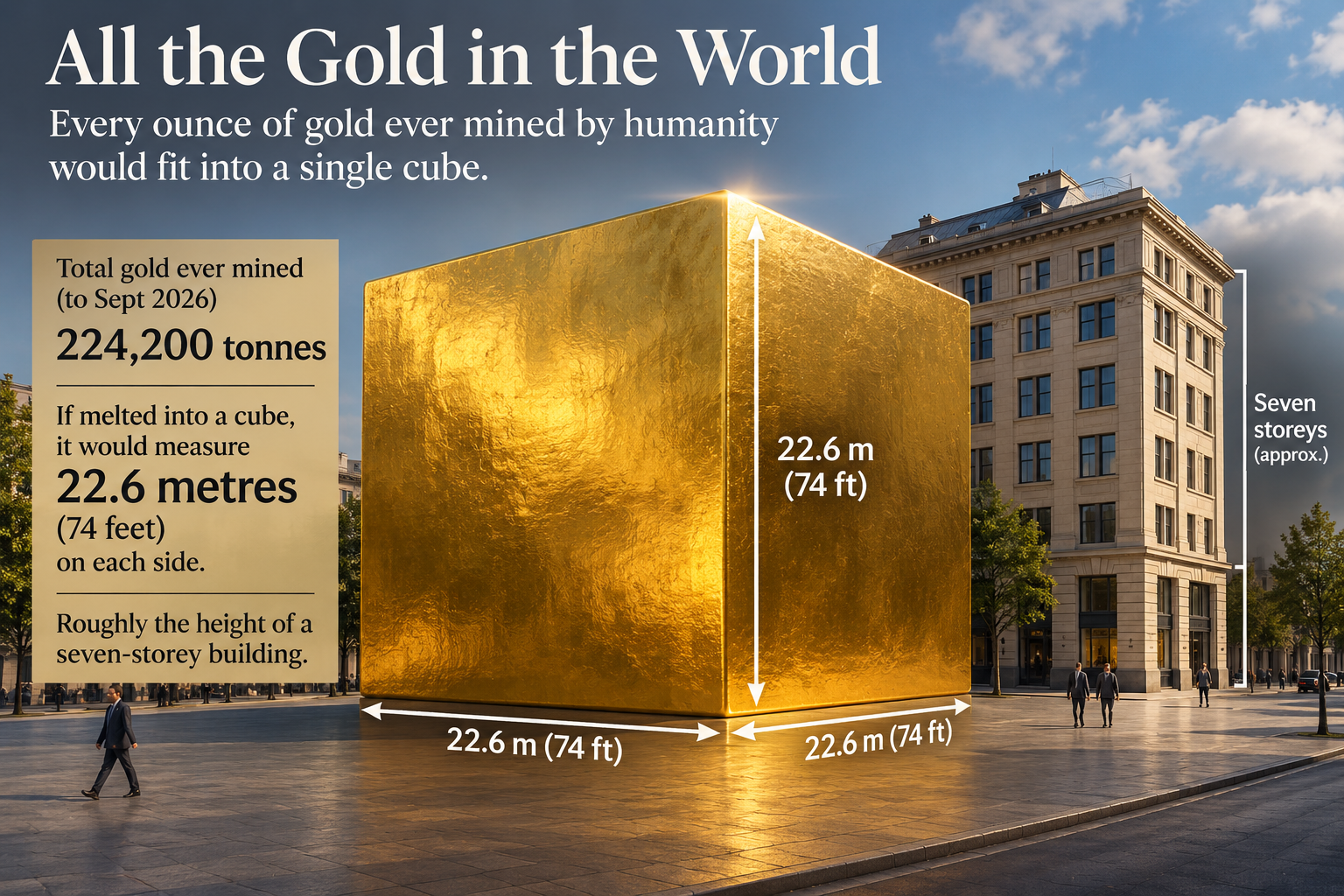
Thousands of years of mining, conquest, exploration, commerce and human endeavor.
And all the gold mankind has ever brought above ground would occupy a space smaller than many ordinary city buildings.
Even more remarkably, roughly two-thirds of that gold has been mined since 1950.
Almost all of it still exists.
Gold fashioned into jewelry in ancient Egypt may have been melted and remelted countless times. The same metal could eventually find its way into a modern wedding ring, an investment bar or the reserves of a central bank.
We cannot trace the journey of every atom.
But the metal endures.
And unlike diamonds, we cannot simply grow more of it in a laboratory at a commercially useful cost.
New deposits are discovered. Better technology improves extraction. Higher prices encourage additional production.
But nobody can simply decide that another million tonnes of gold should exist tomorrow.
There is no printing press for gold.
The Alchemists Discover Paper
For centuries, gold played a central role in monetary systems.
But moving it around was inconvenient.
Bankers and goldsmiths offered to store the metal and issue receipts or claims against their holdings.
Eventually, those claims could circulate as payment.
Why carry a heavy bag of gold when a piece of paper representing the same amount would do?
And here, the financial world discovered something extraordinary.
If people trusted the paper, they would accept it.
Indeed, banks could issue more claims than they held in immediately available gold, provided everyone didn’t demand redemption simultaneously.
Credit expanded. Commerce flourished. Economies grew.
But a dangerous temptation had emerged, and we humans can resist everything except temptation.
If the public was happy to accept paper promises, why not issue more of them?
The original alchemists had spent centuries attempting to turn lead into gold.
Their successors discovered something altogether more useful.
They could persuade people to accept paper instead.
And eventually, they would discover they didn’t need to promise gold at all.
The Day the Gold Window Closed
On August 15, 1971, President Richard Nixon addressed the American people.
Under the monetary system established after the Second World War, the US dollar had been linked to gold at $35 an ounce, with foreign monetary authorities able to exchange dollars for American gold.
But the United States had issued increasing quantities of dollars, and confidence in the promise was weakening.
Foreign governments were asking an awkward question.
Could America really honor all those claims at the promised price?
Nixon announced that the United States would suspend the dollar’s convertibility into gold. Federal Reserve History.
It was supposed to be temporary.
The old arrangement never returned.
The world moved towards a system of fiat currencies: money no longer redeemable for a fixed quantity of precious metal.
And something extraordinary happened.
The dollar continued to function.
People went to work, bought groceries, paid mortgages and saved for retirement.
International trade continued. Banks lent money. Businesses invested.
Gold was no longer necessary to settle most everyday monetary obligations.
The modern alchemists had succeeded.
They had helped create a world in which paper, and eventually electronic entries, could serve as money without a promise of gold redemption.
But there was a catch.
The value of that money now depended heavily on the credibility of the institutions managing it and the strength of the economies supporting it.
And institutions, unlike gold, are run by human beings.
The Power to Create Money
Leaving gold behind brought genuine benefits.
Central banks gained greater flexibility to respond to financial crises, provide liquidity and influence the availability and cost of credit.
Commercial banks could create deposit money through lending, subject to capital requirements, regulation and market constraints.
Governments operating in their own currencies gained financial flexibility that would have been more difficult under strict gold convertibility.
But freedom from one constraint creates another responsibility.
Just because you can create more money doesn’t mean you’ve created more wealth.
An additional trillion dollars does not automatically produce another trillion dollars’ worth of houses, energy, food or productive capacity.
If spending persistently outruns an economy’s ability to supply goods and services, prices can rise.
And inflation has a peculiar way of exposing the difference between money and wealth.
A hundred-dollar bill remains a hundred-dollar bill.
It is the groceries, electricity, rent and other necessities that require more of them.
The paper hasn’t changed.
Its purchasing power has.
Of course, a gold standard has its own serious weaknesses. Economic crises under gold-based systems could be severe, and a rigid monetary supply could make recessions harder to manage.
There are good reasons the world moved away from it.
But the disappearance of gold convertibility didn’t make gold irrelevant.
Far from it.
The Barbarous Relic That Wouldn’t Go Away
John Maynard Keynes famously described the gold standard as a "barbarous relic."
He was criticizing the constraints of the monetary system rather than the chemical element itself.
Nevertheless, gold became associated with an older, supposedly less sophisticated age.
Modern economists developed elaborate monetary theories. Central banks acquired increasingly sophisticated instruments. Governments learned to finance themselves through vast bond markets.
And gold?
Gold just sat there.
It paid no interest. It produced no earnings. It offered no dividend.
It didn’t employ anybody or publish quarterly results.
And yet, more than fifty years after the dollar’s final break with gold convertibility, the world’s central banks still hold tens of thousands of tonnes of it.
According to the World Gold Council, their holdings amounted to approximately 39,300 tonnes at the end of September 2026. World Gold Council.
There’s a wonderful irony in that.
The very institutions charged with managing modern currencies continue to hold large reserves of a metal that their currencies no longer promise to deliver.
Why?
Because gold has a characteristic that most financial assets do not.
It is not somebody else’s liability.
A government bond depends on an issuer meeting its obligations. A bank deposit is a claim on a financial institution, supported by the relevant banking and legal arrangements.
Physical gold makes no such promise.
It simply exists.
That doesn’t mean its market price cannot collapse. Gold can be extraordinarily volatile, and ownership brings costs and risks.
But the metal itself needs no counterparty to honor a contract.
And that characteristic becomes particularly interesting whenever confidence in governments, currencies or financial institutions begins to weaken.
What Survives When Confidence Disappears?
Consider the difference between our three characters.
De Beers helped persuade generations of people that diamonds represented eternal love. Technology has challenged the scarcity premium supporting part of that story.
Governments and central banks established a world in which money no longer needed to be exchangeable for gold. That system depends on credible institutions, economic productivity and public confidence.
Gold occupies a different position.
Its scarcity wasn’t invented by an advertising executive.
Its supply cannot be expanded by a central bank committee meeting.
And its reputation as a store of value has survived an extraordinary succession of monetary systems.
Gold was there before the dollar, the pound sterling in its modern form, the euro and almost every currency circulating today.
It has witnessed the rise and fall of empires, the destruction of fortunes and the abandonment of monetary arrangements once regarded as permanent.
We shouldn’t confuse that extraordinary durability with a guarantee of financial returns.
Gold’s purchasing power changes. Its price can rise or fall dramatically. It may perform poorly for long periods.
But it has something that no monetary authority can manufacture.
A history stretching across civilizations that never met, governments that fought one another, and cultures that agreed on remarkably little else.
Time and again, they found value in the same yellow metal.
No advertising campaign ever achieved anything quite like it.
The Lens
Perhaps the most remarkable thing about gold is how little it has changed.
The ancient Egyptians would recognize it.
So would a Roman merchant, a medieval goldsmith or a nineteenth-century banker.
They wouldn’t recognize our digital wallets, exchange-traded funds, central bank balance sheets or trillion-dollar government debts.
They might be astonished that enormous quantities of money can be created through electronic accounting entries.
And they would probably find it amusing that generations of young men had been persuaded to demonstrate their affection through the price of a diamond.
But show them a piece of gold, and there would be no confusion.
They would know exactly what it was.
The greatest love story ever sold may have been the diamond.
But gold has enjoyed a relationship with humanity that no advertising agency could have invented.
It was there near the beginning of civilization’s monetary history.
And whatever monetary systems we devise next, there is every reason to expect it will remain.
The kings will go. The empires will fall. Their currencies may disappear, their promises forgotten.
But gold will still be gold.
“Look on my works, ye Mighty, and despair!”