Tuesday, November 17, 2026 | The Daily Lens
On Monday, a tanker off Oman caught fire and lost power. Maritime authorities said the crew was safe. On Tuesday, the ship was hit again. This time, the authorities said they couldn’t account for the crew. Brent settled at $93.14, up 70 cents on the day and down roughly 20% for the month. The war could get worse and oil could still finish November cheaper. We’re already seeing how both can happen. Reuters on the tanker · Reuters
Two other numbers caught our eye. Ten countries signed a declaration on AI supply chains. And Nvidia sold $115.8 billion in a quarter, in the last set of accounts from Jensen Huang’s time in charge. His successor now has to steer the company through a fight over who gets to buy its chips. Reuters on the declaration · Nvidia results
The oil market is counting barrels
The US struck Iran’s Qeshm Island on Tuesday. The tanker was hit on the opposite side of the strait, near the Omani port of Khasab. The attacks gave oil traders a reason to bid crude higher. There was also a reason to hold back. Gulf exports have been recovering, and last week the International Energy Agency projected that global supply would exceed demand this quarter. Reuters · IEA
Some of that recovery depends on routes outside Hormuz. We looked at Saudi Arabia’s Red Sea route last week. Every cargo that leaves by another route helps keep crude available. Meanwhile, a refinery still taking deliveries from inside the Gulf can face a higher freight or insurance bill even while the price of the crude itself falls.
That distinction is worth keeping in mind the next time cheaper oil is offered as good news for airlines or hauliers. They buy jet fuel and diesel. What matters to them is the price of the finished fuel where they need it. The IEA was already warning last week that diesel supplies remained tight despite the improving crude balance. IEA
Washington needs Tokyo and Seoul
On Sunday, the US and nine partners signed the San Francisco Declaration. Japan and South Korea are on the list, as are India, Britain and the UAE. The agreement covers the supply chains behind AI, from minerals to chips and data centres. Reuters on the declaration
Japan makes equipment and materials chip factories depend on. South Korea supplies memory. Washington can restrict an American company’s exports, but how much that achieves depends in part on what suppliers elsewhere can still sell. Getting governments to sign a declaration is one step. Asking them to turn down business under a common set of rules is where the negotiation gets expensive.
The same goes for minerals. A government can agree that it relies too heavily on China. Replacing a supplier means finding a company willing to build a plant and a customer willing to buy what comes out of it. That’s the part we’ll be looking for when the first projects are announced.
Nvidia’s customers have a bigger bill coming
Nvidia more than doubled quarterly revenue. More than $107 billion came from its data-centre business alone. Interim chief executive Colette Kress put the next quarter’s sales at $126 billion to $134 billion, ahead of Wall Street’s estimates. The forecast includes zero sales of data-centre chips to China. Shares rose after hours. Nvidia results · Reuters on Nvidia
For Nvidia, that tells us how much money is already being spent. For the companies placing those orders, the harder figures come later. They’ll pay to connect the buildings to the grid, keep the machines cool and replace them as newer chips come out. Their customers have to pay enough for computing time to make that worthwhile. Nvidia can have an excellent quarter while some of the people buying its equipment are still years away from finding out how good a deal they made.
How Markets Responded
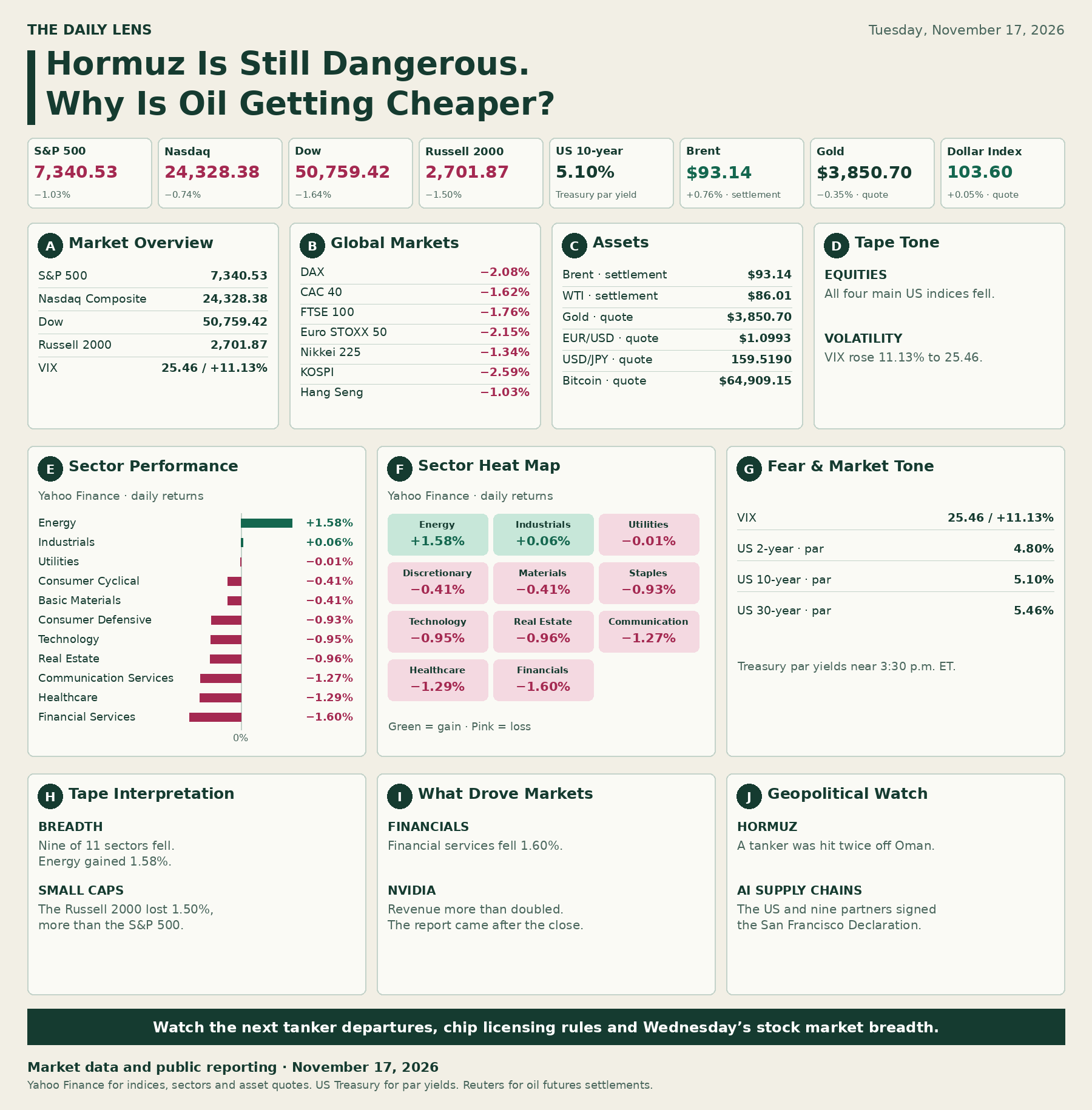
The Dow lost 1.64% and the Russell 2000 fell 1.50%. Both dropped more than the Nasdaq, which fell 0.74%. The S&P 500 was down 1.03%. Financial services fell 1.60%, energy gained 1.58%, and the VIX rose 11.13% to 25.46. The US closing numbers were in before Nvidia reported. AP · Nvidia results
Germany’s DAX fell 2.08%, Britain’s FTSE 100 lost 1.76% and South Korea’s KOSPI dropped 2.59%. The US 10-year Treasury yield eased to 5.10%. Brent futures settled at $93.14 and WTI at $86.01. The dollar index was quoted at 103.60, gold at $3,850.70 and Bitcoin at $64,909.15. US Treasury · Reuters
What We’re Watching
- Are ships still loading inside the Gulf? Watch departures and war-risk insurance quotes.
- Will Japan or South Korea change what their companies can sell? Watch for changes to licensing rules.
- Does Nvidia’s rebound spread? See whether financials and the Russell 2000 join it.
The Lens
A month ago, the risk of running short of oil was weighing heavily on prices. Today traders reckon enough barrels will get through. That’s a reasonable bet while exports are recovering. But the people making it can change their minds with a click. The ships have to get home.
The Impartial Lens provides market commentary and education only. Nothing published here constitutes investment advice.
Featured photograph: Khasab Harbour, Oman, December 2024. Sdtrams / Wikimedia Commons, CC BY-SA 4.0.
