Oil went back above $95. US borrowing costs rose. And Nvidia’s rivals gained after its founder stepped down.
Thursday, November 12, 2026 | The Daily Lens
A Saudi oil pipeline caught fire on Monday, and oil got cheaper. On Thursday, the Houthis claimed fresh attacks on the same pipeline system, and Brent, the global oil benchmark, rose to $95.82 a barrel. What changed? On Monday, Saudi Arabia said the oil was still moving. By Thursday, buyers had fresh reason to wonder whether it would keep moving.
President Trump also said the US didn’t need a deal with Iran. We’ll start with what that means for oil buyers, then look at why a new mortgage can get more expensive even when the Fed does nothing, and why Nvidia’s rivals rose on the day its founder quit.
How Saudi oil gets around Hormuz
When tankers can’t get through the Strait of Hormuz, Saudi Arabia can send oil by pipeline to Yanbu, a port on the Red Sea, and load it onto ships there. That keeps some oil moving, but it can’t replace all the supplies that normally pass through the strait. Before the war, about 20 million barrels of oil and fuel went through Hormuz each day. The International Energy Agency put the available capacity on the Saudi and Emirati alternatives at 3.5 to 5.5 million barrels a day.
On Monday, Saudi Arabia said the pipeline kept operating after the fire. On Thursday, the Houthis claimed new attacks on the pipeline and an oil facility at Yanbu. We don’t yet know whether shipments were delayed. If they are, refineries can use some of the crude they have in storage or buy a replacement cargo. When several buyers need a replacement at once, they can bid up the cost of oil that’s ready to ship.
That’s how trouble at a Saudi port can reach the petrol pump, if the disruption lasts. A single day’s jump tells us little about that. Even after Thursday’s rise, both Brent and US crude were still cheaper than at the end of last week.
Why mortgage rates can rise without the Fed
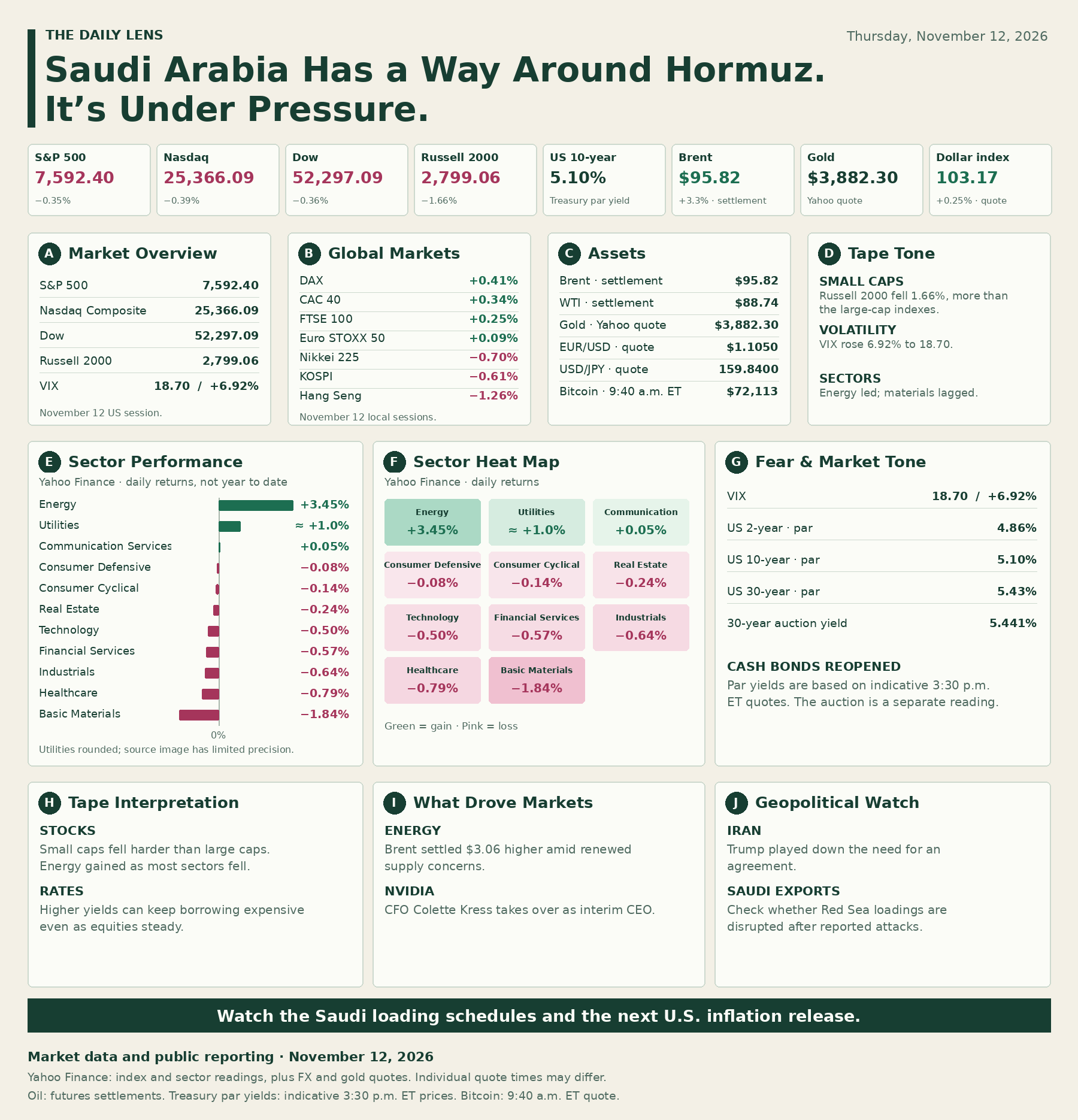
Washington borrowed $25 billion for 30 years on Thursday. The highest yield it accepted at the auction was 5.441%, just above what traders had expected. The bigger move was in the wider bond market: the benchmark 10-year Treasury yield rose from 4.98% on Tuesday to 5.10% on Thursday. The US cash bond market was closed on Wednesday for Veterans Day.
The 10-year yield is a benchmark lenders use when pricing a new fixed mortgage. When it rises, a lender may quote a higher rate even if the Federal Reserve hasn’t touched its own rate. That can change what a buyer can afford. If you already have a fixed-rate mortgage, your rate stays put. Higher fuel prices can add to inflation worries, but Thursday’s oil move alone doesn’t explain the rise in yields or tell us what the Fed will do next.
Why Nvidia’s rivals rose
Nvidia said co-founder Jensen Huang resigned as chief executive and from the board. Finance chief Colette Kress took over as interim chief executive. Nvidia shares fell sharply before recovering part of the loss. Shares of AMD and Broadcom, two competitors, rose.
That split matters if you follow the stock market through an index fund. Nvidia is big enough to drag down the S&P 500 on its own, while other chip companies can be having a good day. One reading is that investors see an opening for rivals. Whether those rivals actually win more business will depend on what they can deliver and how easily customers can switch.
How Markets Responded
US stocks fell, and smaller companies took the bigger hit. The S&P 500 slipped 0.35%, the Nasdaq 0.39% and the Dow 0.36%. The Russell 2000, which tracks smaller companies, fell 1.66%. Energy rose 3.45% even as most sectors fell, and the VIX, a measure of how much investors expect the market to swing, rose 6.92% to 18.70.
Germany’s DAX gained 0.41%, France’s CAC 40 rose 0.34% and London’s FTSE 100 added 0.25%. In Asia, Japan’s Nikkei and Hong Kong’s Hang Seng fell 0.70% and 1.26%, respectively. US crude futures settled at $88.74 a barrel. Gold was quoted at $3,882.30 and the US dollar index was up 0.25% at 103.17. Earlier, bitcoin traded near $72,113 at 9:40 a.m. Eastern.
What We’re Watching
- Are ships still loading at Yanbu on time? Look for missed shipments or buyers booking replacement cargoes. If exports hold steady, the case for a lasting price jump weakens.
- Are Washington and Tehran still talking? Look for a meeting confirmed by both sides.
- Will higher borrowing costs stick? Watch Friday’s report on the prices US producers charge and whether the 10-year Treasury yield stays above 5%.
- Do Nvidia customers change their plans? Listen for any changes to orders or delivery dates when the company reports on November 17.
The Lens
On Monday, Saudi Arabia could tell buyers the pipeline was still running. What matters now is whether it can keep loading ships on schedule. If it can, Thursday’s jump may fade. If buyers start paying up to replace cargoes, there’s a better reason to expect higher fuel bills than anything said in Washington this week.
The Impartial Lens provides market commentary and education only. Nothing published here constitutes investment advice.
Featured image: AI-generated editorial illustration of a crude oil tanker at a Red Sea loading terminal, inspired by Yanbu, Saudi Arabia.