The revenue is real. So are the costs of building the businesses behind it. Wednesday exposed the gap between enthusiasm for AI and confidence in the money financing it.
Wednesday, October 14, 2026 | The Daily Lens
What Today’s Tape Is Saying
Wall Street spent Wednesday marking down the companies building the AI boom. Later, Anthropic supplied a reminder that people really are paying to use it.
Those developments are less contradictory than they appear.
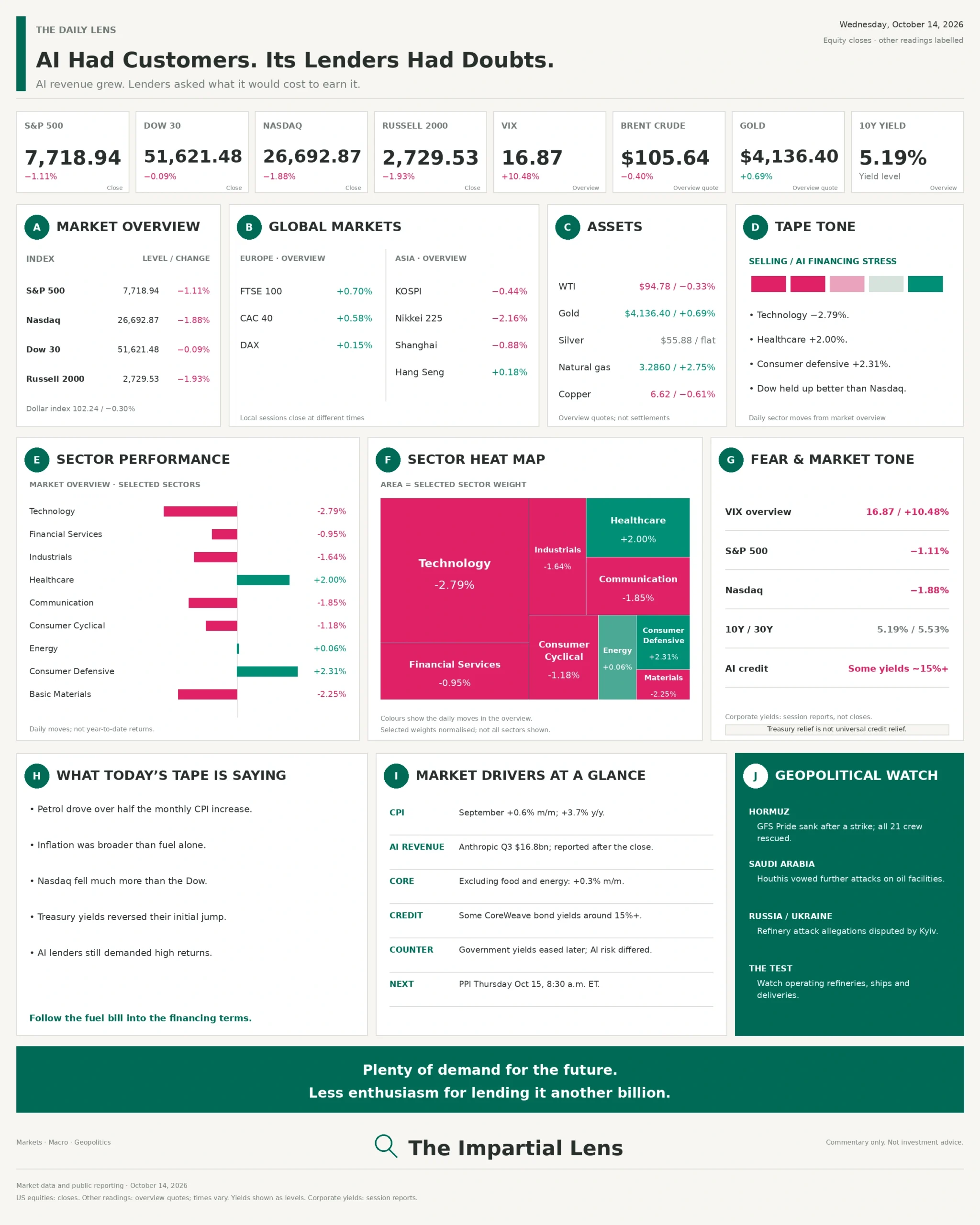
The S&P 500 fell 1.11%, the Nasdaq lost 1.88%, and the Russell 2000 dropped 1.93%. The Dow slipped just 0.09%.
Our market overview showed technology down 2.79%, while healthcare gained 2.00%. Investors were still buying shares—just becoming more particular about whose future they wanted to finance.
Inflation had given them another reason to be selective. September consumer prices rose 0.6%, taking the annual increase to 3.7%. Petrol accounted for more than half the monthly rise.
For households, that meant another expensive visit to the pump. For companies relying on borrowing, it made hopes of cheaper money harder to count on.
The Customers Were Real. The Financing Was Uncomfortable.
Later reporting said Anthropic had generated $16.8 billion in third-quarter revenue and told investors it had become profitable on an adjusted basis. Those adjustments deserve examination, but the revenue is substantial.
That is important evidence against dismissing the entire industry as an elaborate demonstration looking for a customer.
The harder question is how much it costs to serve those customers.
An AI developer buys computing from a cloud provider. The provider needs servers, buildings and electricity. The companies supplying those things can earn money well before the finished service has justified everything spent constructing it.
Revenue travels through the chain. So does dependence on the next customer paying.
Wednesday’s pressure was particularly visible at CoreWeave, which rents computing capacity. Its shares fell roughly 15%, while reports put yields on some of its bonds around 15% or higher.
Investors buying that debt wanted a substantial return for accepting the risk.
That does not suddenly increase the fixed interest on existing bonds. It does make the next financing conversation less pleasant.
Yesterday’s The AI Casino Met the Loan Officer examined banks choosing how much financing risk to accept. Wednesday showed the investors on the other side becoming more demanding too.
The customer can love the product. The lender can still dislike the balance sheet.
The Petrol Pump Spoiled the Argument for Relief
The inflation report made that financing problem harder to dismiss.
Fuel was the largest contributor, but prices excluding food and energy also rose 0.3% over the month. Shelter became dearer too. The Fed could not file the whole report under “trouble overseas” and move on.
Higher interest rates cannot produce another barrel of diesel. They can discourage spending elsewhere, making it harder for businesses to keep raising prices.
The discomfort therefore spreads beyond whoever caused the original shortage.
A delivery company pays more for fuel. Its customers face higher charges. Households have less left for other purchases. Businesses considering expansion must weigh those weaker customers against the cost of a new loan.
Meanwhile, Treasury yields retreated after their initial jump, with the 10-year around 5.19% later in the session. That offered some relief in government borrowing costs. It did not remove investors’ doubts about particular AI borrowers.
Washington and a company building server rooms are asking lenders to accept different risks.
As Yields Fell. AI Fell Harder. showed last week, a lower Treasury yield is helpful. It is not a certificate of profitability.
The Wars Were Still Sending Bills
There was little comfort in the shipping news.
These were container ships. The danger extends beyond tankers to the goods and equipment moving through the same waters.
Saudi Arabia has an alternative for some of its oil: pump it across the country to the Red Sea. But the Houthis have threatened Saudi shipping and attacked the pipeline. They vowed further attacks on airports and oil facilities Wednesday.
Taking the other road is useful. Finding another war along it is less so.
Russia and Ukraine offered a separate warning about relying on announcements. Moscow alleged fresh Ukrainian refinery attacks; Kyiv denied the accusation. The dispute itself showed how far the proclaimed energy ceasefire remained from a dependable agreement.
For fuel buyers, the practical questions remain unchanged: are refineries operating, are ships arriving, and what does delivery cost?
Promises of peace matter. So does whether anyone stops shooting.
What to Watch
- Does AI growth turn into cash? Look beyond revenue to spending and repayments.
- Do lenders become less nervous? Recovering AI bond prices would ease the warning.
- Are price pressures spreading? Thursday’s producer-price report is the next check.
- Does diplomacy change behaviour? Watch refinery operations, attacks and actual deliveries.
The Lens
Wednesday did not establish that AI lacks customers. Nor did it show that every business building it can earn enough to reward its investors.
The distinction matters.
Anthropic’s reported revenue showed money coming into the industry. CoreWeave’s financing pressure showed investors questioning what happens before that money reaches them.
There can be plenty of demand for the future—and considerably less enthusiasm for lending it another billion.
The Impartial Lens provides market commentary and education only. Nothing published here constitutes investment advice.