Chipmakers are selling the future. Lenders are examining the repayments. Meanwhile, attacks around Saudi Arabia’s oil industry are keeping another cost firmly in the present.
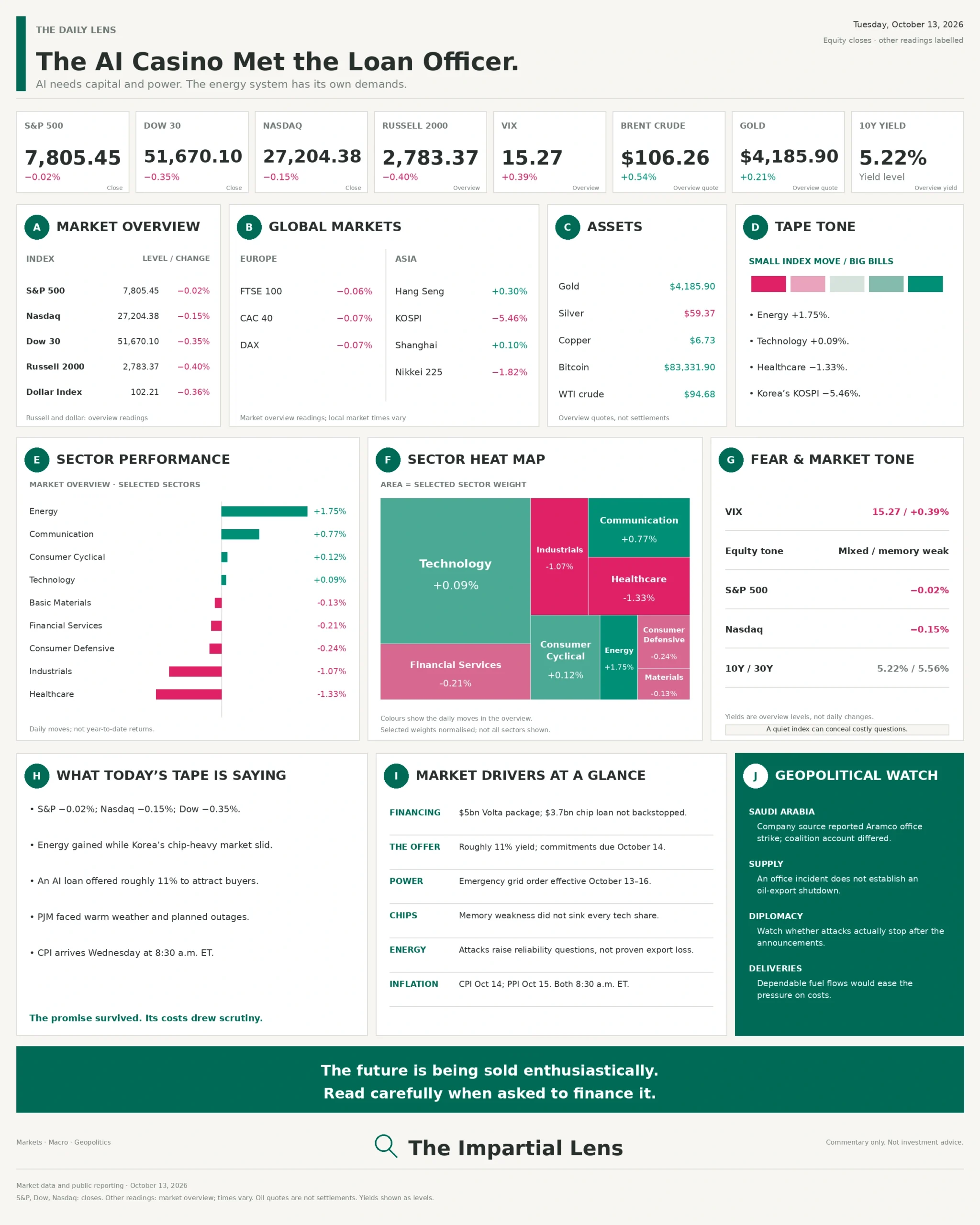
Tuesday, October 13, 2026 | The Daily Lens
What Today’s Tape Is Saying
The S&P 500 barely moved on Tuesday. South Korea’s stock market would have appreciated the same courtesy.
The S&P slipped 0.02%, the Nasdaq fell 0.15%, and the Dow lost 0.35%. Korea’s KOSPI dropped 5.46%.
That difference matters. South Korea is home to major memory-chip suppliers, whose fortunes depend heavily on demand and prices for the hardware powering the AI boom.
Monday brought concerns about Chinese competition. Tuesday brought closer scrutiny of the money financing the customers.
Technology edged higher in our market overview, while energy gained 1.75%. This was not a verdict against every technology company. Investors were examining where the pressure might land.
Growing demand for AI does not settle two important questions: what will suppliers earn, and can their customers afford the expansion?
The Chip Seller Mentioned a Casino
Broadcom chief executive Hock Tan compared some AI investment to casino gambling at a conference in Singapore on Monday.
An interesting observation from someone supplying the equipment.
His more consequential point concerned capital. The industry needs enormous amounts of money to keep building.
That money has to come from somewhere. Shareholders can provide it. Companies can reinvest their earnings. Lenders can finance equipment and buildings—but lenders expect repayment whether the enthusiasm survives or not.
Tan also acknowledged significant revenues at leading AI developers. There is real business behind the excitement.
The question is whether enough of that business reaches each company paying for the expansion.
As last Thursday’s Lens explored, demand for computing and a profitable investment are related questions. They are not interchangeable.
The Banks Were Reading the Small Print
One financing deal made the distinction unusually clear.
Bloomberg reported that JPMorgan and Goldman Sachs were arranging a $5 billion loan package for Volta, an AI infrastructure company. The borrowing was being offered at a yield of roughly 11%.
The banks had guaranteed $1.3 billion of the financing. A separate $3.7 billion loan to buy chips had no such guarantee.
That leaves the larger loan dependent on investors agreeing to provide the money.
Arranging financing and guaranteeing it are different jobs. The first brings a fee. The second can leave a bank holding debt it cannot sell.
Lenders learned that lesson painfully in 2022, when rising interest rates made previously agreed financing harder to pass on to investors.
An 11% offered yield is therefore worth examining. It is attractive income for a lender, but a substantial financing cost for the borrower. The computing business must earn enough to cover that cost alongside equipment, electricity and everything else required to operate.
None of this proves the project will fail. Investors may readily fund it.
But the terms show why “the banks are financing AI” needs a second question: how much risk are they keeping?
Cheaper Chips Have Two Sets of Customers
Monday’s concerns about Chinese memory-chip competition continued into Tuesday’s trading.
For a company building data centres, more competitive chip prices could be helpful. Equipment becomes cheaper, leaving less to finance.
For an established chip supplier, the same development can squeeze prices and profits.
Both companies may be growing. Their shareholders can still want opposite things from the price of a chip.
That is why weakness in memory shares does not automatically mean demand for AI has collapsed. Investors may be questioning how much suppliers will earn from demand that remains strong.
The useful test is whether lower equipment costs help customers build profitable businesses—or merely encourage another expensive round of expansion.
Saudi Arabia Supplied a Different Warning
The energy story was less concerned with competition.
Reuters reported that a company source said a missile struck an office tower at Saudi Aramco’s headquarters complex. The Saudi-led coalition separately described an interception and falling debris.
The accounts differed. Neither established that oil exports had stopped.
Nevertheless, further attacks around Saudi Arabia’s oil industry make dependable energy supplies harder to take for granted.
Monday’s Lens followed the consequences through ships, refineries and deliveries. Those remain the things to watch.
If disruption keeps fuel expensive, businesses face higher costs. If those costs sustain inflation, central banks have less room to ease borrowing.
That matters to the company financing a data centre—and to the household financing a car.
What to Watch
- Does the chip loan find buyers? Commitments are due October 14. Strong demand would ease the financing concern.
- Who benefits from cheaper chips? Watch suppliers’ margins and customers’ equipment spending.
- Will inflation allow cheaper borrowing? CPI arrives Wednesday. Watch the response in yields.
- Does diplomacy make deliveries safer? Look for fewer attacks, not another promised ceasefire.
The Lens
The AI boom has customers, revenues and useful technology. It also has suppliers protecting margins and lenders protecting their money.
Those interests can support the same expansion without sharing the same risks.
Tan’s casino comparison attracted attention. The loan terms offered something more useful.
Before following the enthusiasm, check what the people providing the money have agreed to guarantee.
The Impartial Lens provides market commentary and education only. Nothing published here constitutes investment advice.