
America Lost Jobs. Wall Street Found Goldilocks.

Stocks hit a record after payrolls fell by 23,000, while gold surged and Hormuz optimism returned.

Friday, August 7, 2026

The U.S. economy lost jobs in July. Wall Street celebrated.

Nonfarm payrolls fell by 23,000, badly missing expectations for an 80,000 gain. Traders responded by reducing the probability of another Federal Reserve rate increase, buying bonds, selling the dollar, and pushing the S&P 500 to a record close.

Gold climbed above $4,400, silver jumped 3.56%, and the Nasdaq gained 1.30%.

Bad news became good news again—but the precious-metals rally suggested investors were buying insurance along with the celebration.
The Tape: Records, Risk Appetite and a Falling VIX

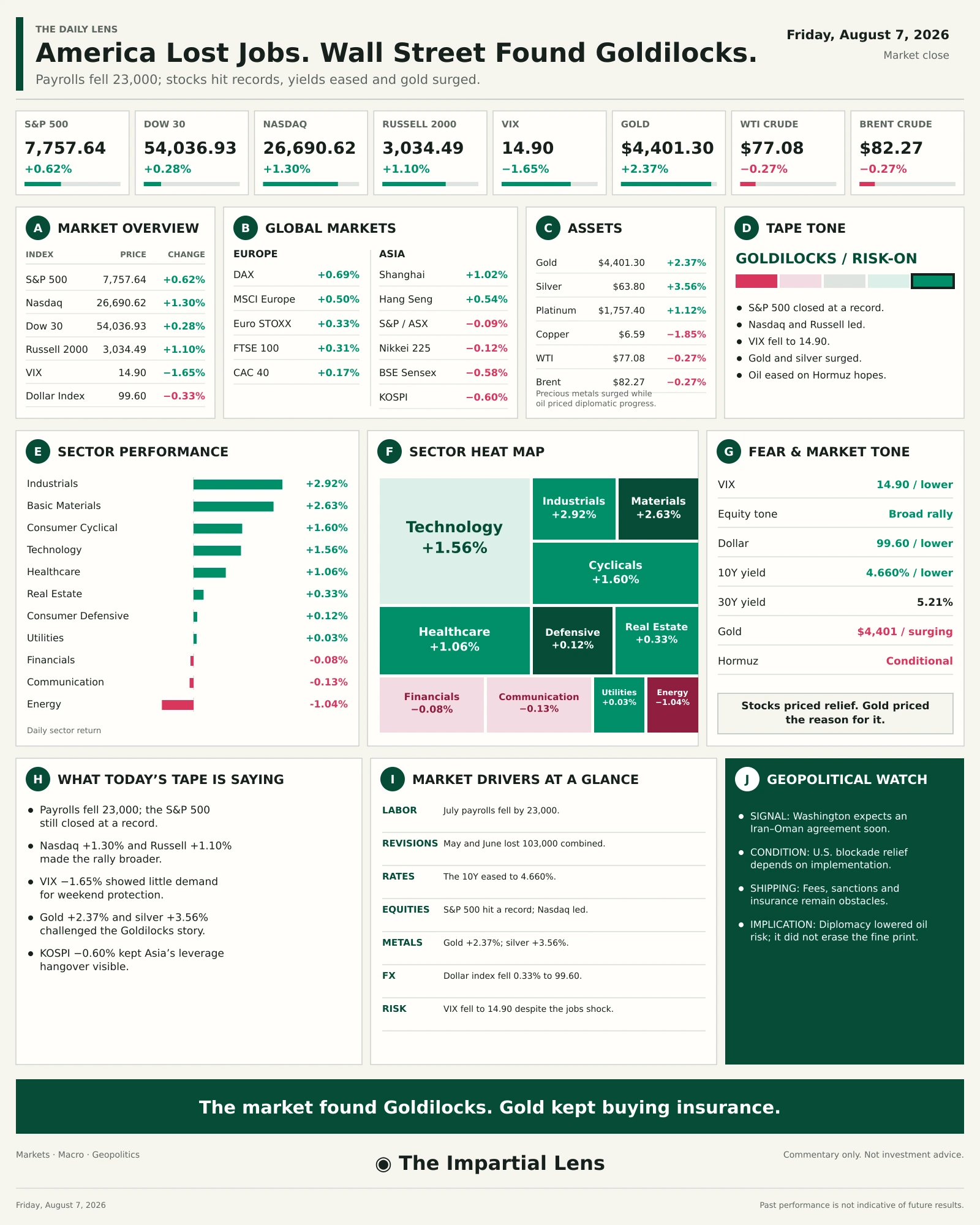
The S&P 500 gained 0.62% to 7,757.64, while the Nasdaq rose 1.30% to 26,690.62. The Dow added 0.28%, closing at 54,036.93, and the Russell 2000 advanced 1.10% to 3,034.49.

The VIX fell 1.65% to 14.90, showing little demand for immediate downside protection. Advancing stocks outnumbered decliners by more than two to one on both the New York Stock Exchange and Nasdaq.

Industrials led the sector map with a 2.92% gain, followed by consumer cyclicals at 1.60% and technology at 1.56%. Energy fell 1.04%, while communication services and financials slipped modestly.

For the week, the S&P 500 gained 3.58%, the Nasdaq rose 5.19%, and the Dow advanced 2.96%. After several violent reversals, Wall Street finished the week with risk appetite firmly restored.

The Jobs Report Was Weaker Than the Headline

The unemployment rate fell from 4.2% to 4.1%, but that was not evidence of a strengthening labor market. The participation rate declined to 61.4%, while another 381,000 people moved outside the labor force.

Previous months also deteriorated. May payroll growth was revised from 129,000 to 63,000, and June was cut from 57,000 to 20,000. Together, those revisions removed 103,000 jobs from earlier estimates.

The report did not describe a labor-market collapse. It described an economy losing momentum while the measurement itself kept getting marked down.

Rate markets reacted immediately. The estimated probability of a September rate increase fell to roughly 44%, from 55% before the report and 67% a week earlier.

Wall Street saw relief from higher rates. The bond market saw weaker growth.

Gold Did Not Buy the Goldilocks Story

The 10-year Treasury yield eased to 4.660%, while the dollar index fell 0.33% to 99.60. Gold rose 2.37% to $4,401.30, and silver climbed to $63.80.

Lower yields and a weaker dollar supported precious metals, but the scale of the move carried a second message. Investors were not simply celebrating easier policy expectations. They were also hedging economic weakness, unreliable labor estimates and an uncertain inflation path.

Stocks priced a friendly Federal Reserve. Gold priced the reason the Fed might need to become friendlier.

Global Markets: Europe Up, Asia Divided

Europe finished broadly higher, led by Germany’s DAX at +0.69%. Shanghai gained 1.02%, the Hang Seng rose 0.54%, and Australia advanced 0.50%.

Japan’s Nikkei slipped 0.12%, India lost 0.58%, and South Korea’s KOSPI fell another 0.60%. The global mood improved, but Asia’s leverage hangover remained visible.

Geopolitics: A Hormuz Deal Is Near—Again

A U.S. official said an agreement between Iran and Oman was expected soon. Washington would lift its blockade of Iranian ports once commercial shipping through the Strait of Hormuz was restored without impediments.

The important words were once and implemented. U.S. actions remain conditional on Iran fulfilling its commitments. Shipping groups have also warned that proposed transit fees, sanctions and insurance restrictions could make an agreement difficult to operate.

WTI and Brent both slipped 0.27%, suggesting the market assigned some credibility to the diplomacy. But an expected deal is not the same as ships moving freely under commercially workable terms.

Peace hopes lowered oil. They did not remove the fine print.

What Today’s Tape Is Saying

  • Weak employment reduced rate-hike expectations and lifted growth stocks.
  • The rally was broad enough to be more than another narrow AI squeeze.
  • Falling yields and a weaker dollar sent gold and silver sharply higher.
  • A low VIX showed that investors were comfortable carrying risk into the weekend.
  • Korea’s continued weakness showed that the global leverage unwind remains unfinished.
  • Oil eased as markets priced progress toward a Hormuz agreement.

Market Drivers at a Glance

  • Labor: Payrolls fell 23,000; prior months lost another 103,000 through revisions.
  • Rates: The 10-year eased to 4.660% as September hike expectations declined.
  • Equities: The S&P 500 reached a record; the Nasdaq led with a 1.30% gain.
  • Metals: Gold rose 2.37%, while silver jumped 3.56%.
  • Geopolitics: Washington said a Hormuz deal was near but conditional.
  • Risk: The VIX fell to 14.90 despite a week filled with policy and geopolitical shocks.

What to Watch Next

Watch whether the next inflation reports allow weaker employment to remain bullish for bonds and equities. If inflation stays firm, the market may discover that slower growth does not automatically produce easier policy.

Watch actual vessel traffic through Hormuz, not announcements. And watch whether gold continues climbing while the VIX falls. When stocks, bullion and complacency rise together, the market is expressing confidence and doubt at the same time.

Friday’s close was triumphant. The reasons behind it were less reassuring.

The Impartial Lens provides market commentary and education, not individualized investment advice.

America Lost Jobs. Wall Street Found Goldilocks.

Stocks hit a record after payrolls fell by 23,000, while gold surged and Hormuz optimism returned.

Friday, August 7, 2026

The U.S. economy lost jobs in July. Wall Street celebrated.

Nonfarm payrolls fell by 23,000, badly missing expectations for an 80,000 gain. Traders responded by reducing the probability of another Federal Reserve rate increase, buying bonds, selling the dollar, and pushing the S&P 500 to a record close.

Gold climbed above $4,400, silver jumped 3.56%, and the Nasdaq gained 1.30%.

Bad news became good news again—but the precious-metals rally suggested investors were buying insurance along with the celebration.

The Tape: Records, Risk Appetite and a Falling VIX

The S&P 500 gained 0.62% to 7,757.64, while the Nasdaq rose 1.30% to 26,690.62. The Dow added 0.28%, closing at 54,036.93, and the Russell 2000 advanced 1.10% to 3,034.49.

The VIX fell 1.65% to 14.90, showing little demand for immediate downside protection. Advancing stocks outnumbered decliners by more than two to one on both the New York Stock Exchange and Nasdaq.

Industrials led the sector map with a 2.92% gain, followed by consumer cyclicals at 1.60% and technology at 1.56%. Energy fell 1.04%, while communication services and financials slipped modestly.

For the week, the S&P 500 gained 3.58%, the Nasdaq rose 5.19%, and the Dow advanced 2.96%. After several violent reversals, Wall Street finished the week with risk appetite firmly restored.

The Jobs Report Was Weaker Than the Headline

The unemployment rate fell from 4.2% to 4.1%, but that was not evidence of a strengthening labor market. The participation rate declined to 61.4%, while another 381,000 people moved outside the labor force.

Previous months also deteriorated. May payroll growth was revised from 129,000 to 63,000, and June was cut from 57,000 to 20,000. Together, those revisions removed 103,000 jobs from earlier estimates.

The report did not describe a labor-market collapse. It described an economy losing momentum while the measurement itself kept getting marked down.

Rate markets reacted immediately. The estimated probability of a September rate increase fell to roughly 44%, from 55% before the report and 67% a week earlier.

Wall Street saw relief from higher rates. The bond market saw weaker growth.

Gold Did Not Buy the Goldilocks Story

The 10-year Treasury yield eased to 4.660%, while the dollar index fell 0.33% to 99.60. Gold rose 2.37% to $4,401.30, and silver climbed to $63.80.

Lower yields and a weaker dollar supported precious metals, but the scale of the move carried a second message. Investors were not simply celebrating easier policy expectations. They were also hedging economic weakness, unreliable labor estimates and an uncertain inflation path.

Stocks priced a friendly Federal Reserve. Gold priced the reason the Fed might need to become friendlier.

Global Markets: Europe Up, Asia Divided

Europe finished broadly higher, led by Germany’s DAX at +0.69%. Shanghai gained 1.02%, the Hang Seng rose 0.54%, and Australia advanced 0.50%.

Japan’s Nikkei slipped 0.12%, India lost 0.58%, and South Korea’s KOSPI fell another 0.60%. The global mood improved, but Asia’s leverage hangover remained visible.

Geopolitics: A Hormuz Deal Is Near—Again

A U.S. official said an agreement between Iran and Oman was expected soon. Washington would lift its blockade of Iranian ports once commercial shipping through the Strait of Hormuz was restored without impediments.

The important words were once and implemented. U.S. actions remain conditional on Iran fulfilling its commitments. Shipping groups have also warned that proposed transit fees, sanctions and insurance restrictions could make an agreement difficult to operate.

WTI and Brent both slipped 0.27%, suggesting the market assigned some credibility to the diplomacy. But an expected deal is not the same as ships moving freely under commercially workable terms.

Peace hopes lowered oil. They did not remove the fine print.

What Today’s Tape Is Saying

  • Weak employment reduced rate-hike expectations and lifted growth stocks.
  • The rally was broad enough to be more than another narrow AI squeeze.
  • Falling yields and a weaker dollar sent gold and silver sharply higher.
  • A low VIX showed that investors were comfortable carrying risk into the weekend.
  • Korea’s continued weakness showed that the global leverage unwind remains unfinished.
  • Oil eased as markets priced progress toward a Hormuz agreement.

Market Drivers at a Glance

  • Labor: Payrolls fell 23,000; prior months lost another 103,000 through revisions.
  • Rates: The 10-year eased to 4.660% as September hike expectations declined.
  • Equities: The S&P 500 reached a record; the Nasdaq led with a 1.30% gain.
  • Metals: Gold rose 2.37%, while silver jumped 3.56%.
  • Geopolitics: Washington said a Hormuz deal was near but conditional.
  • Risk: The VIX fell to 14.90 despite a week filled with policy and geopolitical shocks.

What to Watch Next

Watch whether the next inflation reports allow weaker employment to remain bullish for bonds and equities. If inflation stays firm, the market may discover that slower growth does not automatically produce easier policy.

Watch actual vessel traffic through Hormuz, not announcements. And watch whether gold continues climbing while the VIX falls. When stocks, bullion and complacency rise together, the market is expressing confidence and doubt at the same time.

Friday’s close was triumphant. The reasons behind it were less reassuring.

The Impartial Lens provides market commentary and education, not individualized investment advice.