
Stocks slipped as Alphabet tapped the debt market, Treasury yields rose, oil rebounded, and the Hormuz “deal” looked less peaceful than advertised.
Thursday, August 6, 2026
The AI boom has spent two years being treated as an earnings story. On Thursday, it became a funding story.
Alphabet moved to raise as much as $25 billion in the bond market. Treasury yields climbed, oil rebounded, and U.S. stocks drifted lower. Data centres, chips and power infrastructure are built with capital, not adjectives.
At the same time, optimism over a Strait of Hormuz agreement collided with proposed Iranian restrictions on American and Israeli vessels.
Wall Street discovered that both AI and peace arrive with term sheets.
The Tape: What Actually Happened
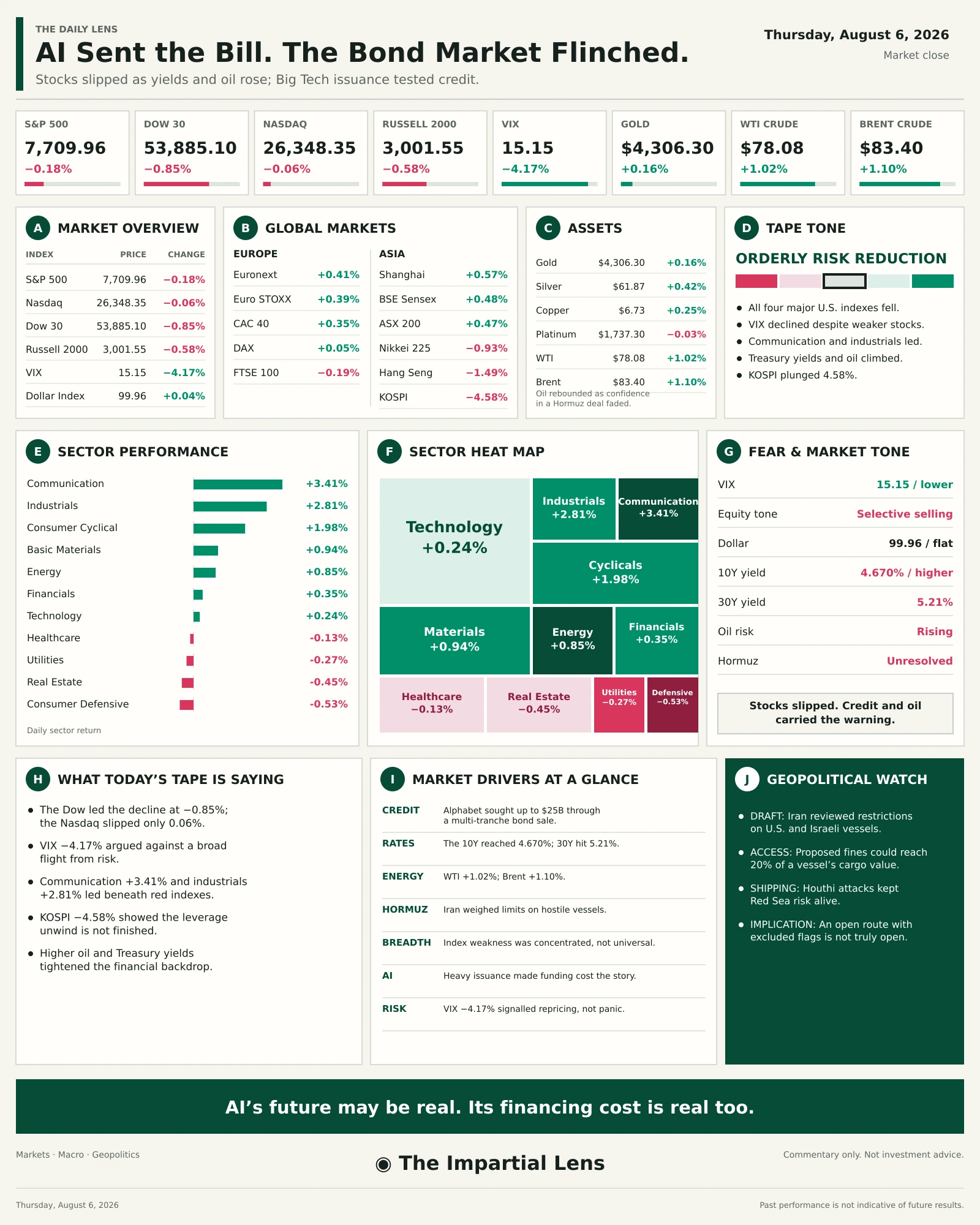
The Dow fell 0.85% to 53,885.10, the S&P 500 slipped 0.18% to 7,709.96, and the Nasdaq declined just 0.06% to 26,348.35. The Russell 2000 lost 0.58%, closing at 3,001.55.
Yet the VIX fell 4.17% to 15.15. Investors did not rush to buy protection. This looked like an orderly repricing rather than panic.
The sector map reinforced that message. Communication services gained 3.41%, industrials rose 2.81%, consumer cyclicals advanced 1.98%, basic materials added 0.94%, and energy gained 0.85%. Technology remained positive at 0.24%.
The indexes were red, but much of the market underneath them was green. The weakness was concentrated, not universal.
Asia Paid for Wednesday’s Exuberance
South Korea’s KOSPI plunged 4.58%, surrendering more than Wednesday’s rebound. The Hang Seng fell 1.49%, and Japan’s Nikkei lost 0.93%. China’s Shanghai Composite moved the other way, gaining 0.57%.
Europe was steadier. The Euro STOXX gained 0.39%, the CAC 40 rose 0.35%, and the DAX edged 0.05% higher, while the FTSE 100 slipped 0.19%.
This was not a synchronized selloff. Markets were sorting through where leverage and geopolitical exposure were most concentrated.
Big Tech’s AI Bill Reached the Bond Market
The 10-year Treasury yield rose to 4.670%, while the 30-year reached 5.21%. Against that backdrop, Alphabet sought between $20 billion and $25 billion through as many as ten bond tranches, with maturities ranging from two to 40 years.
Amazon, Alphabet, Meta and Oracle issued roughly $194 billion of bonds through early July—about 79% more than during the comparable 2025 period. Big Tech is expected to spend more than $730 billion this year, primarily on AI.
Credit is not warning that Alphabet is about to default. It is saying the AI buildout is becoming too large to hide inside cash reserves and quarterly enthusiasm.
Equity investors price the dream. Bond investors price the duration, supply, and repayment schedule.
AI may be transformative. The financing is not imaginary.
Geopolitics: An Open Strait—Except for the United States
An Iranian parliamentary committee was reviewing preliminary legislation that could bar American, Israeli and other “hostile” vessels from the Strait of Hormuz. Violators could face fines worth as much as 20% of their cargo.
The measure was not finalized. But it exposed the problem beneath the diplomacy: Tehran views the waterway as leverage, not merely traffic management.
A shipping route open only to approved flags is not an open waterway. It is a geopolitical tollbooth.
Houthi attacks kept the Red Sea risk alive. WTI rose 1.02% to $78.08, while Brent gained 1.10% to $83.40. Energy stocks advanced even as the broader indexes fell.
The market had priced a cleaner outcome. Thursday reintroduced the fine print.
Macro: Higher Oil Meets a Nervous Bond Market
Weekly unemployment claims changed little ahead of Friday’s July employment report, which lands in a market balancing softer hiring against persistent price pressure.
Oil is climbing, the 10-year is approaching 4.70%, and the 30-year remains above 5%. Add heavy corporate issuance, and the cost of capital becomes difficult to ignore.
The Federal Reserve does not need to raise rates for financial conditions to tighten. The bond market can do some of the work itself.
What Today’s Tape Is Saying
- The index decline did not become a broad risk event.
- A falling VIX showed that investors remained calm despite weaker stocks.
- Big Tech’s AI spending is increasingly becoming a credit-market story.
- Higher Treasury yields place more pressure on long-duration valuations.
- Korea’s renewed plunge showed that the leverage unwind is not finished.
- Hormuz optimism weakened as Iran’s proposed restrictions became clearer.
Market Drivers at a Glance
- Credit: Alphabet sought up to $25 billion through a multi-tranche bond sale.
- Rates: The 10-year reached 4.670%; the 30-year rose to 5.21%.
- Energy: WTI and Brent rebounded as confidence in a Hormuz deal faded.
- Geopolitics: Iran considered restrictions on hostile vessels.
- Positioning: Retail and momentum investors continued reducing crowded exposure.
- Earnings: Weak guidance punished several highly valued technology companies.
- Risk: The VIX fell, signalling repricing rather than panic.
What to Watch Next
Watch demand for Alphabet’s bonds and whether further hyperscaler issuance pushes borrowing costs higher. Watch the 10-year near 4.70%, the 30-year above 5.20%, and WTI as it approaches $80.
Most importantly, watch actual passage through Hormuz—not diplomatic adjectives. A draft route, restrictions and military activity can coexist.
Thursday’s market delivered a simple warning: the AI boom can be real and still become expensive to finance. Diplomacy can advance and still leave the risk premium intact.
The Impartial Lens provides market commentary and education, not individualized investment advice.