An AI boom waiting for electricity. An investment summit waiting for peace. A government waiting for creditors to regain their confidence. This week, the distance between ambition and reality became impossible to ignore.
The Weekly Lens | Saturday, October 24, 2026
Somewhere in Amazon’s AI supply chain, enormously expensive computing equipment was waiting for somewhere to plug in. The chips had been ordered; the electricity hadn’t caught up.
In Riyadh, an international gathering of financiers scheduled for next week was postponed until 2027. Saudi Arabia was selling its future, but first its guests needed to arrive safely.
And in Paris, the French government couldn’t postpone the interest on its debts. Investors were asking for more money to lend it the same euros.
Three countries. Three ambitions. One question: what happens when the cost of delivering tomorrow catches up with the promises made yesterday?
That was the story beneath five days of headlines. The world still dreamed big. Its financiers grew more particular about the price.
The Machines Arrived Before the Electricity
The image from Tuesday’s Daily Lens was almost comical: advanced AI equipment reportedly sitting in storage because some intended facilities still lacked enough power to operate it.
Business Insider reported on the scheduling problem inside Amazon’s vast data-centre expansion. Servers, substations, cooling systems and grid connections don’t arrive together. Ordering chips doesn’t make the finished facility appear.
That isn’t proof Amazon’s strategy is failing; securing scarce equipment early can be rational. But the market increasingly recognised: a purchase order is not a functioning business.
Then came Meta’s earnings. Revenue reached $64.6 billion in the third quarter, up 26% from a year earlier. It generated nearly $32.8 billion in operating cash flow. A formidable business.
Yet Meta’s own figures showed $34.91 billion in capital spending, including principal payments on finance leases, and negative $2.12 billion in free cash flow. It expects full-year capital expenditures of $135 billion to $145 billion. Not every dollar is for AI, and Meta remains financially strong. But when will returns match the outlay?
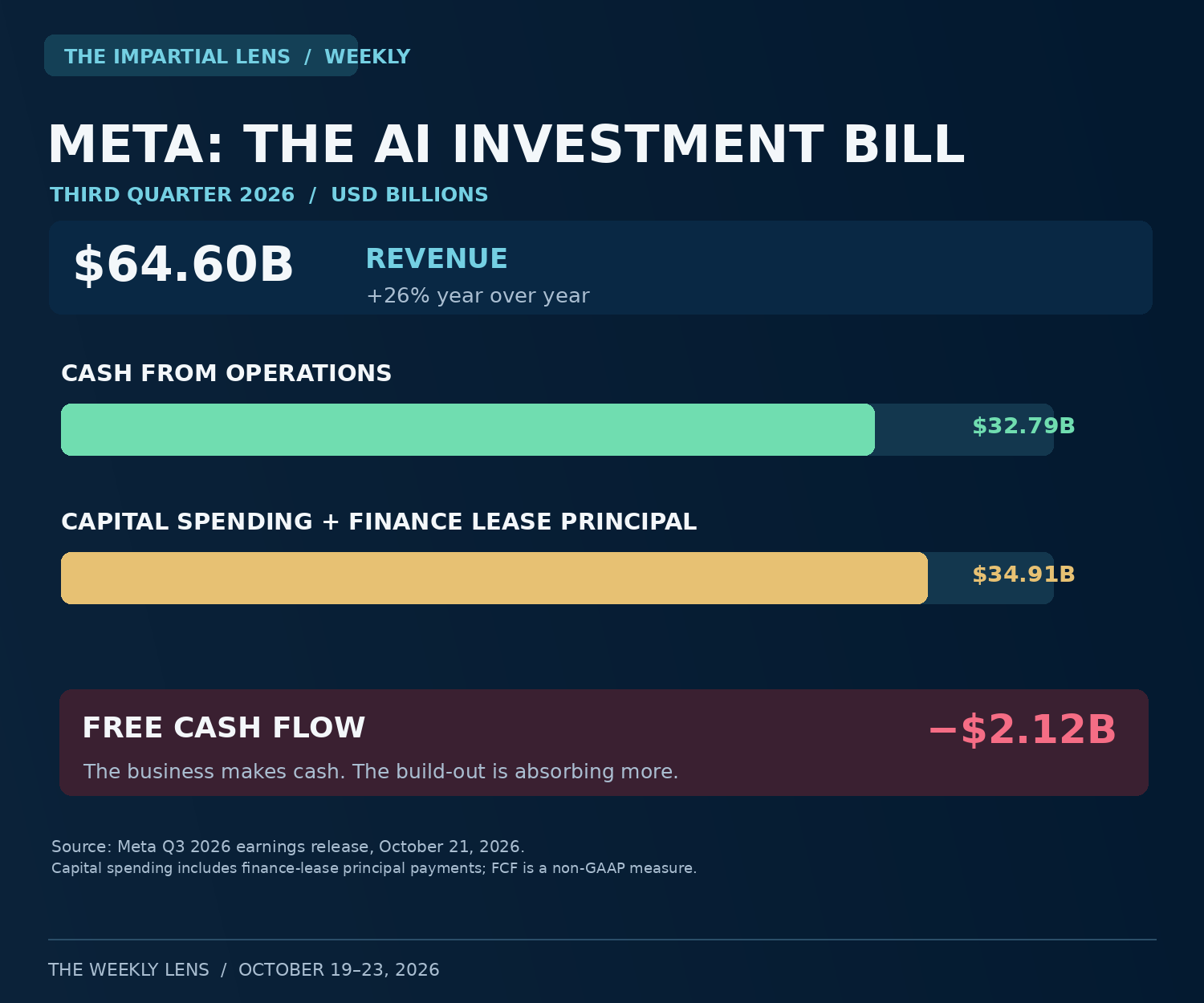
The question changed this week. Less what can AI do? More what will it earn, when will it earn it, and who finances the wait?
Riyadh Had the Capital. It Needed the Calm.
Saudi Arabia has spent years inviting international money into its transformation beyond oil: tourism, infrastructure, technology and business. Its Future Investment Initiative brings leading financiers face-to-face with that ambition.
This week the invitations met the war. Organisers postponed the October 26–29 gathering to 2027, after Houthi attacks heightened security concerns. Money moves easily. People, planes and infrastructure remain vulnerable.
Now follow the coastline east. The Persian Gulf narrows into the Strait of Hormuz, between Iran and Oman. According to the International Energy Agency, about a quarter of the world’s seaborne oil trade normally passes through this passage. Some pipelines bypass it; other producers have few alternatives.
Oil needn’t stop flowing for war to reach a household budget. A tanker captain needs a safe passage. An insurer needs to price the danger. A refinery needs reliable delivery dates. Every extra cost has somewhere to land.
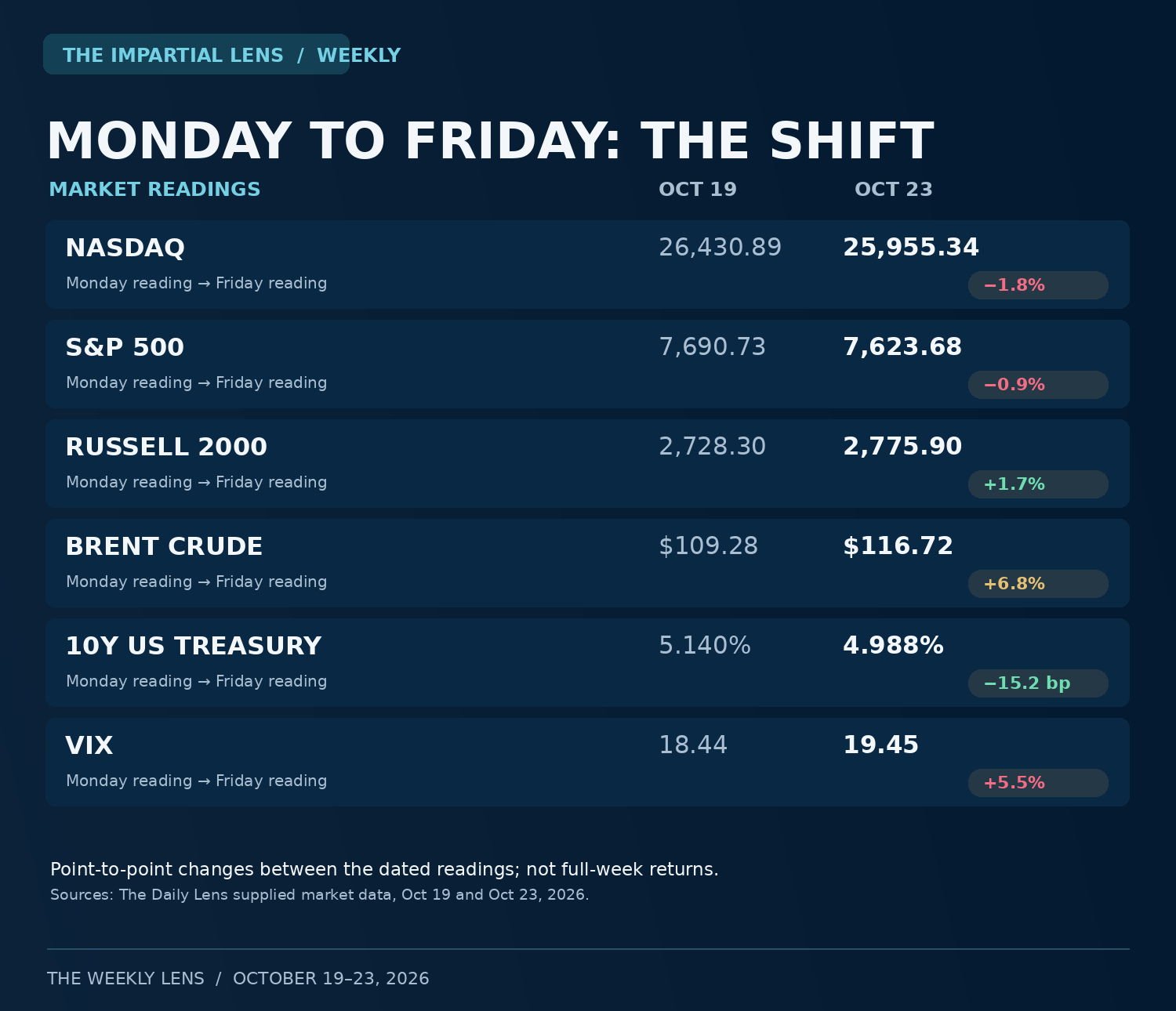
By Friday, Brent crude settled at $116.72 a barrel, roughly 6.2% higher for the week. Energy-market reporting tied the rally to renewed fears of disruption. Higher oil prices reward producers but punish many fuel buyers.
The paradox: expensive oil can enrich Saudi producers while undermining the diversified business economy Riyadh wants to build.
Paris Discovered the Price of Doubt
France needed no missile to unsettle its bond market. Political deadlock, unrest and an unconvincing budget were enough.
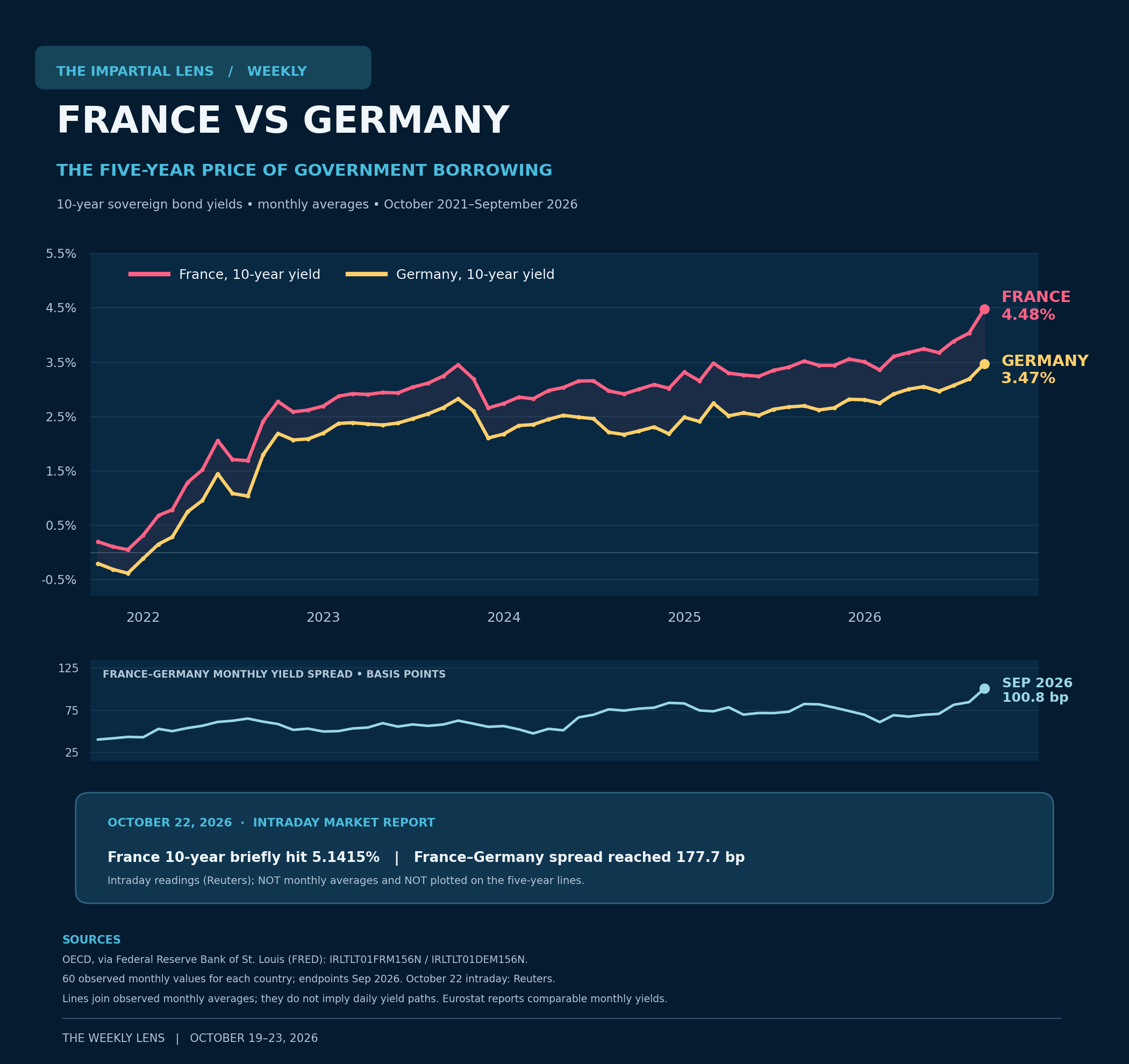
France’s 10-year government-bond yield reached roughly 5.14% on Thursday, its highest since 2002. The additional yield investors demanded over German government bonds widened to a level last seen in the eurozone debt crisis, according to Reuters.
The word spread sounds technical but tells a simple story. France and Germany borrow in the same currency. If lenders charge France significantly more, they are demanding a higher return for taking its risks. When existing bond prices fall, their yields rise. Future borrowing and refinancing can become more expensive.
That does not mean France is about to default. Nor is today’s Europe a replay of 2011. Europe has stronger financial defences than in 2011. Still, widening spreads tell politicians: the bond market is no longer taking their reassurances at the old price.
On Thursday, buyers sought shelter in US Treasuries, pulling American yields lower, while selling French debt. One government’s promise looked more attractive; another’s required a discount. It was an unusually clear illustration that even among government bonds, confidence has a price.
The consequences reach beyond trading desks. Interest competes with public services; fiscal repairs may mean taxes or cuts. A country cannot settle an argument over who pays for its future by refusing to acknowledge the invoice.
We’ve Built a Future Too Quickly Before
In the late 1990s the internet was real and demand for data was growing. Telecommunications companies raced to lay fibre-optic cables and finance new networks.
The Federal Reserve Bank of Richmond later described the investment surge and the painful reversal that began in 2000. Forecasts had been wrong; too much capacity had been built ahead of demand. Companies and investors suffered even as the internet went on changing the world.
Today’s AI boom isn’t an exact replay. Meta and Amazon possess established profits, customers and financial resources many telecom challengers lacked. AI also faces a special physical constraint: even a perfectly useful model is worthless to a customer if the electricity, cooling and grid connection are unavailable.
The older lesson remains: Correctly predicting the future is not the same as paying the right price to build it. A breakthrough can change civilisation and still leave some of its financiers nursing losses.
What the Week’s Market Prices Were Saying
The Nasdaq rose 1.11% Monday, barely moved Tuesday, climbed 1.05% Wednesday and fell 2.60% Thursday. Oil pressure brought another small decline Friday.
But the week’s final score wasn’t an indiscriminate rout. AP’s Friday close showed the Nasdaq down about 0.7% for the week and the S&P 500 down about 0.5%, while the Dow gained roughly 0.4% and the Russell 2000 rose about 2%.
| Weekly market reading | Week ending Oct. 23 |
|---|---|
| Nasdaq Composite | −0.7% |
| S&P 500 | −0.5% |
| Dow Jones Industrial Average | +0.4% |
| Russell 2000 | +2.0% |
| Brent crude | +6.2%; Friday $116.72 |
That is market breadth: how widely gains and losses are spread. It also showed rotation: investors moving between sectors and company sizes, not simply abandoning stocks. Friday’s energy shares were the standout in our Daily Lens market reading, up 4.58% on the day—a very different experience from businesses buying fuel.
Bond yields offered a second clue. US Treasury yields fell during Thursday’s technology selloff as demand for the bonds increased. Fear of inflation hadn’t vanished. It was being joined by fear that expensive capital and overbuilding might eventually slow growth.
What This Means Beyond Wall Street
For a family, the question is whether energy, mortgage costs and wages leave room for savings. For a business, it is whether the next delivery, loan or electricity connection arrives at a price that still permits a profit. For an investor, it is whether an attractive story is also an attractive investment after financing costs and risks are counted.
There may be opportunities in infrastructure, reliable energy and businesses that defend margins—and expensive mistakes elsewhere. The point isn’t to guess this week’s winning ticker. It’s to understand which businesses can turn spending into durable cash flow.
Five Things We’re Watching
1. AI’s timetable. Are new data centres gaining power, customers and revenue as quickly as their bills arrive?
2. The French-German spread. Does France calm investors with a credible budget, or keep paying more for borrowed money?
3. The price of delivered oil. Do safer voyages reduce insurance and freight charges, even if crude production continues?
4. The next earnings reports. Do AI suppliers and customers show stronger returns on capital, or merely bigger spending plans?
5. Market leadership. Will gains broaden beyond the largest companies, or will caution keep shifting between sectors?
The Lens
The financiers who were meant to fly into Riyadh can rearrange their calendars. The server racks can wait for the power to arrive. French voters can argue about which promises their government ought to keep.
But someone is still paying for the delays. A developer carries the cost of idle equipment. A shipper pays more for a dangerous voyage. A government refinancing its debts discovers that lenders have raised their price.
None of this proves that the world’s ambitions are foolish. We need better technology, more reliable energy and governments capable of investing in their future.
It does suggest a more demanding test of every grand plan: can you actually build it, can people afford to use it, and will the return justify the risk?
The world has no shortage of big ideas. This week was a reminder that the electricity, the security and the money still have to turn up.
The Impartial Lens provides commentary and education, not personalised investment advice.
Featured photograph: Cranes of Dusk by Badseed (Athens, 2008), CC BY-SA 4.0. Resized for publication. Illustrative historical photograph, not an image of October 2026 events.
