Oil relief lifted the Dow, but a 10.84% collapse in Korea and a 2.69% fall in US technology showed that the AI unwind was far from over.
Tuesday, July 28, 2026
The Tape: What Actually Happened
Observable market data
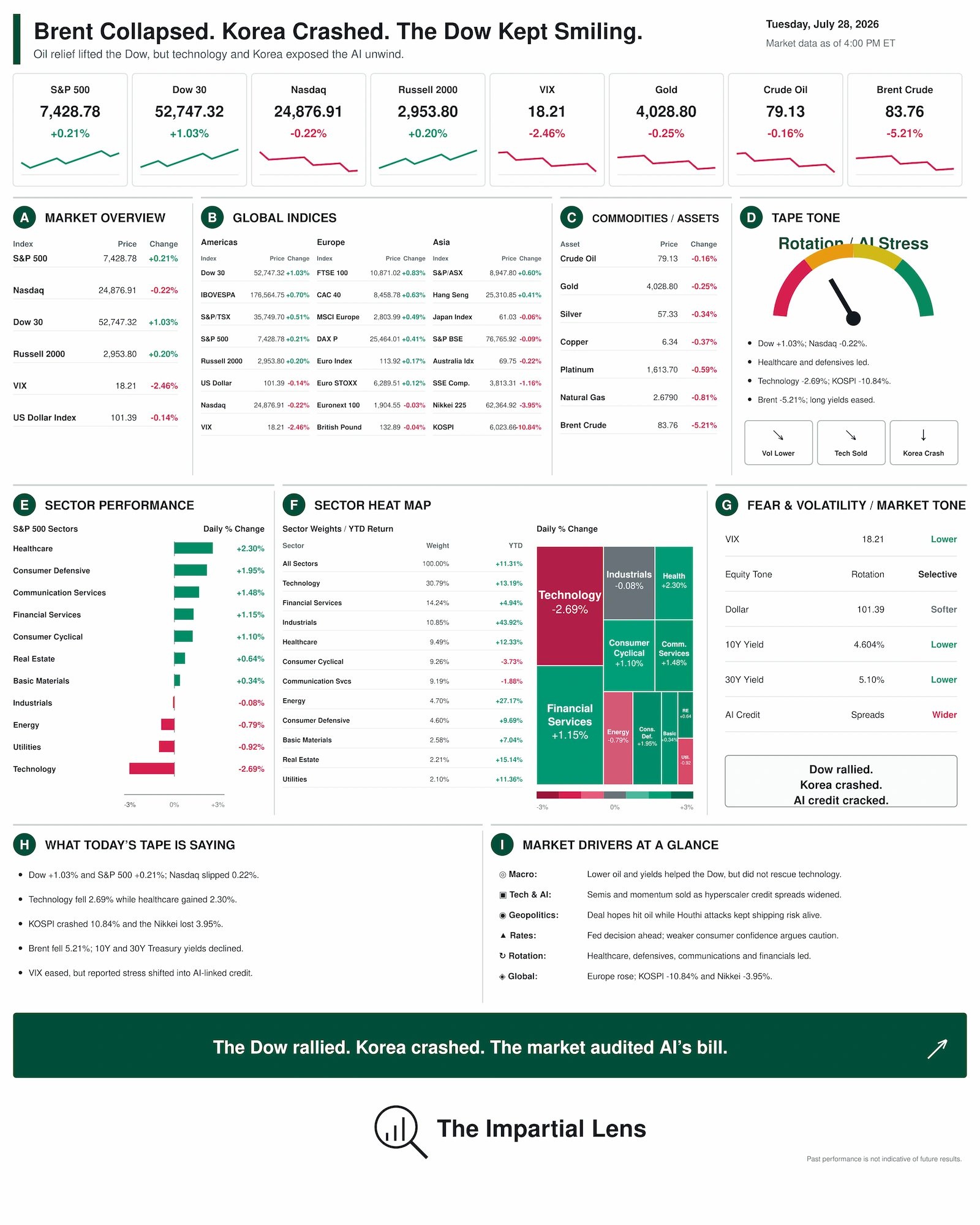
The S&P 500 gained 0.21% to close at 7,428.78. The Dow rose 1.03%, and the Russell 2000 added 0.20%, while the technology-heavy Nasdaq slipped 0.22%. The VIX fell 2.46% to 18.21.
Beneath those modest index moves, the sector split was much wider. Technology fell 2.69%, energy lost 0.79%, and utilities dropped 0.92%. Healthcare gained 2.30%, consumer defensive stocks rose 1.95%, communication services added 1.48%, financials advanced 1.15%, and consumer cyclicals gained 1.10%.
Brent crude fell 5.21% to $83.76, while WTI slipped 0.16% to $79.13. The 10-year Treasury yield declined to 4.604%, and the 30-year yield fell to 5.10%. Gold lost 0.25% to $4,028.80, while Bitcoin gained 0.27% to $63,905.
The Impartial Lens
Tuesday brought a rotation, not a broad rally. Investors bought healthcare, defensive companies, and financials while selling technology and semiconductors. Rotation means money is moving between sectors rather than lifting the whole market. The Dow’s gain showed investors finding places to hide while reducing exposure to AI.
The headline indices looked calm. The market underneath them did not.
Global Markets: Korea Became the Warning
Europe had a solid session. The FTSE 100 gained 0.83%, France’s CAC 40 rose 0.63%, MSCI Europe added 0.49%, and Germany’s DAX advanced 0.41%.
Asia told a very different story. Australia rose 0.60%, and Hong Kong gained 0.41%, but Shanghai fell 1.16%, Japan’s Nikkei dropped 3.95%, and South Korea’s KOSPI crashed 10.84%.
Korea matters because its market had become heavily tied to semiconductors, AI enthusiasm and leveraged retail trading. Reports pointed to forced selling and ETF rebalancing. Falling prices forced leveraged funds to cut exposure; those sales pushed prices lower and risked triggering more selling.
Oil and Geopolitics: Traders Priced Hope, Ships Priced Risk
Brent’s 5.21% fall followed renewed optimism that the United States and Iran were moving closer to an agreement. Reports suggested Iran was becoming more flexible over operations in the Strait of Hormuz.
But the physical evidence remained less comforting. The Houthis reportedly fired on a Saudi vessel, other ships changed course and China was said to be negotiating safe passage for its tankers.
Oil traders priced a better chance of diplomacy. Shipping companies continued to behave as though the danger was real. Brent’s decline meant the market saw less risk—not that Hormuz or the Red Sea had become safe.
Rates and the Fed: Relief, but Not Certainty
Treasury yields fell, but uncertainty remained over Wednesday’s Federal Reserve decision. Some strategists believed a surprise rate increase was possible, even as weaker consumer confidence argued for caution.
Lower yields would normally help technology shares because they increase the present value of expected future profits. Technology fell anyway. That suggests investors were worried about more than interest rates.
Big Tech and AI: The Market Is Auditing the Invoice
Technology’s 2.69% decline was much worse than the Nasdaq’s 0.22% loss suggested. Gains elsewhere softened the index-level damage while semiconductor and momentum trades remained under pressure.
More important was the reported stress in hyperscaler credit. A credit spread is the extra return investors demand to lend to a company rather than the US government. A wider spread means lenders see more risk.
Reports highlighted concerns about off-balance-sheet obligations, intercompany relationships and opaque financing arrangements connected to the AI buildout.
Stocks ask whether AI will generate enough growth to justify today’s valuations. Credit asks a more basic question: who is paying for it?
AI infrastructure requires enormous spending on chips, data centers, power and networks. If profits arrive too slowly, companies may need to borrow more or issue shares. AI can be transformative and still become a poor investment when prices and debt rise faster than cash flow.
The market may still love the product. It is beginning to audit the invoice.
What to Watch
- The Federal Reserve: The decision and press conference could move both bonds and technology.
- Korea and semiconductors: Stabilization would suggest forced selling is easing. Another sharp decline would indicate the unwind is spreading.
- Hyperscaler credit: Widening spreads could expose financial stress before it appears in earnings.
- Hormuz and the Red Sea: Diplomatic headlines matter, but tanker movements provide the harder evidence.
- Market breadth: Watch whether gains spread across sectors or remain a rotation away from technology.
The Bottom Line
The Dow rose 1.03%, volatility fell, and Brent dropped sharply. Yet technology lost 2.69%, and Korea crashed 10.84%. This was capital moving away from a crowded AI trade and toward safer or less expensive sectors—not a broad return to risk-taking.
Tuesday’s lesson is simple: a green index can hide a serious problem.
AI may still change the world. But the technology, the companies building it, and the financing behind them are three different investments. The market is finally pricing that difference.
The Impartial Lens provides market commentary and education, not personalized investment advice. Market prices can change rapidly, and past performance does not guarantee future results.