Investors got cheaper crude, lower yields and calmer war headlines. Technology fell 2.37% anyway, as China challenged the scarcity premium supporting America’s AI winners.
Monday, July 27, 2026
The Tape: What Actually Happened
Observable market data
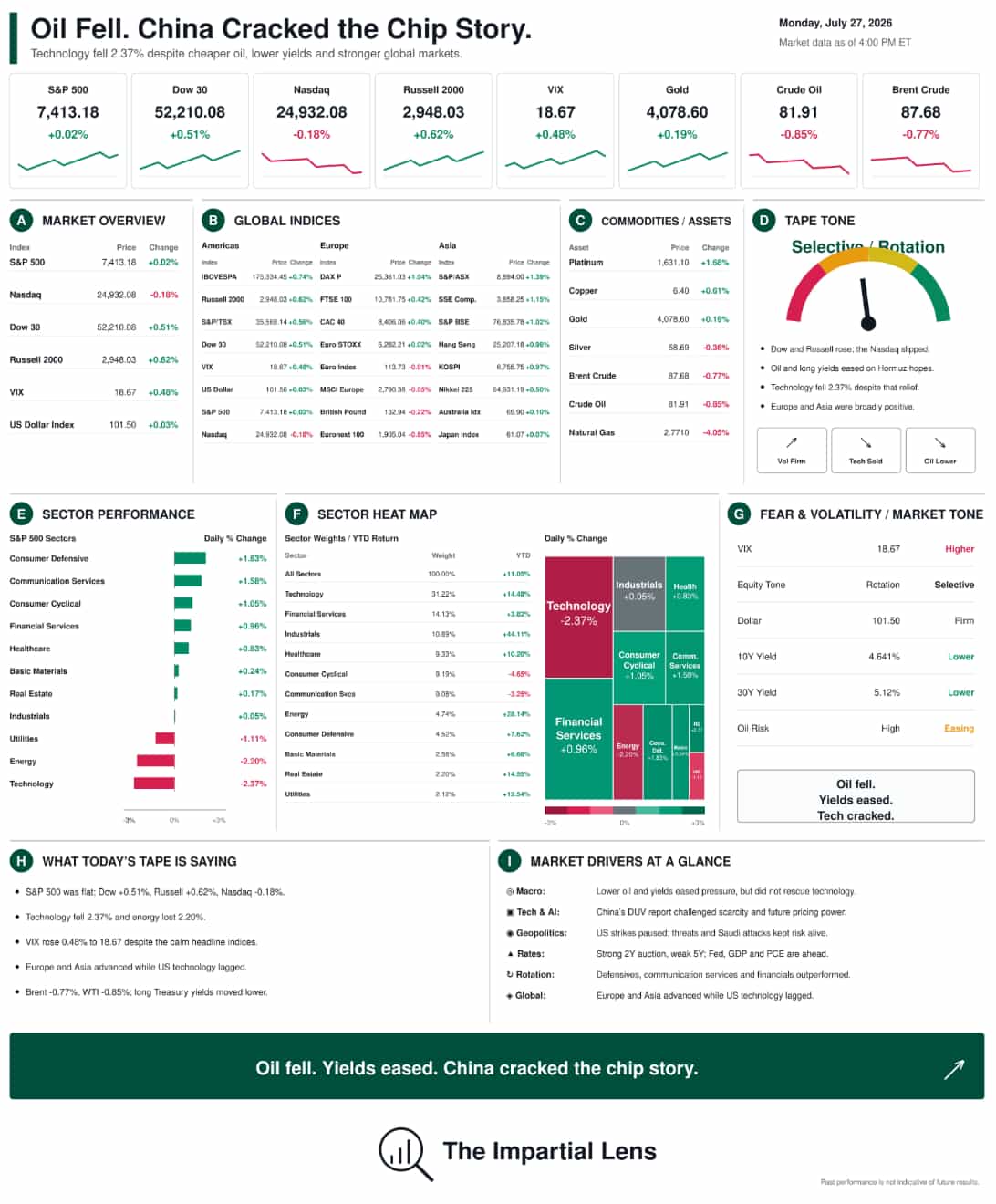
The S&P 500 finished almost unchanged at 7,413.18, up 0.02%. The Dow gained 0.51%, and the Russell 2000 rose 0.62%, while the Nasdaq slipped 0.18%. The VIX edged 0.48% higher to 18.67.
The calm result concealed a violent sector split. Technology fell 2.37%, and energy lost 2.20%. Consumer defensive stocks gained 1.83%, communication services rose 1.58%, consumer cyclicals added 1.05%, financials advanced 0.96%, and healthcare gained 0.83%.
Oil and Treasury yields moved lower. WTI finished at $81.91, down 0.85%, while Brent fell 0.77% to $87.68. The 10-year Treasury yield ended at 4.641% and the 30-year at 5.12%. Gold rose 0.19%, while Bitcoin fell 1.10%.
The Impartial Lens
This was not a market-wide panic. It was a targeted eviction from one of the most crowded rooms on Wall Street.
Oil fell. Yields eased. Most global markets rose. Those conditions should have helped long-duration technology shares. They did not. Investors received macro relief—and sold technology anyway.
That matters. Technology could previously blame its bruises on war, inflation or the bond market. On Monday, those alibis weakened. The pressure increasingly came from inside the AI story itself.
Global Markets: Risk Appetite Did Not Disappear
Germany’s DAX gained 1.04%, the FTSE 100 rose 0.42%, and France’s CAC 40 added 0.40%. The broader Euro STOXX index was nearly unchanged.
Asia was stronger. Australia gained 1.39%, Shanghai 1.15%, India 1.02%, Hong Kong 0.98%, South Korea 0.97% and Japan 0.50%.
Money fled US technology but found other places to hide—or work. This was rotation with teeth, not indiscriminate panic.
Oil and Rates: Relief, With an Expiration Date
Crude retreated after the United States paused strikes on Iran over the weekend. Lower oil reduced fears of another inflationary energy shock and helped Treasury yields ease.
But the geopolitical record remained contradictory. President Trump said military action could resume if diplomacy failed. Iranian officials disputed that they had requested renewed talks. The Houthis claimed attacks on Saudi oil infrastructure, while reports said a tanker struck a mine in Hormuz.
The market priced a lower probability of immediate disruption—not the disappearance of the threat. Hormuz did not become safe overnight. It merely became cheaper to worry about.
A strong two-year Treasury auction was followed by a weak five-year sale. With the Federal Reserve, GDP and PCE inflation data ahead, one quiet weekend was never going to exorcise the bond market’s inflation demons.
Big Tech and AI: The Scarcity Premium Meets China
Reports that China has begun mass-producing domestically developed deep-ultraviolet lithography equipment hit semiconductor shares. Bank of America reportedly called it only a modest near-term threat to ASML. The market heard something larger: the moat may be real, but investors had priced it like an ocean.
The AI boom has rested partly on scarcity: advanced chips, manufacturing capacity, memory and a small group of essential suppliers. China does not need to win the chip war tomorrow. It only needs to puncture the belief that Western scarcity, margins and pricing power will last forever.
Investors are also questioning hyperscaler spending, debt issuance and increasingly circular financing. AI can be transformative while its financing becomes fragile and its valuations unforgiving. Revolutionary technology does not make every capital allocation decision intelligent.
Technology’s 2.37% fall was not a vote against AI. It was a warning that belief in AI is no longer sufficient to defend every AI valuation.
Geopolitics: The Market Wants Peace Before Peace Exists
Monday’s oil decline reflected hope that the US-Iran conflict was moving toward talks. Yet threats, interceptor shortages and attacks on regional energy infrastructure remained in the same headline stack.
Markets can price probabilities; they cannot make uncertainty disappear. Renewed strikes, damage to Saudi infrastructure or another Hormuz disruption could send Monday’s relief trade straight back through the revolving door.
What to Watch
- Semiconductors: Watch whether weakness remains concentrated or spreads into the broader index.
- Mega-cap earnings: Guidance must justify both the scale of AI spending and the financing required to sustain it.
- The Federal Reserve and PCE: The market needs confirmation that inflation is cooling without growth collapsing.
- Treasury demand: The contrast between the strong two-year and weak five-year auctions deserves attention.
- Hormuz and Saudi infrastructure: Lower oil is helpful, but only while physical supply remains intact.
The Bottom Line
Monday gave investors cheaper oil, lower yields, and better geopolitical headlines. Technology still fell 2.37%. When the usual excuses disappear, and the selling continues, it is worth listening.
The AI boom is not necessarily finished. But another piece of the fantasy—that every dollar of AI spending automatically becomes shareholder value—is beginning to crack. The market now wants to know who keeps the pricing power, who finances the buildout, and who earns an acceptable return.
The indices looked calm. Underneath them, one of the market’s most expensive assumptions was being interrogated—with a blowtorch.
The Impartial Lens provides market commentary and education, not personalized investment advice. Market prices can change rapidly, and past performance does not guarantee future results.