Oil rose, energy shares surged and the Dow lost more than 650 points. Behind Friday’s trading was an awkward combination: expensive fuel, doubts about AI spending and investors wondering where the next stretch of growth would come from.
Friday, October 23, 2026 | The Daily Lens
What Today’s Tape Is Saying
The delivery company still had parcels to move on Monday. The airline still had passengers booked. Neither could do much about the fighting around the Persian Gulf, but both had reason to watch Friday’s oil market.
Brent crude settled at $116.72 a barrel. WTI finished at $103.27.
For companies producing oil, higher prices can improve the outlook. For companies buying it, they complicate the budget.
That divide was written across Friday’s trading. Energy shares gained 4.58% in our market overview. Most other sectors fell. Technology edged higher after Thursday’s heavy selling, but the recovery offered little comfort to businesses facing another expensive fuel bill.
| Market | Friday’s reading | Daily move |
|---|---|---|
| S&P 500 | 7,623.68 | −0.52% |
| Dow | 52,215.16 | −1.23% |
| Nasdaq | 25,955.34 | −0.21% |
| Russell 2000 | 2,775.90 | −0.29% |
| VIX | 19.45 | +2.21% |
| US 10-year yield | 4.988% | +0.035 percentage points |
The Dow’s 652.82-point decline made the loudest noise. Energy’s bright green corner told us more about the tension underneath.
Somebody’s better selling price was becoming somebody else’s higher operating cost.
The War Was Becoming a Business Expense
Saudi Arabia has spent years inviting the world to invest in its future. This week, it postponed its flagship investment summit, while Washington ordered some diplomatic staff out of the country.
Then Aramco told headquarters staff to evacuate and work remotely as fighting with Yemen’s Houthis intensified.
That instruction concerned its offices. It did not establish that Saudi oil production had stopped. Nevertheless, the circumstances were hardly reassuring for businesses trying to plan deliveries through the region.
Friday brought another visible consequence of the pressure on Gulf shipping: an oil spill affected UAE beaches, prompting closures and a cleanup. Authorities initially left the tanker’s identity and the cause unspecified.
The economic damage extends beyond barrels lost.
A shipowner needs a crew willing to sail, insurance covering the voyage and confidence that the vessel will reach port. Buyers need dependable delivery dates. Refineries need the right cargo arriving when expected.
When those arrangements become uncertain, everyone builds a little more protection into the price.
Friday’s rise in crude reflected fears of further disruption. From there, the expense can travel through freight charges, production costs and household bills.
A conflict does not need to reach your country to become your problem. It only needs to reach something your country buys.
AI’s Spending Was Somebody Else’s Income
Technology’s modest recovery followed a much rougher Thursday.
Meta had reported a growing business alongside an enormous construction bill. Operating cash generation reached $32.79 billion during the quarter; capital spending, including finance-lease payments, reached $34.91 billion.
Meta has substantial financial resources. Investors nevertheless want to know when the new investment will earn enough to justify its cost.
As Tuesday’s Lens followed, computers require buildings, cooling and electricity before they can serve customers. Delays extend the wait between paying for equipment and earning money from it.
But cutting spending brings another difficulty.
The money financing a data centre becomes revenue for chipmakers, contractors and electrical suppliers. A postponed project can mean fewer orders and less work.
That possibility helps explain why investors bought US Treasuries during Thursday’s technology sell-off, even as oil rose. Concern about inflation was being joined by concern about growth.
Friday’s Treasury yield edged higher again, but remained just below 5%.
The distinction is useful: lower borrowing yields are most reassuring when inflation eases and business stays healthy. They offer less comfort when investors are seeking shelter because they expect business to weaken.
What the Dashboard Is Telling Us
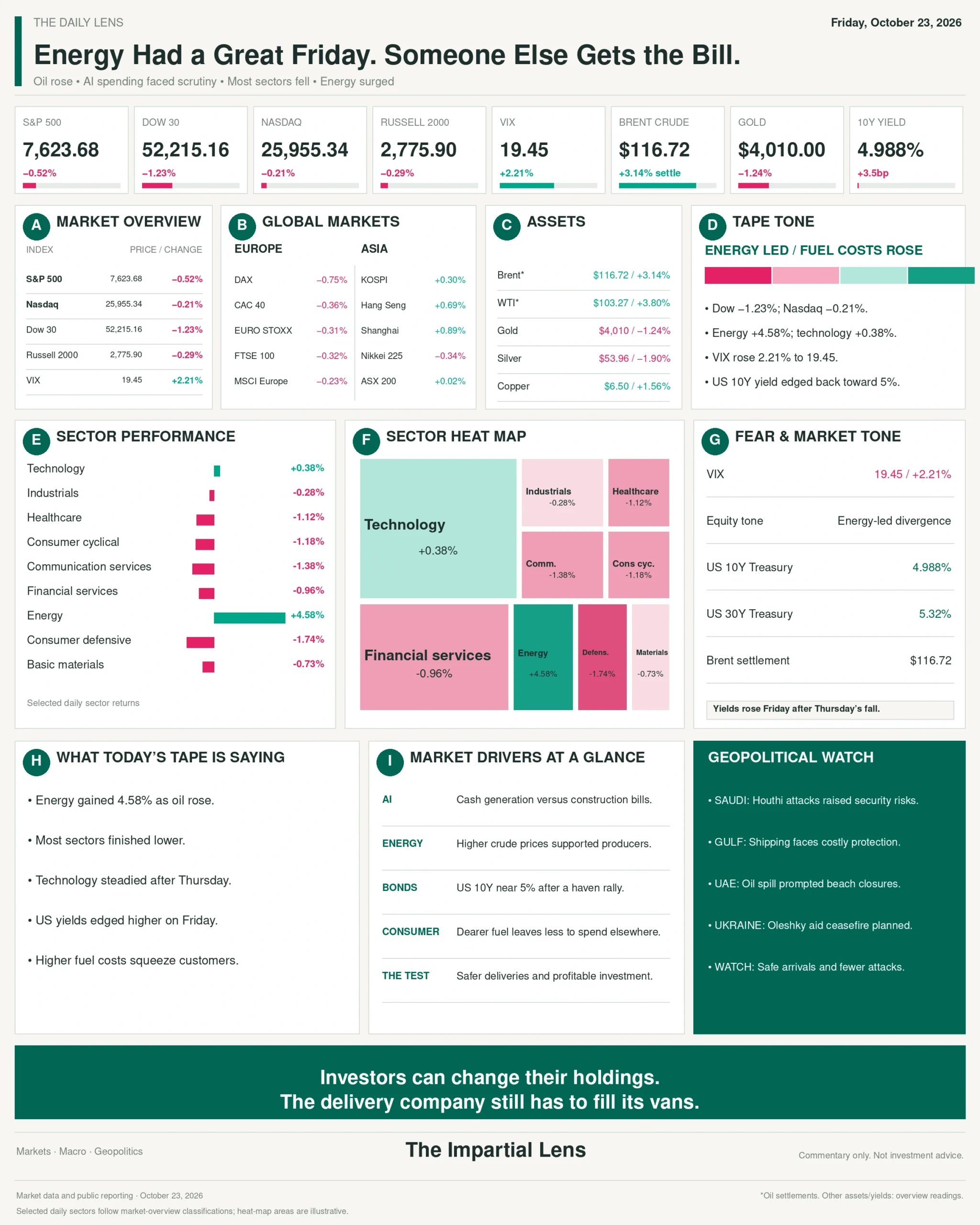
Energy’s 4.58% gain stood apart from the rest of Friday’s sector picture. Technology rose just 0.38%. Financial services fell 0.96%, healthcare lost 1.12%, and communication services declined 1.38%.
Those differences matter more than simply counting red boxes.
Energy producers can benefit from dearer fuel. Many other businesses must absorb the expense or ask customers to pay more. Customers already spending more on transport have less available elsewhere.
International markets added to the caution. France’s CAC 40 fell 0.36%, Germany’s DAX lost 0.75%, while South Korea’s KOSPI finished 0.30% higher.
Gold also fell, losing 1.24%. Investors were responding to several competing pressures; fear was not lifting every asset commonly described as a refuge.
The dashboard gives us our bearings. The story comes from asking why its different parts are moving differently.
What to Watch
- Does fuel become cheaper to deliver? Watch safe arrivals, freight costs and whether attacks ease.
- Can AI explain its spending? Watch cash generation alongside investment plans in the next earnings reports.
- Do lower yields come with healthy orders? That would offer more reassurance than another flight from shares.
- Does diplomacy change events? Watch whether the planned humanitarian ceasefire in Oleshky allows aid and civilian evacuation.
The Lens
Friday rewarded companies selling energy while reminding the rest of the economy what it costs to keep moving.
AI faced a related problem. Its investment programme supports jobs and orders today, but investors need confidence that tomorrow’s earnings will cover the expense.
Neither question is answered by a promising announcement.
The data centre must operate. The ship must arrive. The customer must be able to pay.
Investors can change their holdings over the weekend. The delivery company still has to fill its vans on Monday.
The Impartial Lens provides market commentary and education only. Nothing published here constitutes investment advice.