Friday, November 13, 2026 | The Daily Lens
Jared Kushner and Steve Witkoff saw Vladimir Putin in Moscow on Thursday, then flew to Dublin to see Volodymyr Zelenskyy. By Friday, Europe had agreed who should speak for it in the Ukraine talks. The harder part is deciding what those governments are prepared to promise if a ceasefire is reached. AP · Reuters
There’s a different problem at the fuel pump. More crude is moving out of the Gulf, yet European diesel remains 77% above its pre-war level. And in the US, Friday’s inflation report gave borrowers a little good news before the bond market gave them a fresh reason to check their sums. IEA · BLS · US Treasury
Who Speaks for Europe in Dublin?
Britain, France, Germany, Italy and Poland will speak alongside EU institutions. Britain’s inclusion makes sense for a group that may have to discuss what European militaries can commit. Poland brings the perspective of a country that borders Ukraine, Belarus and Russia. Representatives from four of those countries and the EU were already involved in Abu Dhabi this week. Dublin gives the Europeans a standing group for future talks. Reuters
The disagreement goes well beyond who gets a chair. Before the full-scale invasion, Moscow demanded that NATO pull forces out of countries that joined the alliance after 1997. That would have affected Poland and the Baltic states. Moscow is again pushing for a wider agreement on European security, and Putin told the US envoys that European troops in Ukraine after a ceasefire would be unacceptable. You can see why Warsaw wants to be in the room when those terms come up. Reuters · AP
For Kyiv, a security guarantee has practical parts. Who supplies air defences? Who pays to keep them running? What happens if Russia breaks a ceasefire? European leaders will discuss Ukraine’s 2027 financing on November 26 and 27. That meeting gives them a chance to put money behind what they said in Dublin. EU joint statement · Dublin declaration
More Oil at Sea. Diesel Still Costs a Fortune.
Yesterday we looked at Saudi Arabia’s route around Hormuz. Friday’s International Energy Agency report picks up the story further along the supply chain. Global oil inventories rose by 52 million barrels in October, their first increase since June. Oil aboard ships rose by 86 million barrels. Stocks on land kept falling. The IEA now expects a global supply surplus this quarter, even as the market for diesel stays tight. IEA
Picture a haulage company pricing a delivery for next week. A tanker full of crude can help eventually. First the cargo has to reach port, a refinery has to turn some of it into diesel, and that diesel has to reach the depot. Refinery throughput fell in October, and the IEA says disruptions to Russian and Middle Eastern supplies continue to squeeze the diesel market. European diesel prices had fallen 11% from early October and were still 77% above pre-war levels when the agency compiled its report. IEA
The IEA sees emergency diesel releases helping while refineries catch up. For the haulier deciding what to charge, the price at the depot will tell them when the relief has arrived. IEA
A Softer Inflation Report, a Higher Ten-Year Yield
US producer prices rose 0.3% in October after jumping 1.4% in September. That was a welcome slowdown. Measured against a year earlier, prices were up 6.5%, the fastest increase since November 2022. Both figures describe what US producers received for their goods and services. The monthly figure tells you how much prices moved in October. The annual figure shows how much ground they’ve covered since last autumn. BLS
That distinction matters to a business renewing a contract. A supplier whose costs have risen all year can still ask for more, even after a quieter month. Meanwhile, the US Treasury’s 10-year reference yield reached 5.15%, up from 4.86% a week earlier. For companies borrowing long term and households shopping for a mortgage, that yield is one of the benchmarks lenders use to set their own rates. US Treasury
How Markets Responded
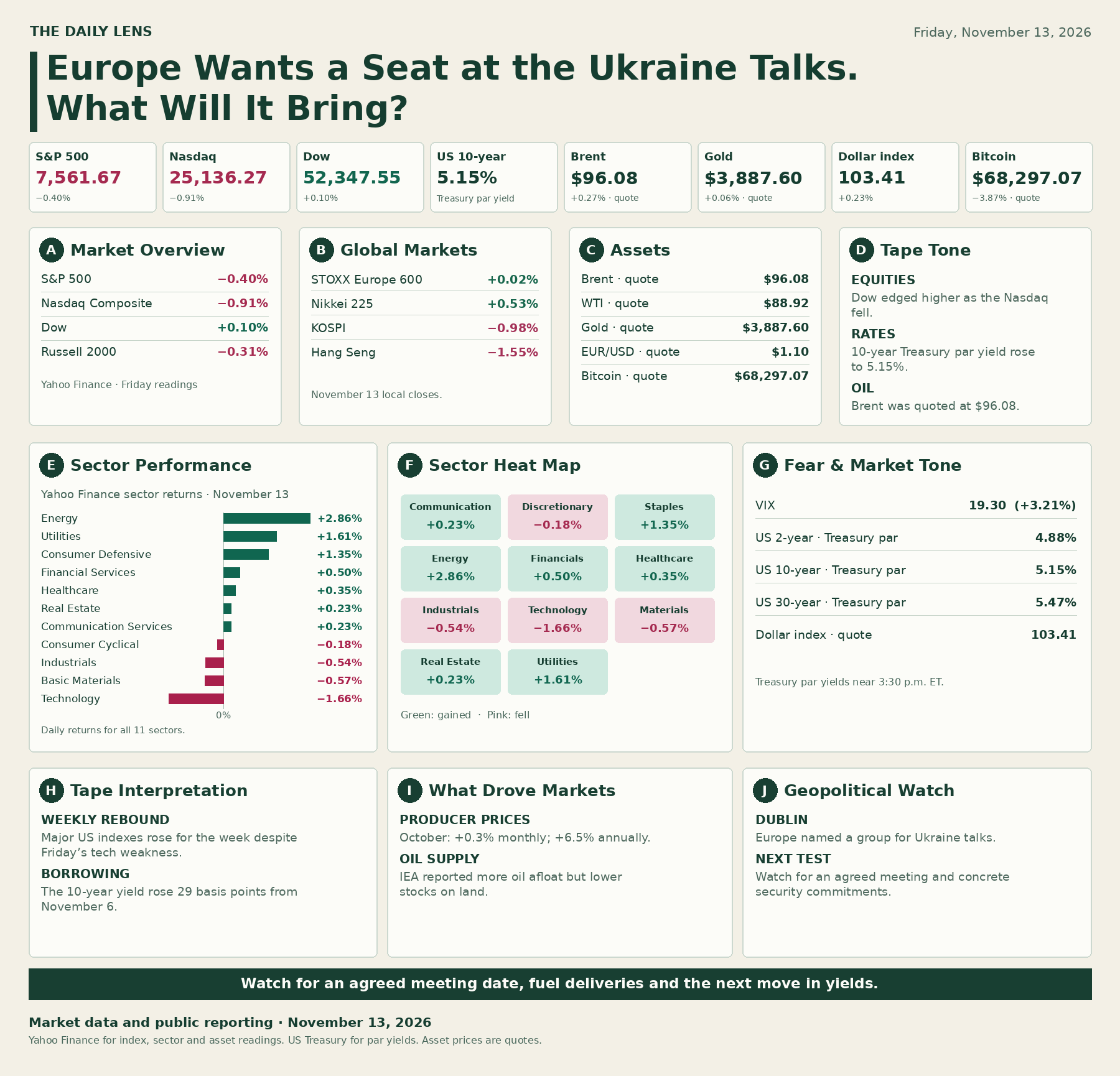
The Nasdaq fell 0.91% and the S&P 500 lost 0.40%. The Russell 2000 slipped 0.31% while the Dow edged up 0.10%. Technology fell 1.66% on the sector heatmap as Nvidia shares slid again following Jensen Huang’s resignation. Energy gained 2.86%, and the VIX rose to 19.30. The S&P 500 still finished the week up 2.5%. AP · Nvidia
London and Paris edged higher while Frankfurt slipped. Japan’s Nikkei gained 0.53%, South Korea’s KOSPI fell 0.98% and Hong Kong’s Hang Seng lost 1.55%. The dollar index rose to 103.41. Gold was quoted at $3,887.60, up 0.06%, and Bitcoin at $68,297, down 3.87%. Brent futures settled at $95.84 and US crude at $88.56. The dashboard shows the separate oil quotes. Reuters
What We’re Watching
- Will Europe’s five countries join the next round? Watch for a meeting notice naming the delegations.
- Is cheaper crude reaching diesel buyers? Watch European wholesale diesel prices as emergency stocks are released.
- Will borrowing costs keep rising? Watch the 10-year Treasury yield and the next weekly US mortgage-rate reading.
The Lens
Europe already has something to bring to the talks. Its governments can finance Ukraine, supply air defences and help rebuild the country. The difficult promise is what they’ll do if a ceasefire fails. Dublin settled who can speak for Europe. Kyiv needs to hear what those people have the authority to promise.
The Impartial Lens provides market commentary and education only. Nothing published here constitutes investment advice.
Featured image: The Convention Centre Dublin and Samuel Beckett Bridge at night. Archival photograph by Jmckinley / Wikimedia Commons, CC BY-SA 3.0.
