Wednesday, November 11, 2026 | The Daily Lens
Poland’s Orlen had a contract for Qatari gas that was supposed to run until 2034. On Tuesday, it gave notice to end it. The supplier couldn’t make the deliveries, and Europe is already drawing down its gas stores for winter.
The timing matters. A cold spell could send European utilities looking for cargoes just as buyers in Asia need them too. Meanwhile, Russia and Ukraine agreed in principle to exchange prisoners after talks in Abu Dhabi, and CoreWeave said it expects customers to put up about $9 billion to help fund its AI buildout.
Poland Has Other Gas. Europe Has a Thinner Cushion.
The Qatari contract covered a million tonnes of liquefied natural gas a year. Orlen says it can cover its customers through other supplies and is keeping its second Qatari deal. That gives the Polish company room to make a decision that would be harder for a buyer with fewer suppliers.
Across the EU, gas storage stood at about 72% full, down from 82.5% a year ago. Qatar is loading more LNG tankers again, though at roughly half its prewar pace. Bloomberg’s ship tracking found that the increase in loadings had yet to produce a similar recovery in traffic heading out through Hormuz. And any cargo that makes it through can go wherever its buyer needs it.
Europe sought alternatives to Russian pipeline gas after Russia’s full-scale invasion of Ukraine. Buying more gas by sea gave European utilities a wider choice of suppliers. It also put them in more direct competition with buyers in Asia. If Europe and northeast Asia get cold at the same time, both can be bidding for the same extra cargoes.
That’s where the storage figure matters. A utility with gas in reserve has some room to wait when a cargo gets expensive. A utility watching its stores empty during a cold spell has less room to haggle. Higher wholesale prices can reach factories when supply contracts reset and households when their tariffs change. How quickly that happens depends on who buys the gas and how far ahead they bought it.
Abu Dhabi Produced a Prisoner Agreement. Now Comes the Timetable.
Yesterday’s Lens asked what Russia wanted from the talks beyond Ukraine itself. Today there’s a concrete answer on a narrower issue. Russia and Ukraine agreed in principle to exchange prisoners of war, with the numbers still to be worked out. For families waiting for someone to come home, that’s the result that matters. They still need names and dates.
Territory remains the harder question. Moscow wants Kyiv to surrender the whole of the Donbas, a demand Ukraine has rejected. US envoys Jared Kushner and Steve Witkoff plan to take the talks to Moscow and then meet Volodymyr Zelenskyy in Dublin. Kushner also said European partners need a place at the table.
That matters because any proposed settlement will have to answer what happens after the shooting stops. Who backs the security guarantees? What would those governments do if the agreement breaks down? A prisoner exchange gives the sides a chance to carry out something they’ve agreed. The next meetings will show whether there’s room to agree on anything beyond it.
Why CoreWeave Wants Customers to Pay Early
CoreWeave rents out powerful computers to companies building AI. Before it can rent them out, it has to buy the chips and get the data centres running. It can borrow to cover those costs, or ask customers to pay part of their bill early.
CoreWeave’s revenue beat Wall Street’s expectations, and the shares surged on Wednesday. The company said it expects about $9 billion in customer prepayments and deposits over the next three months. If that money comes in as expected, CoreWeave can use it to help pay for equipment and construction. Its customers are putting money down now for computing time they’ll use later.
How Markets Responded
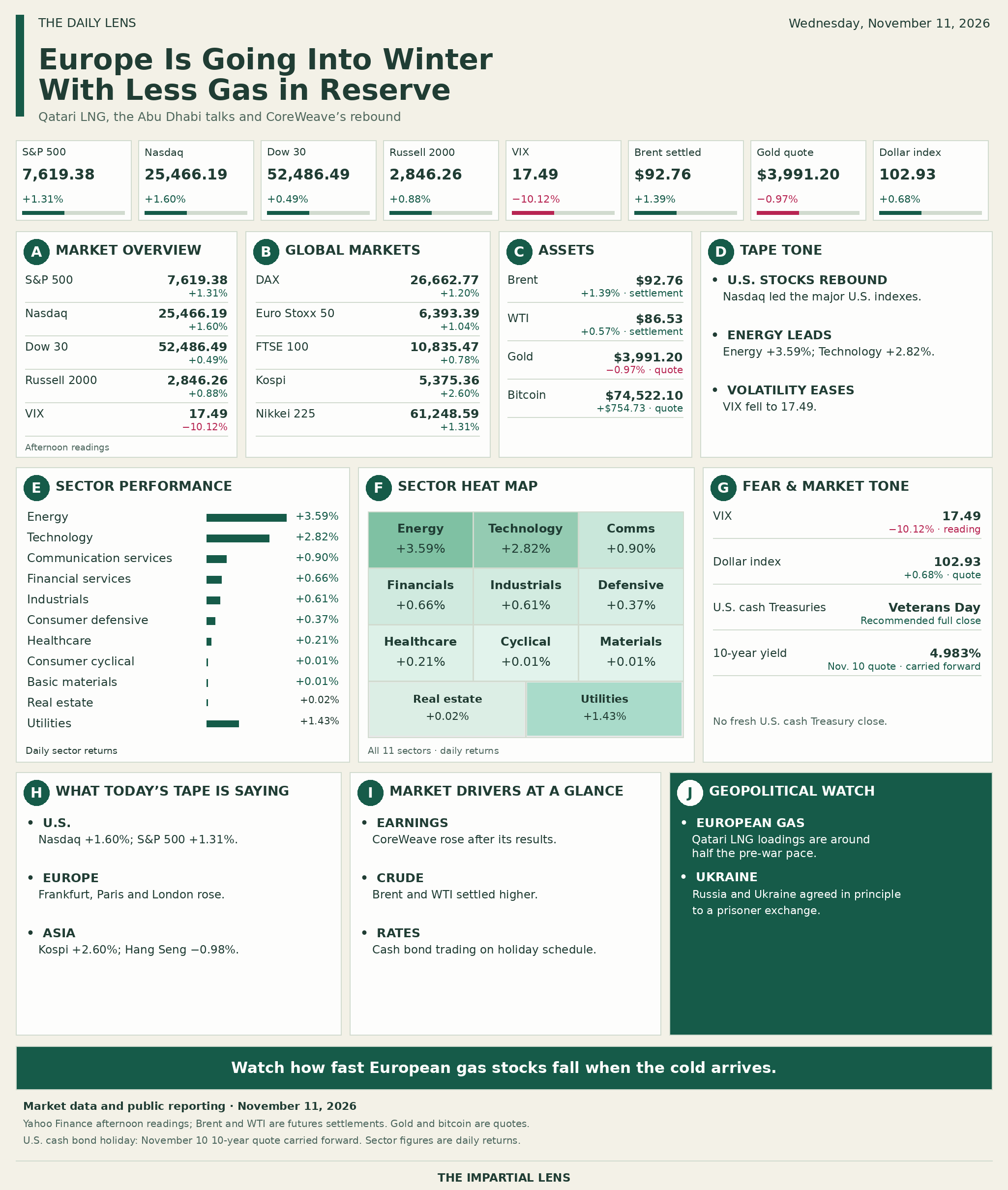
The Nasdaq gained 1.60%, the S&P 500 rose 1.31% and the Russell 2000 added 0.88%. Energy led the sector heatmap at 3.59%, followed by technology at 2.82%. The VIX fell to 17.49. Germany’s DAX gained 1.20% and Britain’s FTSE 100 rose 0.78%. South Korea’s KOSPI gained 2.60%, while Hong Kong’s Hang Seng fell 0.98%.
Brent futures settled at $92.76 and WTI at $86.53. The dollar index rose to 102.93. Gold slipped below $4,000 and bitcoin rose to $74,522. SIFMA recommended a full cash bond market close for Veterans Day, so the dashboard carries Tuesday’s ten-year yield quote.
What We’re Watching
- How quickly is Europe using its reserves? Check weekly storage withdrawals and actual LNG arrivals when temperatures fall.
- When will the prisoners come home? Look for an agreed number and an exchange date after Abu Dhabi.
- How much of CoreWeave’s expected funding arrives? Watch its next cash-flow statement for customer deposits.
The Lens
Orlen could walk away from a contract that had eight years left because it had other gas lined up. The test this winter is how many European buyers have that same freedom when the temperature drops.
The Impartial Lens provides market commentary and education only. Nothing published here constitutes investment advice.
Featured image: The LNG terminal in Świnoujście, Poland, March 2025. Photo by Matti Blume, CC BY-SA 4.0.
