Russia and Ukraine are talking directly again. But the argument extends beyond Ukrainian territory to Europe’s security. In the Gulf, less talk of American airstrikes has helped oil prices fall. Neither negotiation has settled much yet.
Tuesday, November 10, 2026
Russia and Ukraine sat down in Abu Dhabi on Tuesday for their first direct peace talks since February. That alone is welcome after nine months without such a meeting.
But they have different ideas about what needs settling. Ukraine wants to end the war with protection against another attack. Russia wants a wider agreement about Europe’s security, including questions that reach well beyond Ukraine’s borders.
European officials are in Abu Dhabi too. Moscow says it won’t meet them directly.
That is the story to start with today: what Russia wants from these talks, and how much influence Europe has over the outcome. Then to Iran, where Washington is talking about avoiding further combat while keeping the economic pressure on, and America’s nuclear ambitions, which still depend heavily on fuel from abroad.
What Russia wants from Abu Dhabi
A Russian delegation source told Reuters that ending the war in Ukraine should form part of a broader agreement on European security. This is a bigger undertaking than negotiating a ceasefire.
Before the invasion, Moscow sought binding restrictions on NATO activity in eastern Europe and Ukraine. Those demands were rejected by Western governments. Bringing Europe’s security arrangements into these talks gives Russia another opportunity to pursue that argument.
European Commission President Ursula von der Leyen wants the shooting stopped before wider security negotiations begin. Moscow rejects a temporary ceasefire and wants an overall settlement.
Both positions have a practical consequence. A ceasefire could save lives while leaving the main dispute unresolved. Making a ceasefire depend on a much larger agreement could prolong the fighting while negotiators work through it.
Europe has not been shut out entirely. American, Ukrainian and European officials met before the talks with Russia. Ukraine’s presidency confirmed that meeting, and Zelensky subsequently described the discussions as constructive.
The question is how much those consultations influence the terms being discussed. If European governments are expected to help finance reconstruction or provide security commitments, their agreement will be needed. Washington cannot make those commitments for them.
Russia’s concerns will have to be addressed in any lasting settlement. So will the concerns of countries that fear being attacked by Russia. An agreement that neglects either problem is unlikely to last.
Less bombing would help. A blockade still matters.
Marco Rubio said sanctions and the naval blockade were working, reducing the need for major combat operations against Iran. Iranian security chief Mohsen Rezaei denied that negotiations were taking place.
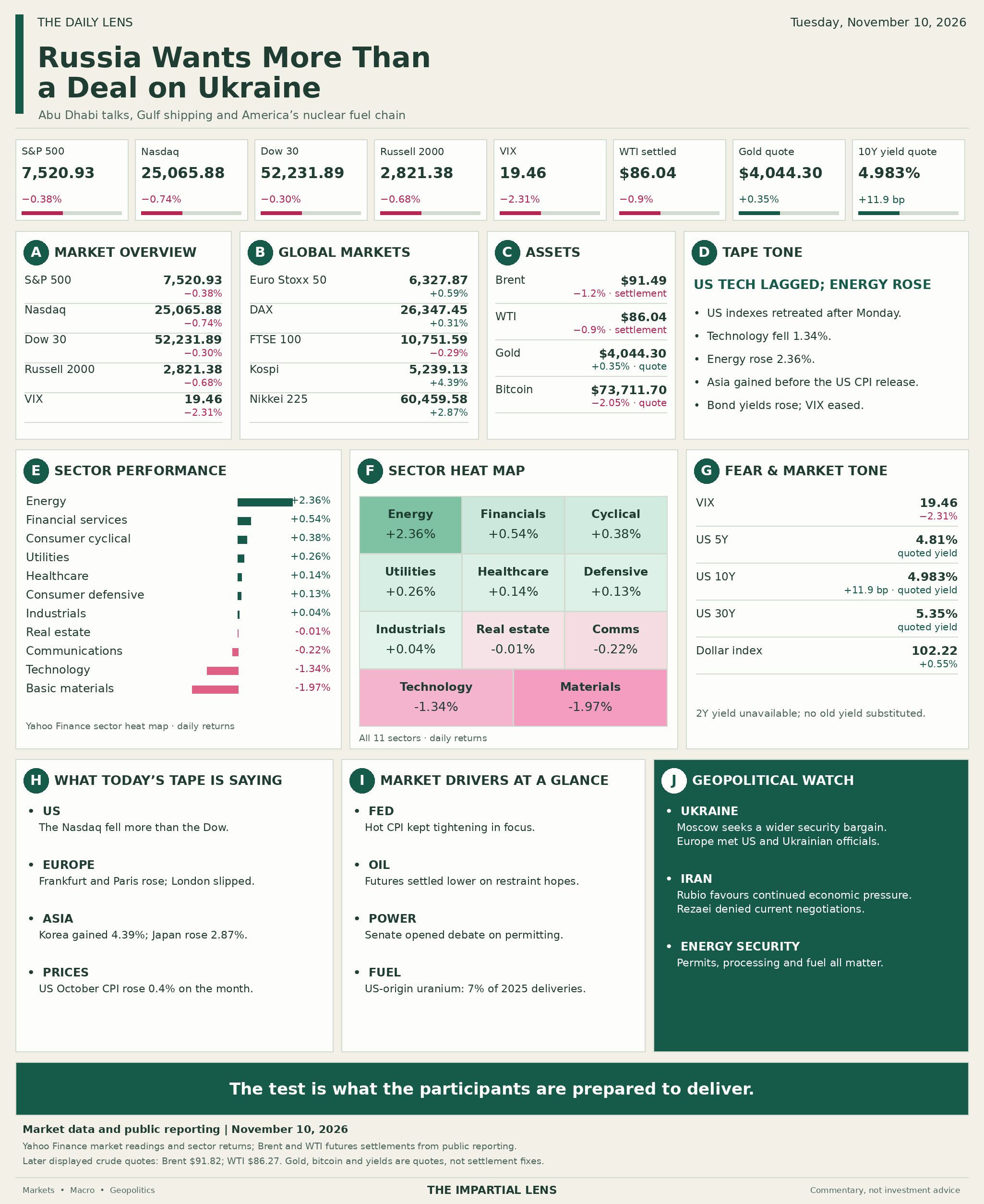
Oil fell despite the conflicting accounts. Brent settled at $91.49, down 1.2%, while US crude settled at $86.04, down 0.9%.
There is a reasonable basis for some relief. Avoiding fresh airstrikes would reduce the risk of further damage to energy infrastructure. But Rubio was describing continued pressure on Iran, not the removal of restrictions.
For companies moving oil, that leaves plenty unresolved. They still need to know which voyages are permitted, whether payments can be processed and what insurance will cost.
Yesterday, Saudi Arabia said its East–West Pipeline kept operating after an attack. That matters because it carries crude towards the Red Sea, providing an alternative to Hormuz.
A sustained reduction in attacks would make that supply more dependable. For now, oil traders are responding to a better prospect of restraint. The companies arranging the next shipment still have to work with the conditions that exist.
Faster nuclear construction still needs a fuel supply
Washington is also trying to make its energy system less vulnerable.
On Monday, senators voted 73–25 to advance debate on an energy-permitting bill. It would speed approvals for infrastructure and require large data centres to pay more of the grid costs associated with serving them.
This was a procedural vote. The bill has not passed, and opposition from environmental and tribal groups remains.
Faster approvals could help nuclear construction. The fuel supply deserves equal attention.
Only 7% of uranium delivered to US civilian reactor operators in 2025 was of US origin, according to the Energy Information Administration. Canada supplied 32%, Kazakhstan 28% and Australia 15%.
Those figures need context. Canada and Australia are important partners. Reactor operators hold inventories and purchase much of their uranium under long-term contracts. Foreign supply does not automatically mean an imminent shortage.
It does mean that building more reactors requires planning beyond the construction site. Uranium must be mined, processed, enriched and made into fuel. Improving one part of that system will not remove dependence elsewhere.
How Markets Responded
US stocks lost some of Monday’s gains. The S&P 500 fell 0.38%, the Nasdaq 0.74% and the Dow 0.30%.
Frankfurt and Paris rose, while London slipped. South Korea gained 4.39% and Japan 2.87%, both closing before the US inflation report.
October consumer prices rose 0.4%, keeping further Fed tightening in focus. Later quotes showed the US ten-year yield at 4.983%, gold at $4,044.30 and bitcoin at $73,711.70. Technology fell 1.34% in the sector heat map; energy gained 2.36%.
What to Watch
- What would Europe be committing to? Watch for specific security guarantees and funding obligations emerging from Abu Dhabi.
- Does the risk to shipping actually fall? Watch attacks, completed voyages and changes to the blockade.
- Can nuclear fuel supply grow with construction? Watch supply contracts and processing capacity alongside reactor approvals.
The Lens
The direct talks are a better development than another week of refusing to meet. They deserve time.
But Europe’s concern is reasonable. If its governments are expected to help protect Ukraine after an agreement, they need influence over that agreement before it is signed.
Getting Russia and Ukraine into the same room was difficult. Agreeing on a settlement that their neighbours can support—and that Ukraine can live with—will be harder.
Featured photograph: Etihad Towers, Abu Dhabi. Saeed Alsoomehi / Pexels. Archival photograph.