A flat PPI sent the S&P 500 to a record, while a 5.22% Treasury auction, a $500 billion AI financing machine and record diesel margins made the celebration considerably less comfortable.
Wall Street received three little gifts Thursday: a flat producer-inflation report, falling Treasury yields and permission to buy technology again.
It did not waste them.
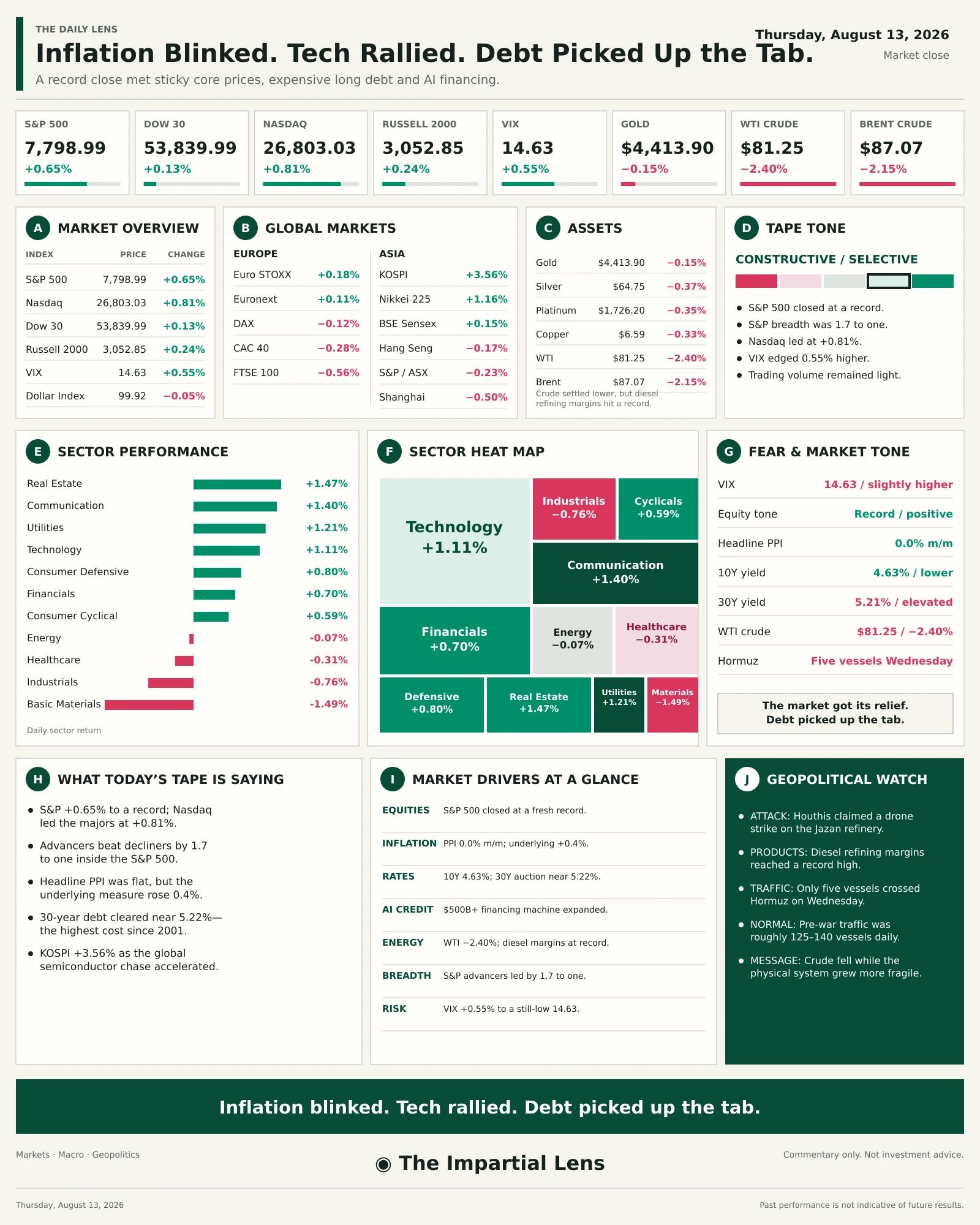
The S&P 500 gained 0.65% and closed at a record 7,798.99. The Nasdaq rose 0.81%, the Dow added 0.13%, and the Russell 2000 joined in with a 0.24% gain. S&P advancers beat decliners by roughly 1.7 to one.
But before anyone unfurls the soft-landing banners, take a bearing. Volume was light, the VIX edged higher, and Washington sold 30-year debt near 5.22%—its highest borrowing cost since 2001.
Wall Street celebrated cheaper inflation in the morning and charged the government a generational price for money in the afternoon.
The Good News Was Good—Just Not That Good
July’s Producer Price Index was unchanged from June versus an expected 0.2% rise. Markets plugged the headline into the Fed calculator and bought duration.
Communication services gained 1.40%, and technology rose 1.11%. Basic materials fell 1.49%, and industrials lost 0.76%. The market wanted platforms and growth—not the grubby business of making physical things.
Annual PPI slowed from 5.5% to 4.7%. But the improvement came with a gasoline-shaped asterisk: goods prices fell 0.7%, energy dropped 3.1% and gasoline declined 5.7%.
Services still rose 0.2%. Excluding food, energy and trade services, prices climbed 0.4% for the month and 4.7% over the year.
That is disinflation. It is not price stability.
The Fed received breathing room. It did not receive absolution.
AI Has Discovered Other People’s Money
The technology rally came with exquisite timing. AI is no longer merely an earnings story; it is becoming one of the largest financing stories on Earth.
Nvidia has teamed up with six financial giants to mobilize more than $500 billion for AI infrastructure and may backstop as much as 25% of some transactions. AMD entered the bond market seeking another $4 billion to $5 billion.
If organic cash flow cannot build the AI future quickly enough, Wall Street will provide scaffolding.
That does not make the boom fraudulent. The chips, data centers and revenue are real. But once suppliers, customers and lenders begin financing one another, the distinction between demand and financed demand becomes rather important.
The 2008 housing comparison is too easy. A GPU is not a subprime mortgage, and a data center is not a no-documentation condo.
But the financial plumbing rhymes.
Credit can pull tomorrow’s demand into today. Guarantees can make risky projects appear safer. The machine works beautifully—provided utilization, pricing, and cash flow keep accelerating.
The AI boom does not have to be fake to become dangerous. It only has to become too expensive to disappoint.
Korea Joined the Chase
The fear of being left behind was not confined to New York. Korea’s KOSPI jumped 3.56%, and Japan’s Nikkei gained 1.16%. Watching a semiconductor rebound from the sidelines is an excellent way to become a forced buyer later.
China did not share the enthusiasm: Shanghai fell 0.50%, and Hong Kong slipped 0.17%. Europe also softened.
This was a technology chase, not a synchronized global boom.
Crude Fell. Diesel Screamed.
Oil delivered the day’s best contradiction.
WTI settled 2.4% lower at $81.25, and Brent fell 2.15% to $87.07. U.S. inventories surged by 17.4 million barrels, while OPEC and the International Energy Agency lowered their demand outlooks.
Yet Yemen’s Houthis said they attacked Saudi Aramco’s Jazan refinery with two drones. Saudi Arabia had not confirmed it, but diesel margins still reached a record. Jazan can produce 250,000 barrels per day of ultra-low-sulfur diesel.
Only five non-container vessels reportedly crossed the Strait of Hormuz on Wednesday. Before the war, the daily count was roughly 125 to 140.
Crude fell while the system used to refine and transport it became more fragile. A barrel sitting in inventory is not diesel reaching the customer who needs it.
Markets trade barrels. Economies consume products.
What Today’s Tape Is Saying
Thursday belonged to the bulls. The S&P made a record, breadth was positive, yields fell, and technology reclaimed leadership. Pretending otherwise would be ideology masquerading as analysis.
But the celebration rested on foundations that are becoming harder to ignore. Underlying producer inflation remained sticky. Thirty-year money cost 5.22%. AI leaned further into credit. Oil fell while shipping and refining stress intensified.
The market got its relief.
Debt picked up the tab.
Market Drivers at a Glance
- Equities: S&P 500 +0.65%; Nasdaq +0.81%; Russell 2000 +0.24%.
- Breadth: S&P advancers beat decliners by roughly 1.7 to one.
- Inflation: Headline PPI was flat; the underlying measure rose 0.4%.
- Rates: The 10-year eased toward 4.63%; the 30-year held near 5.21%.
- AI: Technology rallied as infrastructure financing expanded.
- Energy: WTI fell 2.4%, but diesel margins reached a record.
- Geopolitics: Hormuz traffic remained severely restricted.
What to Watch
Watch whether Friday’s confidence escapes the technology sector without another assist from falling yields. Watch AI credit spreads as closely as AI share prices. And in energy, watch diesel margins and vessel traffic—not crude alone.
A record high tells us where the market is.
It does not tell us how sturdy the road was getting there.
The Impartial Lens provides market commentary and education, not investment advice.