Big Tech fell, and oil rose as AI credit worries and the Hormuz impasse grew louder beneath a deceptively quiet market.
Tuesday’s closing numbers suggested an ordinary summer pullback. The S&P 500 fell 0.32%, the Dow lost 0.34%, and the Nasdaq declined 0.60%. The VIX slipped 1.16% to 15.28, hardly the signature of a market preparing for disaster.
But the calm at index level concealed a more revealing split. The Russell 2000 gained 0.32%, advancing stocks outnumbered decliners within the S&P 500, and financials and energy finished higher. Investors were not fleeing the market. They were moving away from the areas carrying the most uncomfortable questions.
The Tape: Big Tech Took the Weight
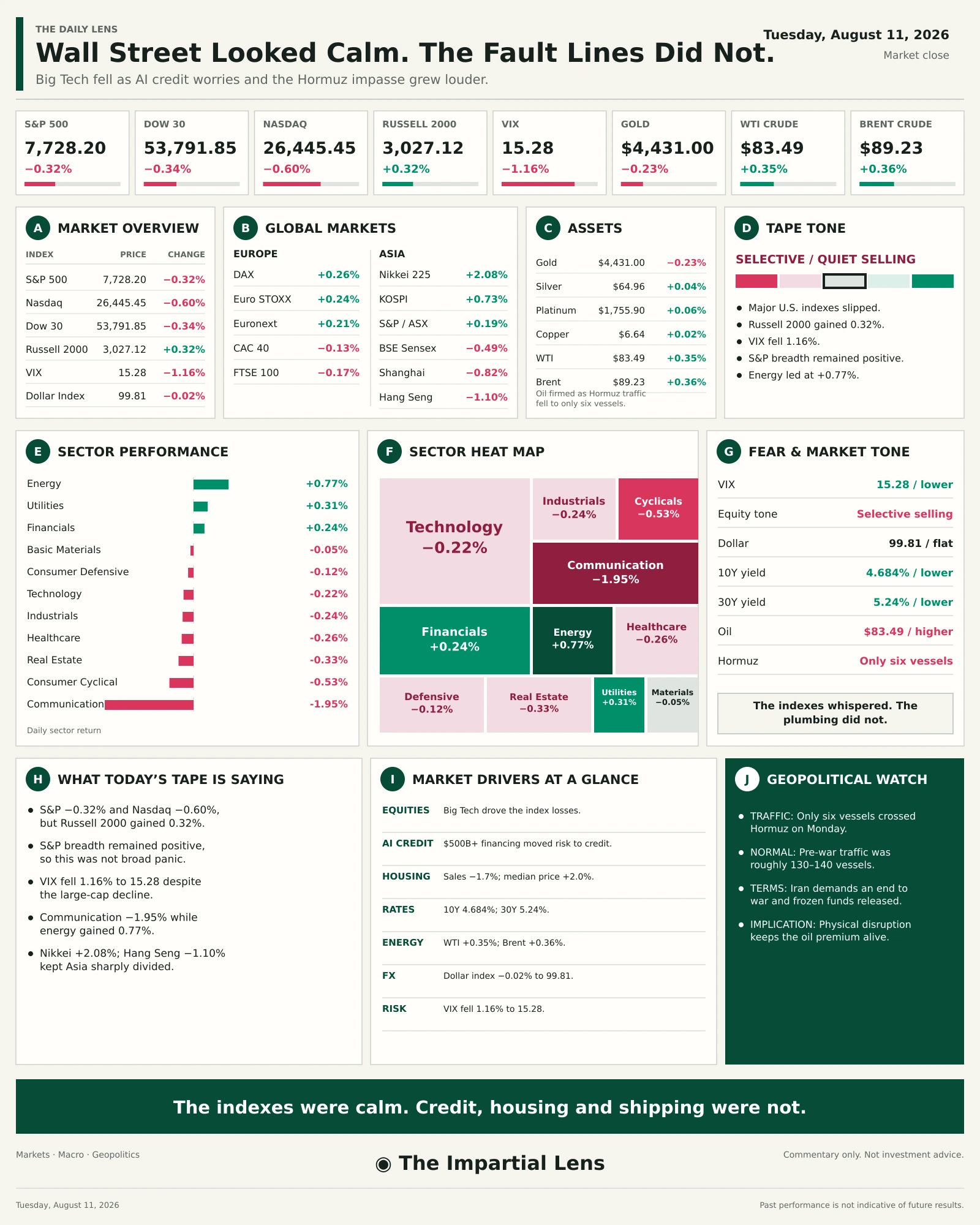
The S&P 500 closed at 7,728.20, the Nasdaq at 26,445.45 and the Dow at 53,791.85. The Russell 2000’s gain to 3,027.12 made the day less bearish than the headline indexes implied.
Communication services was the weakest sector at minus 1.95%. Consumer cyclicals fell 0.53%, healthcare lost 0.26%, industrials declined 0.24% and technology slipped 0.22%. Energy gained 0.77%, utilities rose 0.28%, and financial services added 0.24%.
Amazon fell 2.1%, Alphabet dropped 3.8%, and SpaceX declined almost 4%. Yet Apollo and Blackstone rallied after joining Nvidia’s effort to mobilize more than $500 billion for AI infrastructure.
The market rewarded the firms financing the buildout while questioning some companies expected to justify the spending.
Global Markets: Japan Up, China Down
Europe was narrowly mixed. The DAX gained 0.26%, the Euro STOXX rose 0.24%, and Euronext added 0.21%, while the CAC 40 fell 0.13% and the FTSE 100 lost 0.17%.
Asia showed a sharper divide. Japan’s Nikkei jumped 2.08%, and Korea’s KOSPI gained 0.73%, but the Hang Seng fell 1.10%, and Shanghai declined 0.82%. Regional strength remained selective rather than synchronized.
AI Is Becoming a Credit Story
The AI boom does not need to be fake to become financially dangerous. It only needs investment to arrive faster than cash returns.
Data centers, chips, power and networks increasingly require bonds, private credit and outside guarantees.
That changes the risk. Equity investors can debate growth rates and valuations. Credit investors ask a colder question: who gets repaid if the promised economics arrive late?
Hyperscaler borrowing was already accelerating before Nvidia’s new financing initiative. Wider credit spreads and greater demand for default protection do not prove an AI bust is beginning. They show that lenders are finally attaching a price to execution risk.
The adults are not necessarily leaving the room. They are asking for collateral.
Housing: Fewer Sales, Higher Prices
July existing-home sales fell 1.7% from June to an annualized rate of 4.06 million. Sales were still 0.7% higher than a year earlier, but unsold inventory declined 1.9% to 1.54 million homes.
The median existing-home price rose 2% from a year ago to $434,100.
That is not a clean recovery. Fewer transactions, shrinking inventory and rising prices describe a market constrained by affordability and supply. Owners with low mortgage rates remain reluctant to sell, while prospective buyers face prices that refuse to adjust enough to financing costs.
Treasury yields eased slightly, with the 10-year at 4.684%, the 30-year at 5.24% and the five-year at 4.385%. Housing buyers still need substantially lower borrowing costs before that relief becomes transformative.
Geopolitics: Six Ships Tell the Story
Oil remained firm, with WTI at $83.49 and Brent at $89.23. The explanation was not another dramatic speech. It was physical traffic.
Only six vessels crossed the Strait of Hormuz on Monday, compared with a recent 10-day average of roughly 11 and a pre-war norm of 130 to 140. Iran said the strait would remain closed unless Washington ended the war, unfroze Iranian funds and accepted additional conditions delivered through mediators.
This is why repeated “deal soon” headlines are losing power. Markets can trade rhetoric for a few hours. Refineries, insurers and shipping companies eventually require ships to move.
Incidents around the Gulf of Oman and Bab el-Mandeb kept two crucial energy corridors under pressure. Oil’s rise remained modest, but the geopolitical premium did not disappear.
What Today’s Tape Is Saying
Tuesday was not a broad risk-off session. Small caps rose, market breadth remained positive, and the VIX fell. The selling was concentrated in large technology and communication names.
That makes the quiet more interesting, not less. Equity volatility stayed subdued while credit markets questioned AI financing, housing remained frozen and physical shipping through Hormuz nearly stopped.
Market Drivers at a Glance
- Equities: S&P 500 −0.32%; Nasdaq −0.60%; Russell 2000 +0.32%.
- Sectors: Energy led at +0.77%; communication services fell 1.95%.
- Volatility: VIX declined 1.16% to 15.28.
- Rates: The 10-year yield eased to 4.684%.
- Housing: Existing-home sales fell 1.7% in July.
- Energy: WTI held at $83.49; Brent reached $89.23.
- Geopolitics: Hormuz traffic fell to six vessels.
What to Watch
Wednesday’s inflation report is the immediate test. A soft reading would support bonds and rate-sensitive assets. A hot reading would collide with rising energy costs and force markets to reconsider the comfortable idea that weaker growth automatically brings easier policy.
Beyond CPI, watch the Russell 2000 for evidence of genuine broadening, hyperscaler credit spreads for signs of financing stress, and actual vessel traffic through Hormuz. Diplomatic language matters. Moving ships matter more.
The Impartial Lens provides market commentary and education, not investment advice.
Wall Street Looked Calm. The Fault Lines Did Not.
Big Tech fell, and oil rose as AI credit worries and the Hormuz impasse grew louder beneath a deceptively quiet market.
Tuesday’s closing numbers suggested an ordinary summer pullback. The S&P 500 fell 0.32%, the Dow lost 0.34%, and the Nasdaq declined 0.60%. The VIX slipped 1.16% to 15.28, hardly the signature of a market preparing for disaster.
But the calm at index level concealed a more revealing split. The Russell 2000 gained 0.32%, advancing stocks outnumbered decliners within the S&P 500, and financials and energy finished higher. Investors were not fleeing the market. They were moving away from the areas carrying the most uncomfortable questions.
The Tape: Big Tech Took the Weight
The S&P 500 closed at 7,728.20, the Nasdaq at 26,445.45 and the Dow at 53,791.85. The Russell 2000’s gain to 3,027.12 made the day less bearish than the headline indexes implied.
Communication services was the weakest sector at minus 1.95%. Consumer cyclicals fell 0.53%, healthcare lost 0.26%, industrials declined 0.24% and technology slipped 0.22%. Energy gained 0.77%, utilities rose 0.28%, and financial services added 0.24%.
Amazon fell 2.1%, Alphabet dropped 3.8%, and SpaceX declined almost 4%. Yet Apollo and Blackstone rallied after joining Nvidia’s effort to mobilize more than $500 billion for AI infrastructure.
The market rewarded the firms financing the buildout while questioning some companies expected to justify the spending.
Global Markets: Japan Up, China Down
Europe was narrowly mixed. The DAX gained 0.26%, the Euro STOXX rose 0.24%, and Euronext added 0.21%, while the CAC 40 fell 0.13% and the FTSE 100 lost 0.17%.
Asia showed a sharper divide. Japan’s Nikkei jumped 2.08%, and Korea’s KOSPI gained 0.73%, but the Hang Seng fell 1.10%, and Shanghai declined 0.82%. Regional strength remained selective rather than synchronized.
AI Is Becoming a Credit Story
The AI boom does not need to be fake to become financially dangerous. It only needs investment to arrive faster than cash returns.
Data centers, chips, power and networks increasingly require bonds, private credit and outside guarantees.
That changes the risk. Equity investors can debate growth rates and valuations. Credit investors ask a colder question: who gets repaid if the promised economics arrive late?
Hyperscaler borrowing was already accelerating before Nvidia’s new financing initiative. Wider credit spreads and greater demand for default protection do not prove an AI bust is beginning. They show that lenders are finally attaching a price to execution risk.
The adults are not necessarily leaving the room. They are asking for collateral.
Housing: Fewer Sales, Higher Prices
July existing-home sales fell 1.7% from June to an annualized rate of 4.06 million. Sales were still 0.7% higher than a year earlier, but unsold inventory declined 1.9% to 1.54 million homes.
The median existing-home price rose 2% from a year ago to $434,100.
That is not a clean recovery. Fewer transactions, shrinking inventory and rising prices describe a market constrained by affordability and supply. Owners with low mortgage rates remain reluctant to sell, while prospective buyers face prices that refuse to adjust enough to financing costs.
Treasury yields eased slightly, with the 10-year at 4.684%, the 30-year at 5.24% and the five-year at 4.385%. Housing buyers still need substantially lower borrowing costs before that relief becomes transformative.
Geopolitics: Six Ships Tell the Story
Oil remained firm, with WTI at $83.49 and Brent at $89.23. The explanation was not another dramatic speech. It was physical traffic.
Only six vessels crossed the Strait of Hormuz on Monday, compared with a recent 10-day average of roughly 11 and a pre-war norm of 130 to 140. Iran said the strait would remain closed unless Washington ended the war, unfroze Iranian funds and accepted additional conditions delivered through mediators.
This is why repeated “deal soon” headlines are losing power. Markets can trade rhetoric for a few hours. Refineries, insurers and shipping companies eventually require ships to move.
Incidents around the Gulf of Oman and Bab el-Mandeb kept two crucial energy corridors under pressure. Oil’s rise remained modest, but the geopolitical premium did not disappear.
What Today’s Tape Is Saying
Tuesday was not a broad risk-off session. Small caps rose, market breadth remained positive and the VIX fell. The selling was concentrated in large technology and communication names.
That makes the quiet more interesting, not less. Equity volatility stayed subdued while credit markets questioned AI financing, housing remained frozen and physical shipping through Hormuz nearly stopped.
Market Drivers at a Glance
- Equities: S&P 500 −0.32%; Nasdaq −0.60%; Russell 2000 +0.32%.
- Sectors: Energy led at +0.77%; communication services fell 1.95%.
- Volatility: VIX declined 1.16% to 15.28.
- Rates: The 10-year yield eased to 4.684%.
- Housing: Existing-home sales fell 1.7% in July.
- Energy: WTI held at $83.49; Brent reached $89.23.
- Geopolitics: Hormuz traffic fell to six vessels.
What to Watch
Wednesday’s inflation report is the immediate test. A soft reading would support bonds and rate-sensitive assets. A hot reading would collide with rising energy costs and force markets to reconsider the comfortable idea that weaker growth automatically brings easier policy.
Beyond CPI, watch the Russell 2000 for evidence of genuine broadening, hyperscaler credit spreads for signs of financing stress, and actual vessel traffic through Hormuz. Diplomatic language matters. Moving ships matter more.
The Impartial Lens provides market commentary and education, not investment advice.
