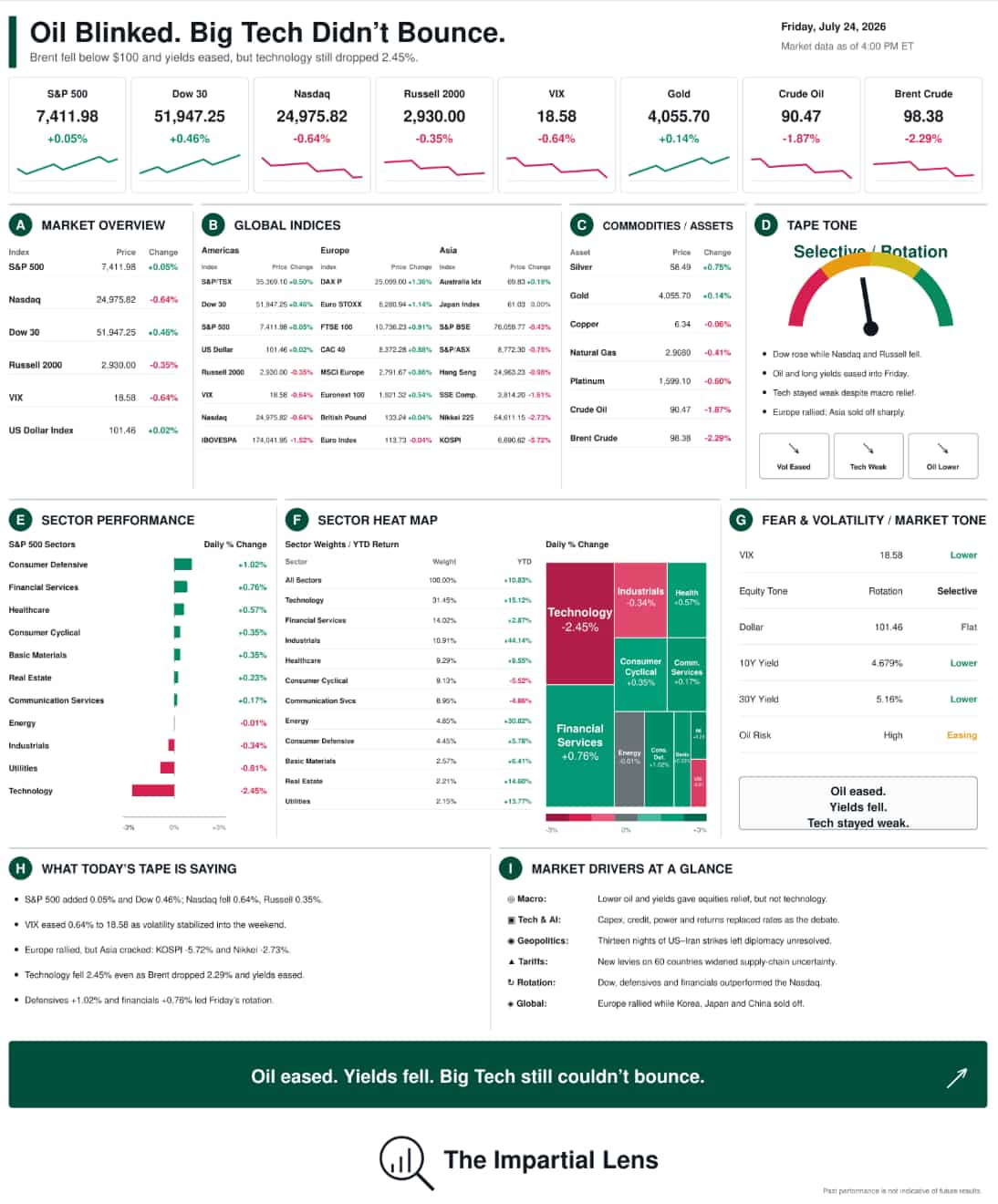
Brent fell below $100, and Treasury yields eased, but technology still dropped 2.45% as investors questioned the cost, financing, and eventual returns of the AI buildout.
Friday, July 24, 2026
The Tape: What Actually Happened
US stocks finished mixed on Friday, but the calm headline concealed another sharp divergence beneath the surface.
The S&P 500 edged up 0.05% to 7,411.98, while the Dow gained 0.46% to 51,947.25. The Nasdaq fell 0.64% to 24,975.82, and the Russell 2000 declined 0.35% to 2,930.00.
The VIX slipped 0.64% to 18.58. Volatility did not disappear, but neither did it confirm another wave of panic.
Technology remained the central problem, falling 2.45% even as several of Thursday’s macro pressures eased. Utilities lost 0.81%, and industrials declined 0.34%.
Elsewhere, consumer defensives gained 1.02%, financials rose 0.76%, healthcare added 0.57%, and consumer cyclicals advanced 0.35%.
This was not a market-wide retreat. Money continued to move away from technology and toward sectors whose valuations depend less heavily on distant earnings.
Bitcoin fell 1.31% to $64,079.46, while gold gained 0.14% to $4,055.70.
Europe Rallied While Asia Cracked
European equities finished firmly higher. Germany’s DAX gained 1.36%, the Euro STOXX rose 1.14%, the FTSE 100 advanced 0.91%, and France’s CAC 40 added 0.88%.
Asia moved in the opposite direction. South Korea’s KOSPI plunged 5.72%, the Nikkei fell 2.73%, China’s SSE Composite declined 1.61%, and the Hang Seng lost 0.98%.
That geographic split is a warning against interpreting the flat S&P 500 as evidence that global markets had stabilized.
Europe benefited from lower oil prices and a partial easing of the inflation shock. Asia remained exposed to the continuing unwind in semiconductors, momentum trades and leveraged positioning.
The global market did not receive one unified Friday message. Europe heard “relief.” Asia heard “unfinished business.”
Oil Fell, But the War Didn’t End
Brent dropped 2.29% to $98.38, while WTI fell 1.87% to $90.47. The retreat provided immediate relief after Brent had moved above $100 earlier in the week.
Treasury yields also eased. The 10-year finished at 4.679%, while the 30-year stood at 5.16%.
Normally, falling oil and lower yields would be expected to support growth stocks. Energy inflation becomes less threatening, the Federal Reserve gains slightly more flexibility, and the discount rate applied to future earnings declines.
Technology fell anyway.
The oil retreat does not prove that geopolitical risk has disappeared. US and Iranian forces reportedly exchanged strikes for a thirteenth consecutive night, Iran rejected the latest ceasefire proposal, and a tanker reportedly rerouted around Africa following Houthi threats in the Red Sea.
Instead, the market appeared to be betting that political pressure, rising gasoline prices and weakening demand could prevent the conflict from developing into a prolonged closure of the region’s energy chokepoints.
That is a bet, not a peace agreement.
Big Tech’s Problem Is No Longer Just Rates
Friday delivered an important change in the AI narrative.
When oil and yields were rising, technology weakness could be blamed on the macro environment. When oil and yields fell, but technology continued sliding, that explanation became less convincing.
The macro excuse improved. The stock-market verdict did not.
Investors are now looking more closely at capital expenditure, depreciation, debt issuance, electricity constraints and the speed of AI monetization. Intel’s earnings and guidance beat expectations, but another increase in planned spending created fresh concern.
The AI industry may not lack capital. It increasingly lacks inexpensive power, immediately usable infrastructure and unlimited investor patience.
Credit-market weakness surrounding hyperscalers adds another layer. Equity investors can celebrate long-term growth stories; bond investors eventually want to know how the bills will be paid.
There is also an accounting question. Today’s enormous AI infrastructure investments do not hit earnings all at once. They are depreciated over time. That can make current profits look stronger while pushing part of the cost into future reporting periods.
The earnings may be genuine. The timing of the bill matters.
The market is moving from asking, “Who is spending the most on AI?” to asking, “Who can earn an acceptable return on what has already been spent?”
Geopolitics: Diplomacy Without a Deal
President Trump said he had not decided whether to order larger strikes against Iran. Pakistan and Iraq were reportedly exploring paths toward renewed talks, but Iran rejected the latest US ceasefire terms.
At the same time, Washington announced tariffs of roughly 10% to 12.5% on products from 60 countries and opened a trade investigation into the European Union over its treatment of major US technology companies.
Markets therefore entered the weekend facing two unresolved policy fronts: a Middle Eastern war capable of moving oil and a widening trade confrontation capable of moving prices, supply chains and corporate margins.
Oil fell because the immediate risk premium eased. The underlying geopolitical machinery continued running.
What to Watch
First, watch whether Brent can remain below $100. A sustained retreat would reduce inflation pressure; another move above it would quickly revive the rates debate.
Second, watch technology credit as well as technology stocks. Weak bonds can reveal financing concerns before they become obvious in earnings.
Third, observe whether the Dow and defensive sectors continue outperforming the Nasdaq. That would confirm that investors are rotating rather than rebuilding the old leadership.
Finally, Asia deserves attention. The KOSPI’s 5.72% decline suggests that the leveraged semiconductor unwind is not finished.
The Bottom Line
The week ended with a peculiar combination: oil fell, yields eased, volatility declined—and technology still could not bounce.
That may be Friday’s most important signal.
Earlier in the week, Big Tech could blame China, Iran, oil or the bond market. By Friday, some of those pressures had softened, yet the selling continued.
The market is no longer merely questioning the price of money. It is questioning what hundreds of billions of dollars in AI spending will actually buy.
Oil blinked. Big Tech didn’t bounce. The AI trade is being asked to stand on its own earnings—and the answers are becoming more expensive.
For educational and informational purposes only. Not investment advice.
— The Impartial Lens