Wall Street slipped as the 30-year yield hit a 19-year high, Hormuz diplomacy unraveled and Bitcoin treated the chaos as a feature.
Monday did not deliver a crash.
It delivered something more interesting: a disagreement.
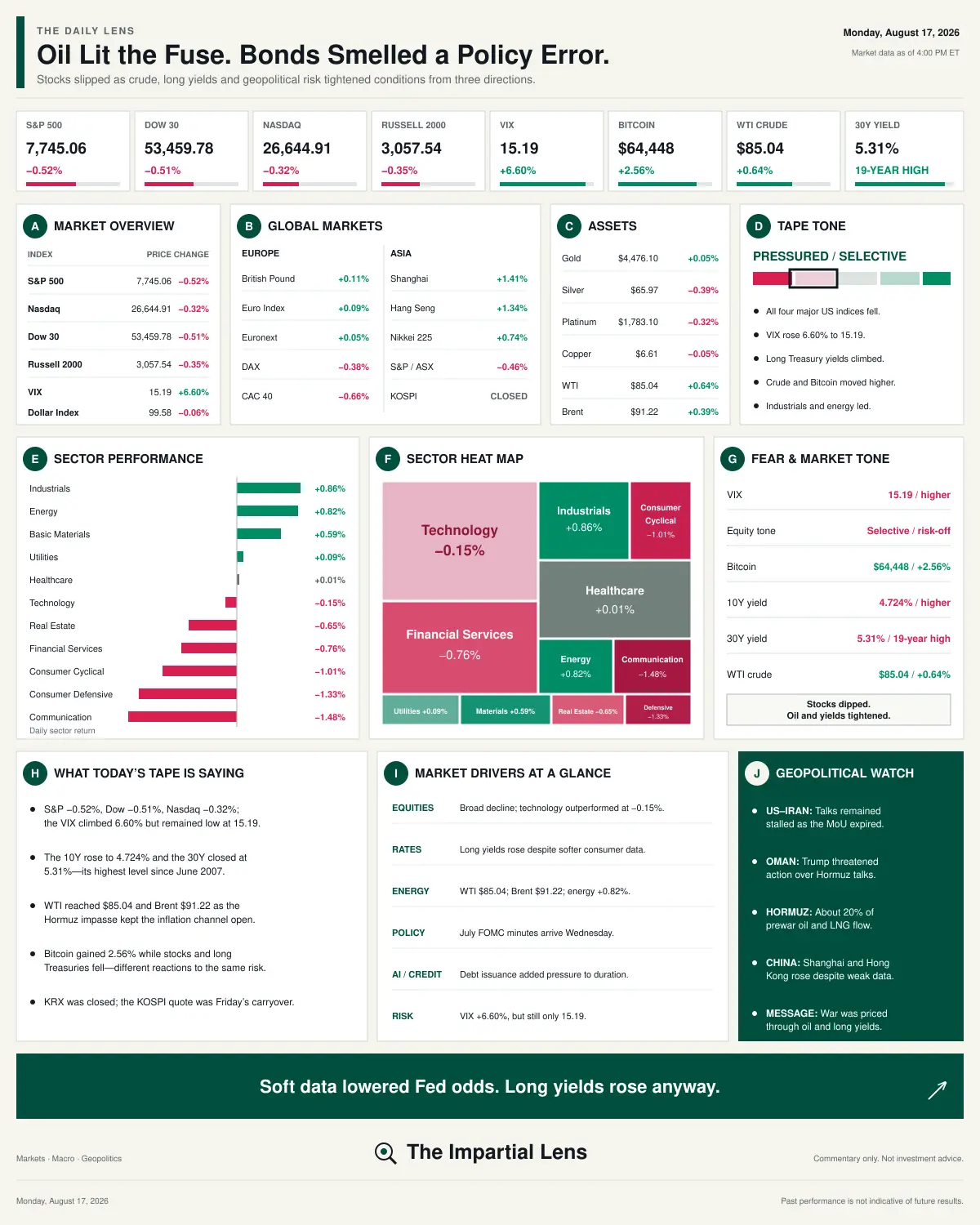
The S&P 500 fell 0.52%, the Dow lost 0.51%, the Nasdaq slipped 0.32% and the Russell 2000 declined 0.35%. The VIX jumped 6.60%, although at 15.19 it remains far from panic territory.
Meanwhile, crude oil pushed above $85, Brent cleared $90, Bitcoin gained 2.56% and long-dated Treasury bonds were hit again.
The market is trying to price three stories that do not fit neatly together:
The consumer is weakening, which should reduce pressure on the Federal Reserve.
Oil is rising, which threatens another inflation problem.
And investors are still chasing selected risk assets as though liquidity will eventually rescue everything.
Welcome to the new week.
The Bond Market Smells a Policy Error
Friday’s unexpected 0.6% decline in retail sales reduced expectations for another Fed rate hike. By Monday, markets were pricing roughly a 35% chance of a September move, down from about 55% a week earlier.
Ordinarily, weaker consumer data and falling rate-hike expectations should push long-term Treasury yields lower.
Instead, the 10-year yield climbed to 4.724%, while the 30-year reached 5.31%—its highest closing level since June 2007. TLT fell another 0.84%. Reuters reported that fiscal concerns and heavy AI-related corporate debt issuance were adding to pressure on the long end.
That is the real warning in Monday’s tape.
The Federal Reserve controls the overnight policy rate. It does not fully control what investors demand to lend money for 10 or 30 years.
The market may believe the Fed is finished tightening while simultaneously demanding greater compensation for inflation, government borrowing, corporate bond issuance and geopolitical risk.
That creates two possible policy errors.
Raise rates into a weakening consumer and the Fed risks breaking demand.
Pause while oil and long-term inflation expectations rise and the bond market may tighten financial conditions without it.
Either way, the long end is no longer politely waiting for instructions.
Hormuz Became a Monetary-Policy Problem
The catalyst was once again the Strait of Hormuz.
President Trump said Iran should surrender and threatened military action against Oman if it obstructed negotiations over restoring commercial shipping through the strait. Oman has traditionally acted as a mediator between Washington and Tehran, which makes threatening it an especially peculiar approach to diplomacy.
The Strait carried approximately 20% of global oil and liquefied natural gas supplies before the war began. Reuters confirmed that talks remain stalled and that the 60-day negotiating window under the June memorandum expired Monday.
This is no longer simply a foreign-policy story.
If threats around Hormuz lift crude prices, they influence inflation expectations. Those expectations affect Treasury yields, mortgage rates, corporate borrowing, and, more importantly, the Fed’s room to maneuver.
One narrow shipping lane can now overrule an entire month of reassuring inflation data.
WTI finished around $85.04, while Brent reached approximately $91.22. Energy stocks gained 0.82%, even as the broader market declined.
The war risk did not appear primarily in the fear index, the VIX.
It appeared in oil and bonds.
This Was Not a Conventional Risk-Off Day
The sector map was strangely selective.
Industrials gained 0.86%, energy rose 0.82%, and basic materials added 0.59%. Technology slipped only 0.15%.
The heavier losses appeared in communication services, down 1.48%; consumer defensive stocks, down 1.33%; consumer cyclicals, down 1.01%; and financial services, down 0.76%.
That is not the classic pattern of investors rushing toward safety.
It looks more like capital rotating toward infrastructure, energy, scarcity, and physical investment—while moving away from consumer exposure and parts of the market most dependent on lower borrowing costs.
The message is not that investors have abandoned risk.
They are becoming more particular about which risks they want to own.
Bitcoin Ignored the Memo
Bitcoin rose 2.56% to roughly $64,448 while stocks and bonds fell.
That does not suddenly prove Bitcoin is a safe haven again. Its behavior has been far too volatile and inconsistent for such a simple label.
But the divergence is revealing.
Some investors may be interpreting fiscal stress, geopolitical disorder and monetary uncertainty as a problem for nominal assets rather than a reason to hold cash. Gold’s elevated level points toward the same concern, even though its quoted futures move on Monday was small.
Stocks weakened because discount rates rose. When investors can earn more from bonds, they are less willing to pay high prices for future company profits.
Bitcoin strengthened because the reason those rates were rising—fiscal stress, debt issuance and policy credibility—can also reinforce the argument for assets outside the traditional monetary system.
Different asset. Different reaction to the same anxiety.
AI Is Becoming a Bond-Market Story
Artificial intelligence is also quietly migrating from the technology pages into the credit market.
The next stage of the AI buildout requires more than chips and software. It requires data centres, power generation, transmission infrastructure and enormous amounts of financing.
That means more corporate debt arriving at the same time governments are issuing heavily and traditional bond buyers are becoming increasingly price sensitive.
AI can remain a genuine technological revolution while still contributing to higher capital costs.
The central question is shifting from “How much demand exists for AI?” to “Who finances the infrastructure, at what rate, and who ultimately carries the risk?”
The answer increasingly matters to Treasury investors as much as technology shareholders.
Asia’s Split Screen
Shanghai gained 1.41%, and Hong Kong rose 1.34%, despite another disappointing batch of Chinese economic data. Technology and AI-related names continued to attract capital even as the broader Chinese economy displayed the same familiar pattern: strong strategic sectors, weakness almost everywhere else.
Japan gained 0.74%.
South Korea’s market was closed for the observed Liberation Day holiday, meaning the displayed KOSPI gain of 2.42% was Friday’s carried-over quote—not a fresh Monday move.
What We’re Watching Next
The first level is 5.30% on the 30-year Treasury. Monday was the first close above that level in 19 years. If it holds, pressure on mortgages, real estate and long-duration equities will become increasingly difficult to ignore.
The second is oil. WTI above $85 and Brent above $90 turn geopolitical rhetoric into a measurable inflation problem.
The third is the consumer. Home Depot reports Tuesday and Walmart on Thursday, providing a clearer view of whether Friday’s retail-sales decline was noise or the beginning of something weaker.
Finally, the Federal Reserve releases its July meeting minutes Wednesday. The meeting produced three dissenting votes in favor of a hike. Markets will be looking for just how divided the committee has become.
Stocks still expect every dip to be bought.
The bond market is asking who will finance the deficits, the war, and the AI buildout at the same time.
When weak data lowers Fed expectations but long yields rise anyway, the problem is no longer simply interest rates. It is credibility.
The Impartial Lens provides market commentary and education, not investment advice.