Tuesday, November 3, 2026 | The Daily Lens
Virginia gave Democrats the first Senate win of election night. Mark Warner was already their senator, so the balance of power hadn’t moved.
Ohio was a different race. Sherrod Brown was trying to take a seat from Republican Jon Husted. The House was a separate fight. If Democrats take it, Trump can still veto a spending bill, but he’ll need their votes to get another one through.
Oil settled lower after reports of US strikes near Hormuz, where shipowners still had to decide whether to send their crews through. AMD forecast $17 billion in quarterly sales while Apple warned that the memory in its phones was getting more expensive.
The Nasdaq had risen. The Dow had fallen. Now came the count.
The Midterms: Who Gets to Say No?
Imagine Republicans hold the Senate and lose the House. Trump could still get a judge confirmed with Republican votes. Then he could turn around and find that the people investigating his administration are the same people whose votes he needs to keep it funded. That’s why the two chambers are worth watching separately. Reuters’ election scenarios.
A Democratic House could put money for a programme Trump wants cut into a bill that keeps federal agencies open. Trump could veto it. But if the deadline is approaching and nobody has the votes to override him, both sides have to decide what they’re willing to give up to avoid a shutdown.
The size of the majority matters. If Democrats win by a handful of seats, they may have to cut a deal with their own members before they can make an offer to Trump. Watch who wins the close races tonight. Some of those same people could decide what ends up in the first funding bill.
Oil Fell. Would You Send a Tanker?
Iranian media reported explosions around Qeshm and Hengam and near Bandar Abbas. A US official told the Associated Press that limited strikes targeted Iranian forces firing missiles at US forces near the Strait of Hormuz. Tehran said Washington’s response to its terms for reopening the strait was inadequate. Talks continued. Associated Press reporting.
Brent settled at $103.60 and WTI at $96.09, both lower on the day. At a refinery, the person buying crude has to think about the delivery date as well as the price. If the shipowner balks at the route or the insurance gets too expensive, the buyer may have to find another cargo at short notice. The benchmark can fall while the cost of keeping the refinery supplied goes up.
Saudi Aramco is working to expand the pipeline that carries crude west to the Red Sea. That gives some Saudi barrels a way around Hormuz. For a buyer looking for a fallback, the useful number is how many extra barrels the line can carry and the terminals can actually load. Aramco pipeline coverage.
AMD’s Orders, Apple’s Parts Bill
Apple had a record September quarter for iPhone revenue. Then it told investors to expect a thinner margin over the holidays. One reason was dearer memory. Apple can sell more phones and keep less of each dollar after paying for the parts. Reuters earnings coverage.
After the bell, AMD said its data-centre sales had risen 97% from a year earlier. It expects about $17 billion in total sales next quarter. The chips AMD sells and the memory Apple buys are different products. What connects them is where suppliers see the strongest demand and where they put their next round of investment. Apple’s margin forecast gives us a glimpse of what that competition for capacity can cost. AMD results.
How Markets Responded
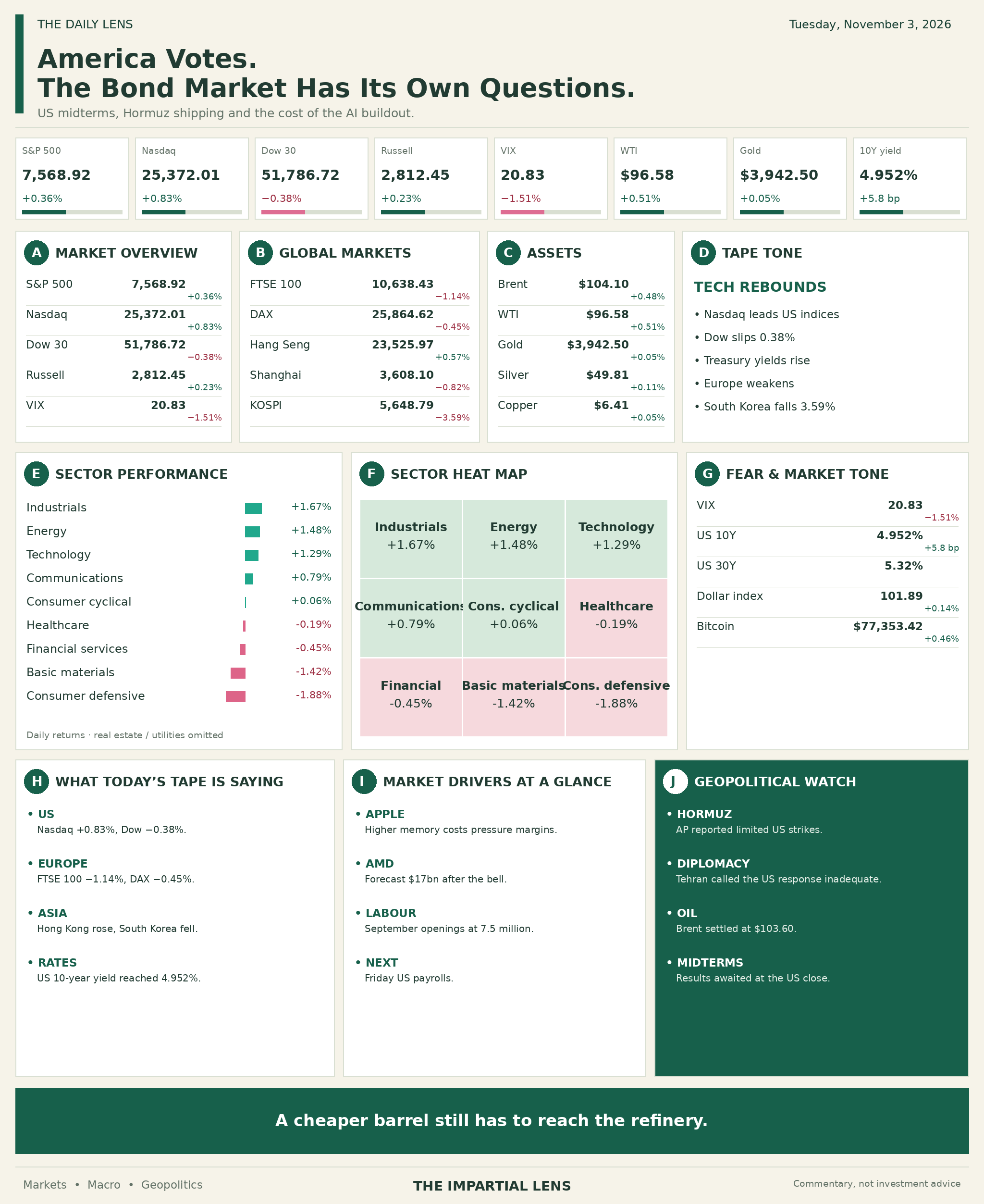
The Nasdaq gained 0.83% and the S&P 500 rose 0.36%. The Dow fell 0.38%. The sector panel tells a better story than the Nasdaq alone. Industrials led, up 1.67%, with energy up 1.48% and technology up 1.29%. Consumer defensive shares fell 1.88%. There was buying beyond the chip names, and it was selective.
The VIX fell to 20.83 while the ten-year Treasury yield rose 5.8 basis points to 4.952%. Traders were paying less for near-term stock market protection even as the benchmark cost of borrowing went up. Both moves came before the election calls. Once the count got under way, Bitcoin slipped about 1% to roughly $77,000 and US stock futures were relatively steady. Election-night market coverage.
Europe was weaker, with London’s FTSE 100 down 1.14% and Germany’s DAX off 0.45%. In Asia, Hong Kong gained 0.57% and Shanghai fell 0.82%. South Korea’s KOSPI lost 3.59%, the sharpest move among those three markets.
What We’re Watching
- Which seats flip and how many votes the new House majority can afford to lose.
- Friday’s jobs report and whether Treasury yields hold their rise.
- Whether shipowners book regular passages through Hormuz and what insurers charge to cover them.
The Lens
Tonight tells us who gets a seat at the table. The first funding bill tells us what they can get out of the people sitting across from them. If Trump signs a bill with something he campaigned against, I’d look at what he got in return. That’s where the deal is.
The other stories have their own tests. Cheaper oil helps a refinery once it can get the cargo delivered. AMD’s sales forecast tells us how much business it expects from the buildout, and Apple’s holiday margins will give us a glimpse of what that buildout costs a company buying parts. Those are three things we can come back and check after tonight’s headlines have moved on.
Featured image: West front of the U.S. Capitol. Credit: Architect of the Capitol.

The Impartial Lens provides market commentary and education only. Nothing published here constitutes investment advice.