Iran diplomacy sent oil sharply lower. But the cost of building artificial intelligence—and the politics surrounding it—kept technology shares under pressure.
Monday, November 2, 2026 | The Daily Lens
Oil plunged, European shares rose and Beijing stepped in to support Chinese stocks. On Wall Street, technology kept falling.
Cheaper energy offered some relief. It could not answer the question troubling investors: how much more money will the AI expansion need before it starts paying its own bills?
Tomorrow, American voters will have a say in where some of that expansion can happen.
Iran Offers a Faster Plan. Agreement Is Another Matter.
Iran said its proposal to reopen the Strait of Hormuz and resume nuclear negotiations could be implemented within two days, provided Washington meets its conditions. Those include lifting the blockade of Iranian ports. The proposal also involves sanctions relief and a ceasefire extending to Lebanon.
This is a conditional offer, not an agreed reopening. Shortening the timetable does not settle the differences.
There is another complication. The Associated Press reported that Benjamin Netanyahu had pressed Donald Trump for renewed strikes after the US elections. Trump had not committed, according to the report.
Monday’s oil sell-off shows how much a diplomatic opening can change expectations. Sustained relief for transport companies, manufacturers and households will depend on safe deliveries. A lower oil price is welcome; dependable passage through Hormuz would make it more convincing.
The AI Expansion Meets the Ballot Box
Tomorrow’s elections reach beyond control of Congress. Ballotpedia counts 41 local data-centre measures across ten states: 28 would limit development if approved, while 13 would facilitate it.
These votes are not all outright bans. They cover restrictions, pauses, zoning and advisory questions. Their significance is practical: buildings need permission, electricity, cooling and local acceptance before they can produce revenue.
Meanwhile, Oracle filed for $10 billion in share sales alongside a separate $10 billion debt offering. Its shares fell 8.94% in the supplied market overview.
Oracle’s own timetable anticipates positive free cash flow in the second half of fiscal 2028. Investors must finance the intervening construction—and bear the risk that costs or approvals change.
AI’s potential is not the same thing as an attractive return on every project. Tomorrow’s local votes make that distinction unusually tangible.
Beijing Tries to Put a Floor Under Confidence
China announced fresh support for equities, including a 100-billion-yuan swap operation, roughly $15 billion, scheduled for Tuesday. It helps eligible financial institutions obtain funding to buy shares.
Authorities also lowered the rate on financing for buybacks and share purchases. Shanghai gained 1.08%; Hong Kong’s Hang Seng rose 0.42%.
The distinction matters here too. Making money available to buy stocks can ease selling pressure. It does not establish that the underlying companies will earn more.
For investors outside China, this is a reminder to distinguish a market supported by policy from a business recovery supported by customers.
How Global Markets Responded
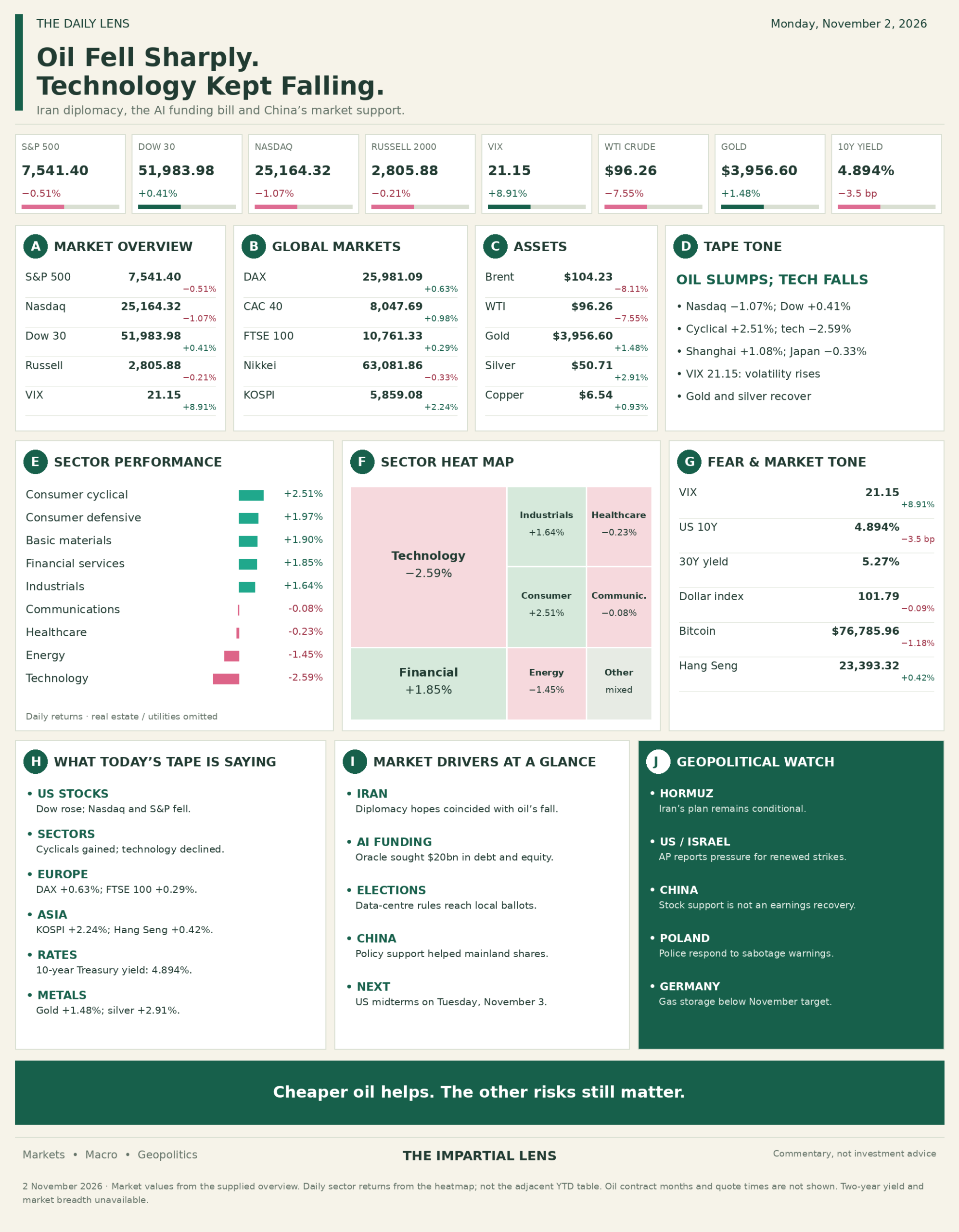
The Nasdaq Composite fell 1.07% and the S&P 500 lost 0.51%. The Dow rose 0.41%, while the Russell 2000 slipped 0.21%.
Technology fell 2.59%, while consumer cyclical shares gained 2.51% and financial services rose 1.85%. This was an uneven market, with gains outside the technology giants.
Europe advanced: France’s CAC gained 0.98%, Germany’s DAX 0.63% and Britain’s FTSE 0.29%. Asia was mixed: South Korea’s KOSPI rose 2.24%, while Japan’s Nikkei slipped 0.33%.
The supplied overview showed Brent at $104.23, down 8.11%, and WTI at $96.26, down 7.55%. These are displayed quotes; contract months and quote times are not provided.
Gold gained 1.48% and silver 2.91%. The ten-year Treasury yield fell 3.5 basis points to 4.894%, while VIX rose 8.91% to 21.15. Falling oil did not remove the demand for protection.
What We’re Watching
Tuesday’s US election results and local data-centre votes; concrete agreement on Hormuz; and whether China’s support attracts sustained buying.
Europe also deserves attention. Montel reports German gas storage at 61.6%, below its roughly 70% November target. That is a vulnerability to cold weather, not proof of an imminent shortage.
Poland has reinforced security near Kaliningrad following warnings of possible sabotage. The precaution should not be reported as confirmation that a new attack has occurred.
The Lens
Monday brought a useful reminder: one problem becoming less expensive does not make the others disappear.
Cheaper oil can help households and businesses. It cannot make an unprofitable data centre profitable, settle tomorrow’s elections or refill Germany’s gas stores.
We should welcome progress where it happens—and judge it by what changes afterwards. Ships sailing safely, projects earning their keep and homes getting through winter matter more than a day’s hopeful headlines.
The Impartial Lens provides market commentary and education only. Nothing published here constitutes investment advice.
Featured image: Strait of Hormuz, March 24, 2021. Credit: NASA.