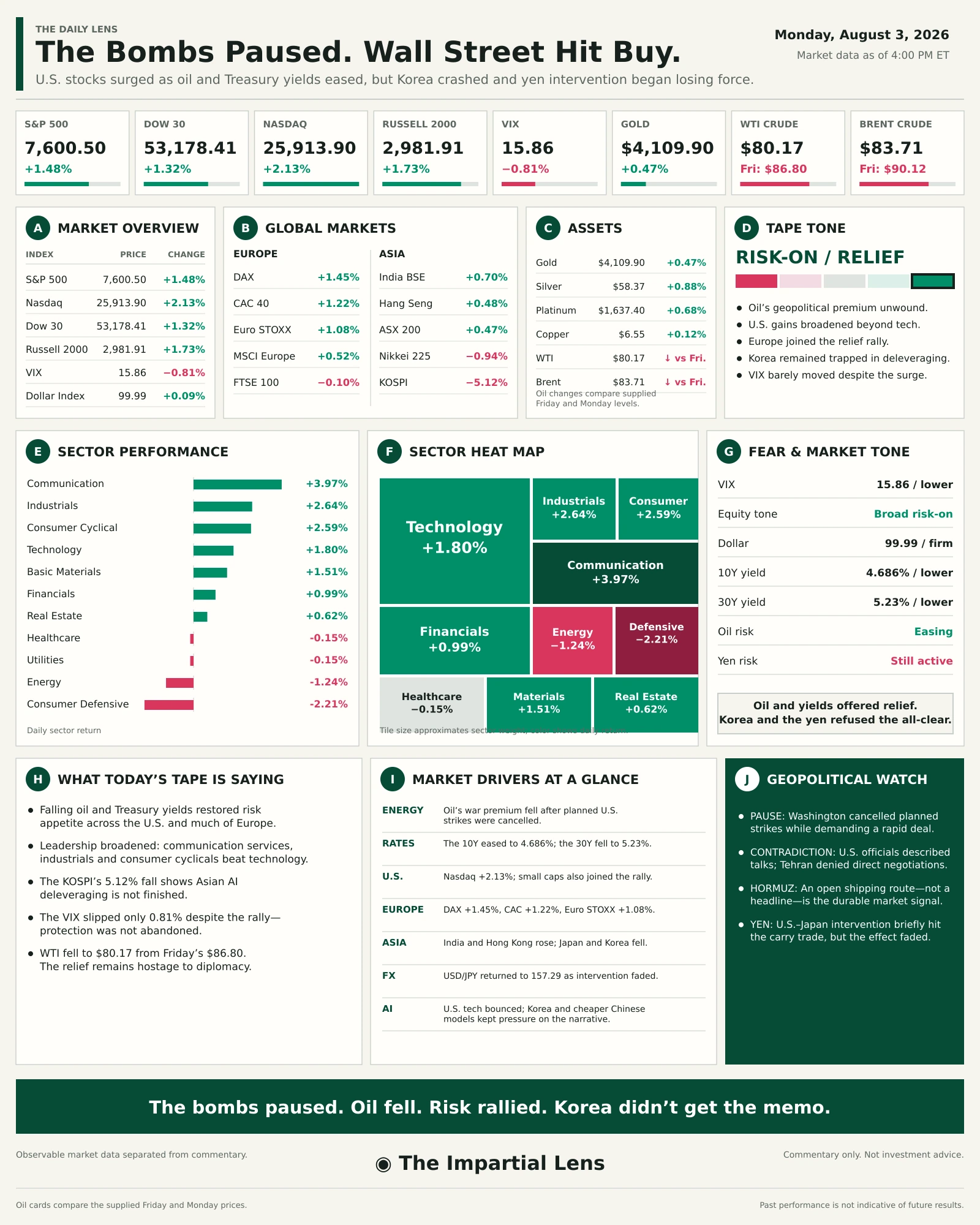
U.S. stocks surged as oil and Treasury yields eased, but Korea crashed, and the record yen intervention began losing force.
Monday, August 3, 2026
Wall Street began August by buying the one thing it wanted most: relief.
President Trump cancelled planned strikes on Iran while talks continued through regional intermediaries. Oil fell sharply from Friday’s levels, Treasury yields eased, and investors rushed back into growth stocks.
The Nasdaq jumped 2.13%. The S&P 500 gained 1.48%, the Dow rose 1.32%, and the Russell 2000 added 1.73%.
That was a real rally. It was not an all-clear.
South Korea’s KOSPI plunged 5.12%, the effects of the enormous yen intervention were already fading, and Iran denied that direct negotiations with Washington were taking place.
The bombs paused. The contradictions did not.
The Tape: What Actually Happened
U.S. markets closed as follows:
- S&P 500: +1.48%
- Nasdaq: + 2.13%
- Dow: +1.32%
- Russell 2000: + 1.73%
- VIX: 15.86, -0.81%
- Dollar Index: 99.99, up 0.09%
Leadership looked healthier than it did during many of July’s rallies. Communication services gained 3.97%, industrials rose 2.64%, consumer cyclicals added 2.59%, and technology advanced 1.80%.
The defensive side of the market moved in the opposite direction. Consumer defensive shares fell 2.21%, and energy lost 1.24%. Investors were not seeking shelter. They were repositioning for lower immediate geopolitical risk.
Europe mostly joined the rally. Germany’s DAX rose 1.45%, France’s CAC 40 gained 1.22%, and the Euro STOXX advanced 1.08%. The FTSE 100 slipped 0.10%.
Asia was far less comfortable. India and Hong Kong rose modestly, but Japan’s Nikkei fell 0.94%, and South Korea’s KOSPI dropped 5.12%. The American bounce did not repair the damage to Asia’s leverage.
The Relief Mechanism
Monday’s rally followed a simple chain:
Fewer expected strikes → lower oil → less inflation pressure → lower Treasury yields → higher growth-stock valuations.
Compared with Friday’s supplied levels, WTI crude fell from $86.80 to $80.17—approximately 7.6%. Brent dropped from $90.12 to $83.71, a decline of roughly 7.1%.
The 10-year Treasury yield eased from 4.745% to 4.686%, while the 30-year slipped from 5.28% to 5.23%.
Those moves matter because falling yields reduce the discount rate applied to future earnings. That provides immediate support to long-duration assets such as large technology companies.
Wall Street did not suddenly discover stronger profits on Monday morning. It received a lower price for uncertainty.
Geopolitics: A Pause Is Not Peace
Trump said planned strikes on Iran had been cancelled, subject to rapid progress toward a deal and reopening the Strait of Hormuz. Iran, however, denied that direct talks with the United States were underway. Tehran said discussions with Oman concerned a temporary shipping route through the strait.
Later, Trump threatened Iran with “decapitation” if it failed to accept a satisfactory agreement.
That is not a settled diplomatic process. It is coercive bargaining conducted beneath an active military threat.
Markets correctly reduced the probability of an immediate attack. They should not confuse a lower probability with a permanent solution.
The market can rally on a cancelled strike. The global economy needs an open shipping route and an agreement that survives the next headline.
The Yen Just Became Everyone’s Problem
Japan and the United States reportedly carried out a rare coordinated intervention to support the yen. Reuters estimated that Japan may have spent as much as $36.6 billion in the latest operation after an earlier intervention of nearly $59 billion.
That is close to $100 billion—and USD/JPY still ended Monday around 157.29 after briefly moving near 155.
Why does this matter outside Japan? For years, investors have borrowed cheaply in yen and invested the money in higher-yielding assets elsewhere. A rapidly strengthening yen can force those positions to unwind, creating selling across stocks, bonds and currencies.
Intervention may slow the move. Lasting stability probably requires the interest-rate gap between Japan and the United States to narrow. Until then, the carry trade can retreat, reload and return.
What Today’s Tape Is Saying
- The U.S. rally was broad and genuine. All four major indexes rose more than 1%.
- Lower oil and yields powered the move. The rally depended heavily on geopolitical relief.
- Asia remains the fracture line. Korea’s 5.12% decline showed that forced deleveraging is not finished.
- The VIX stayed calm. At 15.86, equity volatility reflected relief—not resolution.
- Leadership improved, but confirmation is incomplete. Communication services led while Korea and important semiconductor trades remained fragile.
Market Drivers at a Glance
- Geopolitics: Trump cancelled planned strikes; Iran denied direct U.S. talks.
- Oil: Reduced attack risk drove WTI and Brent sharply below Friday’s levels.
- Rates: Falling oil eased inflation pressure and pulled Treasury yields lower.
- Technology: Lower yields helped the Nasdaq outperform.
- Japan: Record-scale intervention supported the yen, but the effect began fading.
- Positioning: Cleaner U.S. positioning encouraged dip-buying; Korea continued to unwind leverage.
What to Watch Next
Tuesday must answer four questions: Are Iran negotiations real or merely indirect messages? Can oil remain near $80 if the Strait stays restricted? Will USD/JPY hold below its intervention highs? And can semiconductors begin confirming the U.S. rally?
Monday delivered relief. The durability test starts with the next headline.
The Impartial Lens separates observable market data from interpretation. This article is for information and education, not personalized investment advice.