
Stocks hit records as oil and Treasury yields fell, but a rising VIX and unfinished Hormuz talks complicated the celebration.
Tuesday, August 4, 2026
Wall Street did not wait for signatures or diplomatic fine print. The suggestion that a Hormuz agreement could arrive imminently ignited a powerful squeeze, sent major indices to records and dragged oil sharply lower.
FOMO returned so quickly it appeared to have skipped the recovery room.
But volatility joined the celebration. The VIX rose even as stocks surged. Investors bought the rally while paying more for protection—a fast market chasing relief without trusting that the headline would survive the night.
The Tape: What Actually Happened
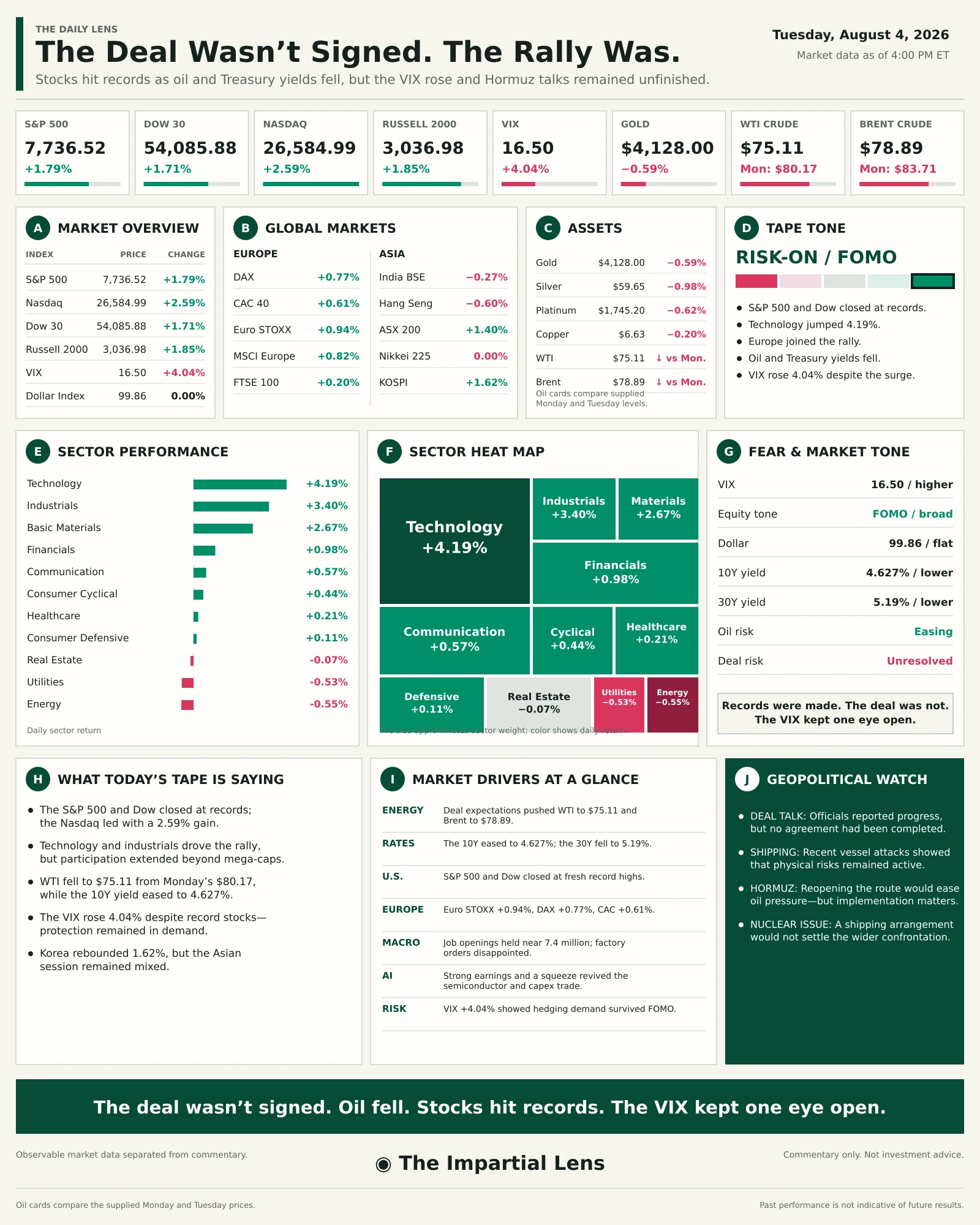
The Nasdaq led the U.S. advance, climbing 2.59% to 26,584.99. The S&P 500 gained 1.79% to 7,736.52, the Dow rose 1.71% to 54,085.88, and the Russell 2000 added 1.85% to 3,036.98.
The rally was broad, but technology supplied the fireworks. Technology gained 4.19%, followed by industrials at 3.40%. Financials rose 0.98%, communication services gained 0.57%, and consumer cyclicals advanced 0.44%. Energy declined 0.55% as crude prices fell.
The contradictory signal came from the VIX, which increased 4.04% to 16.50. The Dollar Index was unchanged at 99.86.
Europe participated: Euronext gained 0.96%, the Euro STOXX rose 0.94%, the DAX added 0.77%, and the CAC 40 advanced 0.61%.
Asia was mixed. South Korea rebounded 1.62% after its recent rout, while Australia gained 1.40%. The Hang Seng fell 0.60%, and India’s BSE declined 0.27%.
Oil and Rates Released the Pressure
Comparing the supplied Monday and Tuesday prices, WTI crude fell from $80.17 to $75.11, while Brent dropped from $83.71 to $78.89. Gold declined 0.59% to $4,128, and silver fell 0.98% to $59.65.
Treasury yields also eased. The 10-year yield fell from 4.686% to 4.627%, while the 30-year moved from 5.23% to 5.19%.
Cheaper oil reduces immediate inflation pressure, while lower yields increase the value investors assign to future earnings. Technology received both gifts at once.
Macro: Bad News Became Helpful Again
U.S. job openings stood at roughly 7.4 million in June, with hiring unchanged at 5.3 million. Factory orders also disappointed.
Those are not booming-growth signals. Yet the market treated them constructively because softer activity reduced the perceived need for tighter monetary policy. The old “bad news is good news” machine was switched back on: weaker data lowered yields, and lower yields lifted stocks.
That works until weaker data stops looking like moderation and starts looking like deterioration. Tuesday did not cross that line.
Geopolitics: Markets Bought a Deal That Does Not Yet Exist
Commentary and interpretation
Reported progress toward reopening Hormuz removed a large portion of oil’s war premium.
But negotiations were still incomplete. Shipping risks remained, vessels had recently reported attacks, and the broader dispute over Iran’s nuclear program had not disappeared. Reopening a shipping lane is not the same as ending a war.
The market priced the cleanest outcome: an agreement, safer passage, recovering oil flows and lower inflation. It largely ignored the messier possibilities—delays, enforcement disputes, renewed attacks or another collapse in negotiations.
An announcement can move prices. Only implementation can keep them there.
The AI U-Turn
Strong AI-linked earnings and guidance helped turn July’s panic back into August’s chase. Palantir and Caterpillar reinforced the argument that AI spending is producing real demand beyond chipmakers. Semiconductors rallied sharply as investors rushed back into positions they had recently abandoned.
Yet the after-hours reaction to AMD offered a warning. Investors still want evidence that enormous infrastructure spending will translate into durable cash flow. The market may forgive high capital expenditure when revenue and margins justify it. It will not write a blank check forever.
FOMO is back—but it still expects receipts.
What Today’s Tape Is Saying
- The rally broadened beyond the largest technology companies.
- Lower oil and Treasury yields removed two major pressures from equities.
- The rising VIX showed that investors did not fully trust the calm.
- Korea bounced, but July’s global AI deleveraging has not been erased.
- Markets priced a successful Hormuz agreement before one was completed.
Market Drivers at a Glance
- Geopolitics: Expectations of a Hormuz agreement crushed oil’s risk premium.
- Rates: Falling Treasury yields supported growth and technology shares.
- AI: Strong corporate demand revived the capex and semiconductor trade.
- Positioning: July’s de-risking left room for a violent short squeeze.
- Macro: Softer employment and factory data reduced tightening fears.
- Risk: A rising VIX warned that protection remained in demand.
What to Watch Next
Watch actual shipping traffic through Hormuz, not merely diplomatic language. Watch whether WTI holds near $75, whether the 10-year remains below 4.70%, and whether semiconductors can lead for more than a single squeeze-driven session.
Most importantly, watch the VIX. Stocks and volatility can rise together briefly, but the disagreement rarely remains unresolved forever.
Tuesday’s market priced peace, easier policy and accelerating AI profits simultaneously. That can produce a spectacular day. Keeping all three will require evidence.
The Impartial Lens provides market commentary and education, not individualized investment advice.