Thursday, November 19, 2026 | The Daily Lens
Trump, Xi and Putin left Shenzhen with a four-point declaration. One of the points will matter to anyone paying a fuel bill. The three countries plan to supply more refined petroleum products. Diesel, jet fuel and petrol could all use the help. The text left quantities and delivery dates open. The White House
In Washington the Senate rejected another attempt to end U.S. hostilities with Iran. On Wall Street Anthropic raised about $81 billion in the largest share flotation on record, then watched the wider market drop more than 2%. Plenty of announcements. What any of them actually change is less clear. U.S. Senate Daily Press · Reuters
More Fuel Is Something They Can Agree On
The three leaders have competing interests in Ukraine, trade and military power. Expensive fuel is one of the few things they can usefully work on together. American voters are angry about living costs. China needs energy for factories and transport. Russia wants customers for its exports. Their statement promised increased production and supply of refined products and reaffirmed the importance of stable energy flows.
Producing another barrel of crude only goes so far when the shortage is in the fuels made from it. Refineries still have to process the oil, and the diesel or jet fuel still has to reach the right port. Last week we looked at the gap between recovering oil supplies and diesel that stayed painfully expensive. This pledge at least points at that part of the problem.
China can change how much fuel its refiners are allowed to export. Russian supplies depend on what its refineries can still produce and ship. American refiners need room to increase output, or the extra fuel has to come from volumes that would otherwise stay at home. We’ll know more when export permissions shift or cargoes are booked. Until then, a transport company pricing next month’s deliveries is still working with today’s quote.
The Election Changed Congress. The War Continues.
The Senate vote on Iran was 48–51 against the resolution that would have directed the president to remove U.S. forces from hostilities. Three Republicans supported it. Democrat John Fetterman opposed it. Chris Murphy did not vote. The official tally is clearer than the speculation about how the midterms might change Republican support for the war. U.S. Senate Daily Press
Democrats won control of Congress. They take over in January. Thursday’s vote belonged to the senators still sitting in the current Congress, and the votes to adopt the measure were not there. That leaves a difficult stretch for businesses exposed to the conflict. A shipowner deciding whether to take a Gulf booking has to judge the voyage before the new Congress sits. An airline buying fuel for the holiday season faces the same calendar. A promise to push for an end to the war in January does little for a December delivery.
The Shenzhen meeting may improve fuel supply. Ending the fighting would address another part of the cost. Thursday produced movement on the first and another failed vote on the second.
A Good Debut Depends on When You Bought
Anthropic sold shares at $83 in its flotation. The first trade was $111.50. By the close the price was $97.17. Someone allocated stock at the offer price finished about 17% ahead. Someone who bought at the opening trade finished almost 13% down. Both owned the same company. Reuters
The offer raised roughly $81 billion after the company increased the number of shares for sale. Investors clearly wanted access. The retreat from the opening price showed the enthusiasm had limits. Reuters
On Tuesday we looked at Nvidia’s equipment sales and the bills facing the companies buying its chips. Anthropic’s listing lets investors follow one of those customers in public. Revenue growth, computing costs and the capital needed to keep expanding will show up in the quarterly accounts. The opening-day celebration ended quickly.
How Markets Responded
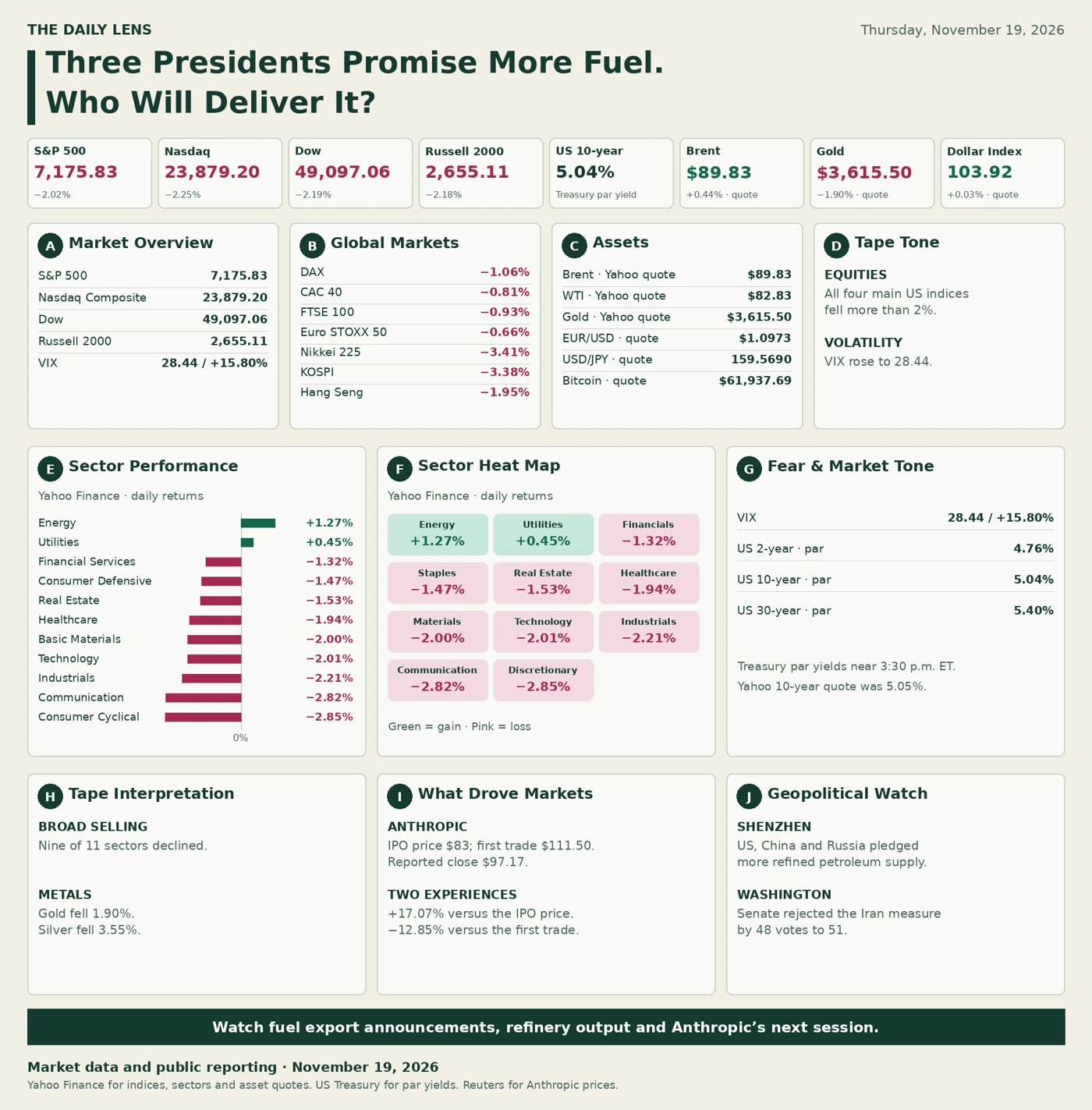
All four major U.S. indices fell more than 2%. The Nasdaq lost 2.25%, the Dow 2.19%, the Russell 2000 2.18% and the S&P 500 2.02%. Nine of the eleven sectors declined. Consumer cyclical shares fell 2.85% and communication services 2.82%. Energy gained 1.27% and utilities 0.45%. The VIX jumped 15.80% to 28.44.
Japan’s Nikkei fell 3.41%, South Korea’s KOSPI 3.38% and Hong Kong’s Hang Seng 1.95%. Germany’s DAX lost 1.06% and Britain’s FTSE 100 0.93%.
Gold was quoted at $3,615.50, down 1.90%, and silver fell 3.55%. Bitcoin stood at $61,937.69. Brent was quoted at $89.83 and WTI at $82.83. The dollar index edged up to 103.92. Treasury’s daily reference yields were 4.76% for two years, 5.04% for ten and 5.40% for thirty. U.S. Department of the Treasury
What We’re Watching
How much extra fuel the summit actually produces will show up in export permissions, refinery output and scheduled cargoes. What the incoming Congress does about Iran will show up in specific funding proposals and the votes required to pass them. Where Anthropic finds willing buyers will show up in the next sessions, measured against both the $83 offer price and the $111.50 opening trade.
The Lens
The fuel pledge is worth watching. These governments have reasons to cooperate, and cheaper diesel would be useful well beyond their borders. A company signing a supply contract still needs an amount, a price and a delivery date. When those appear, the summit photograph will matter less.
The Impartial Lens provides market commentary and education only. Nothing published here constitutes investment advice.
Featured photograph: Vladimir Putin, Xi Jinping and Donald Trump at Kylin Villa in Shenzhen, November 19, 2026. Official White House Photo by Daniel Torok. Resized for web.