Friday, November 20, 2026 | The Daily Lens
Anthropic had barely arrived on the stock market before investors started leaving. Shares that first traded at $111.50 on Thursday finished Friday at $88.91. Anyone who bought that opening trade had lost more than a fifth of their money in two sessions. Thursday’s debut · Friday’s trading
As technology shares sank, Trump threatened to penalise American companies building data centres overseas. Congress, meanwhile, was trying to make it easier to build the power infrastructure those facilities need. Washington wants the investment to keep coming. Investors have become considerably more interested in what comes back.
Trump Wants the Buildings Here
At Friday’s White House press conference, Trump threatened a “tremendous tax” on American companies building data centres abroad. He presented the issue as a contest with China: the United States must retain the infrastructure underpinning its AI advantage. He gave no detailed mechanism for the proposed penalty. Reuters · Bloomberg
That leaves companies planning overseas facilities with another uncertainty to price. These buildings are expensive, long commitments. A possible tax can complicate a project before anyone collects it.
There are practical reasons to build close to foreign customers. Moving large quantities of data across continents costs money, and delays matter for services such as payment processing. A facility in another country can help an American business serve that country. Reuters
Keeping more construction at home also means finding American communities willing to accommodate it. Residents concerned about electricity bills, water and noise are unlikely to find a competition with Beijing sufficient reassurance. The president wants the buildings. Their prospective neighbours want to see the terms.
Nvidia’s Numbers Face Another Examination
Reuters reported Friday that the Securities and Exchange Commission’s Nvidia investigation includes potential accounting issues, citing two people briefed on the matter. The precise issues being examined remain unclear. An investigation does not establish wrongdoing. Reuters
For investors, however, the inquiry reaches an uncomfortable question: how much financial risk sits behind the extraordinary chip sales?
Nvidia has invested in AI companies and supported financing arrangements connected to customers buying its equipment. Such deals can help a promising customer expand. They also complicate the supplier’s exposure if that customer struggles. Reuters reported that interim chief executive Colette Kress said Tuesday that Nvidia would become more selective about these arrangements. Reuters
The distinction matters beyond one company. Selling equipment, financing its buyer and ultimately earning a return from its use are different achievements. A chip can be delivered long before the business using it becomes profitable.
Thursday’s Lens asked where Anthropic would find willing buyers after its flotation. Friday supplied an answer at a much lower price. That says something about appetite for the shares. The quarterly accounts will tell us more about the business.
The Power Bill Still Needs Paying
While markets were shedding enthusiasm, senators had taken a more tangible decision. Late Thursday, the Senate passed a broad permitting overhaul, 62–33, intended to accelerate power plants, transmission lines and other infrastructure. The legislation still needs House approval. Associated Press
Republicans Mike Lee and Shelley Moore Capito negotiated it with Democrats Martin Heinrich and Sheldon Whitehouse. Their argument is straightforward: electricity cannot become more plentiful while projects spend years awaiting permission. Senate Energy Committee
Opponents see a different cost. Environmental groups and some senators argue that the legislation weakens safeguards and communities’ ability to challenge projects affecting their land and water. Faster approval has consequences for the people living beside what gets approved. Associated Press
The bill also addresses who pays for grid expansion and would provide local governments with help assessing data-centre costs, water demand and infrastructure needs. Those details deserve attention. A new substation remains an expensive piece of equipment even if the company requesting it later scales back. Bill text
Friday’s falling share prices do not remove America’s need for better electricity infrastructure. They do sharpen the question of whose balance sheet should carry the risk.
How Markets Responded
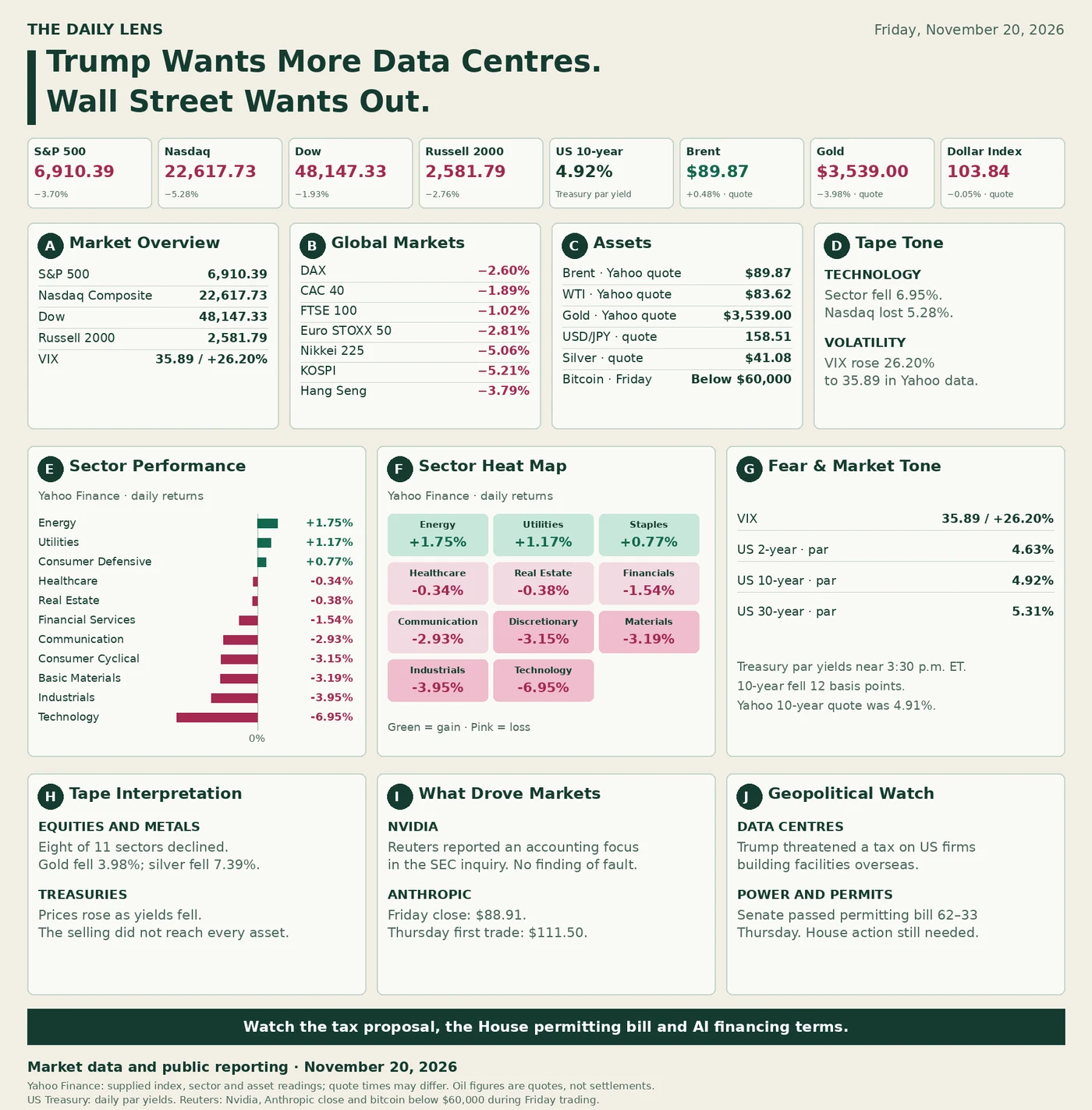
The Nasdaq fell 5.28%, the S&P 500 3.70%, the Russell 2000 2.76% and the Dow 1.93%. In the supplied Yahoo readings, technology lost 6.95%. Eight of eleven sectors declined; energy, utilities and consumer defensive shares gained.
South Korea’s KOSPI fell 5.21%, Japan’s Nikkei 5.06% and Hong Kong’s Hang Seng 3.79%. Germany’s DAX lost 2.60%, France’s CAC 40 1.89% and Britain’s FTSE 100 1.02%.
Gold was quoted at $3,539, down 3.98%; silver fell 7.39%. Brent stood at $89.87 and WTI at $83.62, both higher. These are quotes, rather than futures settlements. The dollar index edged down to 103.84, while the yen strengthened.
Treasuries attracted buyers. Official daily reference yields fell to 4.63% for two years, 4.92% for ten and 5.31% for thirty. Bitcoin traded below $60,000 during Friday’s session. U.S. Treasury · Reuters
The breadth of the selling raises the possibility that some investors needed cash. It does not prove a credit crisis. Forced sales occur when investors must meet borrowing requirements or reduce risk, regardless of what they think an asset is worth. Establishing their scale requires evidence about financing and fund flows, beyond a dreadful chart.
What We’re Watching
- What does Trump’s threat become? Look for a written proposal specifying the tax, legal authority and affected projects.
- Does financing tighten further? Watch lenders’ terms, customer guarantees and disclosures from Nvidia and its buyers.
- Who pays for new electricity infrastructure? Follow House changes to the permitting bill and utility agreements with large customers.
The Lens
America has good reasons to build better power networks and develop useful AI. Neither requires every proposed project to make commercial sense.
The difficult decisions begin when national ambition meets a company’s borrowing limit or a household’s electricity bill. Friday made those limits harder to ignore. If Washington wants communities to welcome the next data centre, it should help them answer one ordinary question before construction starts: what happens to our bill if this business disappoints?
The Impartial Lens provides market commentary and education only. Nothing published here constitutes investment advice.