Wednesday brought a quiet finish for stocks and a lively evening for shareholders. Google’s results exposed the cost of the AI expansion, while Washington tried another opening with Iran.
Wednesday, October 28, 2026 | The Daily Lens
What Today’s Tape Is Saying
Imagine telling your shareholders that sales have risen 25%, your cloud business has doubled, and operating profits are up 30%—then watching them sell.
That was Google’s Wednesday evening.
Alphabet, its parent company, reported $127.6 billion in quarterly revenue. Its shares nevertheless fell more than 10% in after-hours trading as results disappointed expectations and investors examined the spending behind the growth.
Until then, the day had been fairly uneventful. The Fed left rates unchanged, and stocks edged higher. Anyone who switched off at the closing bell missed the more interesting argument.
| Market | Wednesday’s overview |
|---|---|
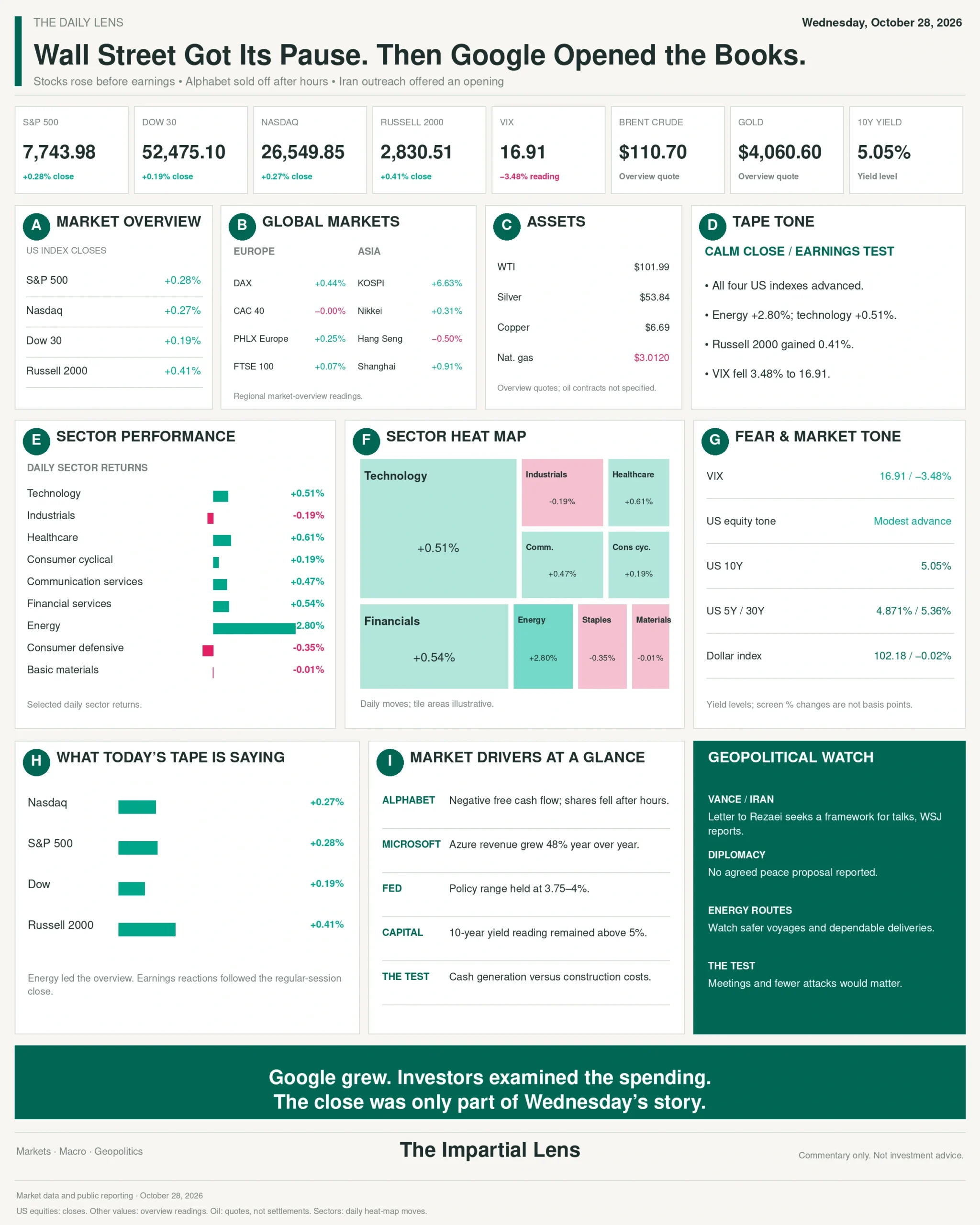
| S&P 500 | 7,743.98 · +0.28% |
| Nasdaq | 26,549.85 · +0.27% |
| Dow | 52,475.10 · +0.19% |
| Russell 2000 | 2,830.51 · +0.41% |
| US 10-year yield | 5.05% |
| Brent / WTI | $110.70 / $101.99 |
A Profitable Company Can Still Spend More Than It Brings In
Google’s problem requires looking beyond the profit figure.
Its operations generated cash, but investment in infrastructure consumed more than that amount, leaving approximately $9.1 billion of negative free cash flow. Management said capital spending would rise significantly again in 2027.
This is where the AI story becomes interesting. Google is building facilities that it expects to use for years. It pays for the equipment now, while the expense is spread through its accounts over the equipment’s useful life. The company can therefore report substantial profits while the cash available after construction goes backwards.
There is nothing inherently wrong with that. Businesses invest because they expect the finished operation to earn more than it cost.
But these are enormous commitments, made while the technology and its competitors are changing quickly. Shareholders have good reason to ask how much more construction is coming and when the extra business will start covering it comfortably.
Microsoft provided a useful counterweight. Revenue rose 19% to $92.3 billion, and Azure, its cloud-computing business, grew 48%. Customers are buying these services in considerable quantities.
Writing off the entire industry would ignore that demand. Buying everything associated with it would ignore the differences between the businesses.
Neither approach requires much homework. Wednesday suggested the homework might be worth doing.
The Fed Is Waiting Too
Earlier, the Fed held its policy rate at 3.75–4%, with two officials preferring another increase. Its statement described strong economic activity and inflation that remained elevated.
For borrowers, the pause is welcome. Another increase would have added pressure while earlier decisions were still working through the economy.
It is a considerable distance from cheap money, however. The 10-year Treasury yield stood at 5.05% in our overview. That benchmark influences longer-term borrowing costs, including the financing needed for large construction projects.
It also gives investors something against which to judge an ambitious company. How much additional reward should they demand for taking the risk?
That question was already relevant to Google’s spending. The Fed’s decision did not remove it.
A Letter to Tehran
Washington was also attempting something that could help the inflation problem from another direction.
The Wall Street Journal reported that JD Vance had written to Mohsen Rezaei, a powerful Iranian security official and former Revolutionary Guard commander, seeking a framework for renewed negotiations. There was no agreed peace proposal.
Talking to a hard-liner may be uncomfortable, but peace agreements need support from people who can stop the fighting. Diplomatic charm is of limited use if someone else controls the weapons.
The economic benefit would come through safer shipping and more dependable energy deliveries. Reduced risks could ease insurance and transport costs, helping businesses that have little choice about how much fuel they use.
For now, a letter is an opening. Shipowners will need rather more before changing their calculations.
What the Dashboard Is Telling Us
Energy gained 2.80% in our overview, compared with technology’s 0.51%. Financial services rose 0.54%, and the VIX stood at 16.91.
Energy’s stronger performance deserves attention. Conditions that improve a producer’s earnings can squeeze an airline, a delivery business or a household.
The regular-session figures also precede the evening’s earnings reactions. They record a relatively calm afternoon, not a verdict on everything Wednesday brought.
What We’re Watching
- Does Google’s cash generation catch up with construction? Watch both figures together.
- Can Microsoft sustain its stronger demand? Look for profits and cash alongside sales.
- Does the Iran outreach produce meetings—and fewer attacks? Watch the practical results.
- Do borrowing costs ease while employment holds up? That would be a more useful improvement than a pause alone.
The Lens
Google’s results make the AI argument more interesting than either the enthusiasts or the disaster merchants would have us believe.
There are customers, growing revenues and real profits. There are also extraordinary construction costs and uncertainty about what the finished capacity will earn.
The sensible response is to examine the terms.
Wednesday evening, shareholders began doing precisely that.
The Impartial Lens provides market commentary and education, not personalised investment advice.